Rooms With A View: The Basics Of Tarpology

Featured

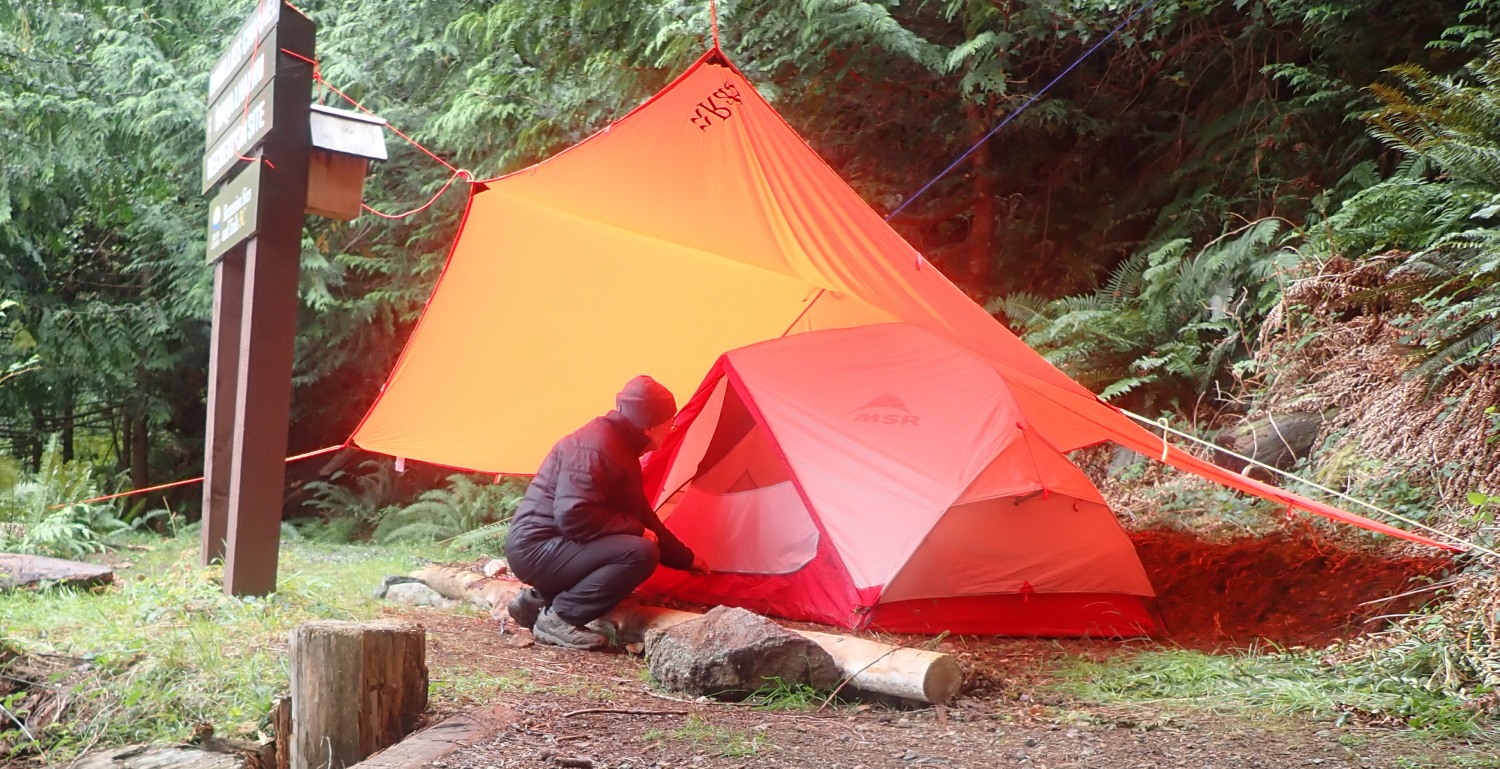
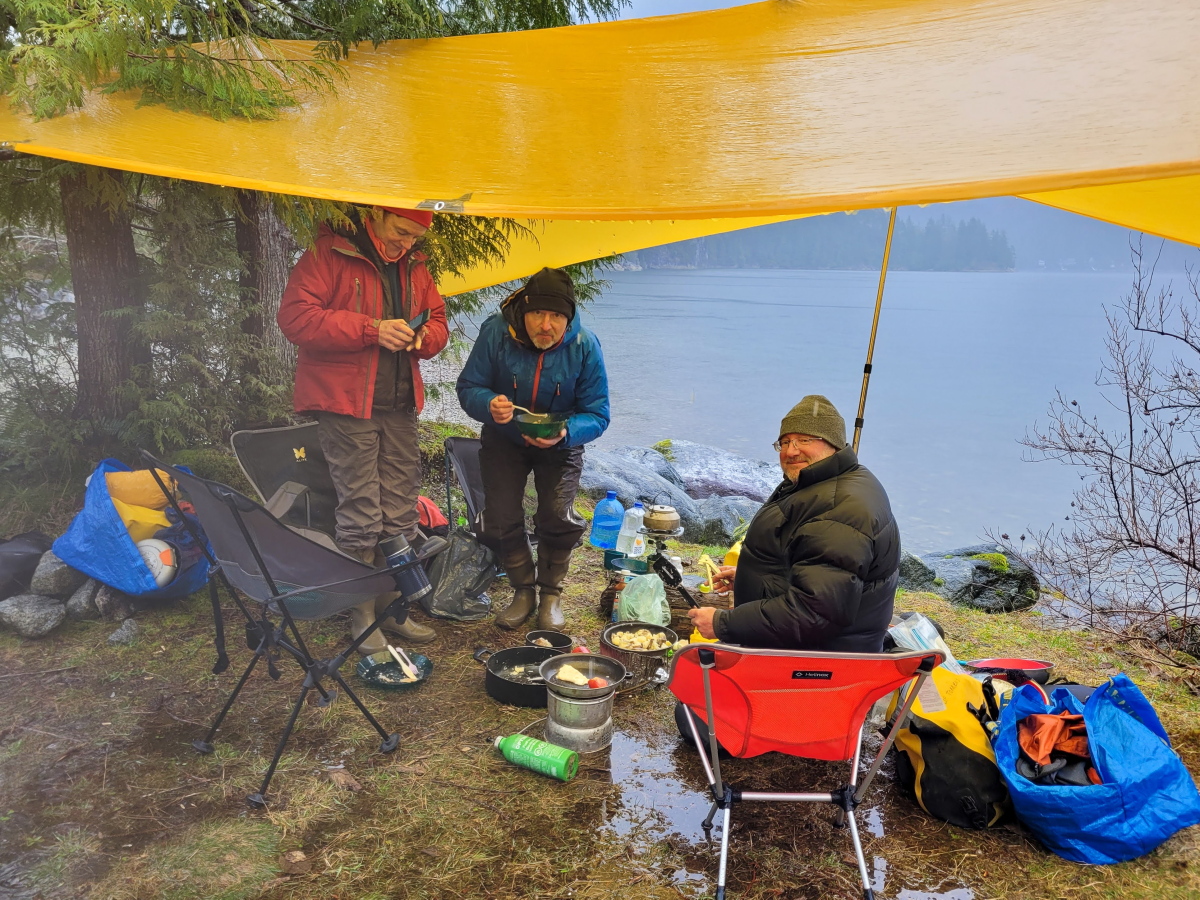
If you’re sea kayak touring in British Columbia, and out for any length of time, it’s not a matter of if it will rain, but when it will rain. They don’t call it “The Wet Coast” for nothing. In such Noahscape situations, being able to rig a secure kitchen-dining shelter is essential to ward off both cold and cabin fever.   

Showing a camp tarp rigged in an A-frame configuration
The classic A-frame bungalow roof tarp configuration, with an end pole improvised from driftwood.
Read more: Rooms With A View: The Basics Of Tarpology

Materials

If you only camp very occasionally, even the basic “plastic” tarps from your local Crappy Tire or Home Depot will suffice. They will be bulky and not terribly durable — though pinholes are easily fixed with duct tape. Please don’t let their semi-disposable price point tempt you to abandon them in the field at the end of your trip. Blue is the most commonly available colour, but if you can find orange, it provides a more cheery ceiling in the rain (this is true of all tarps: yellow and orange fabrics create a gloom-dispelling faux-sunlit vibe even on cloudy days.)

Polyester (PU) coated fabric tarps are more durable and compact, and, predictably, more expensive.

The most compact of all tarps are made with silicone-coated fabrics. (I fondly remember field-testing a prototype tarp for my erstwhile outdoor retailer employer decades back, before silicone fabrics were common. I wound up sharing a backcountry campsite with a friendly father and son. Their astonishment when I conjured an 8’ x 10’ tarp out of a soda-can sized stuffsack was as if I had produced not a rabbit, but an elephant, out of a hat.)
Silicone fabrics are also highly stuffable, saving a lot of time with folding and rolling.

Shapes

Several companies make cunningly-tailored wing tarps. I’ve owned a couple and really loved the catenary-cut, sag-defeating ridgeline and the assured-drainage scalloped edges. I was less enamored of the single set-up option. Particularly at improvised sites deep in the backcountry, vegetation often rudely insists on growing exactly where you need the edges of the wing to be. So these days, I carry rectangular or square tarps. They take a bit more rigor in rigging to prevent pooling water, but are more adaptable to cramped and oddly-shaped sites. 

Lines

When it comes to rope, the rule is: it’s hard to have too much. I typically carry at least a couple of hundred feet of paracord, in hanks of about 20 feet. The more line you have, the more options you have for set-up. By splicing one hank to another with a square knot, you can anchor lines to remote branches, trunks and roots. 

Showing a tarp rigged with very long lines, anchored to rock and trees up to a hundred feet away.
Playing the long (line) game. Having plenty of cord lets you float your tarp pretty much wherever you want it, even when natural anchor points are not nearby.

Brightly coloured lines will reduce stumbles and self-strangulation as you walk under and out from your roof. You can even buy reflective cord, which shows up beautifully in headlamps, and makes an excellent navigation beacon if you’ve wandered far into the bush to answer nature’s call at night.

Rigging Your Roof

If you’re setting up the classic A-frame bungalow roof configuration, you typically start by rigging the two high points that will form the ends of the tarp’s ridge, then adding the side and corner lines. 

Some folks like to do this by rigging a literal ridgeline —  a thicker rope running between two trees and/or poles. Next, they drape the tarp over this line, and use short lengths of cord wrapped in prusik knots (see below) around the ridgeline and secured to tabs or grommets on the tarp to stretch it along the ridgeline. This creates a very strong structure, but with the downside that the ridgeline rope chafing against the tarp may eventually wear the waterproof coating and/or the fabric itself to the point that it leaks. And dead centre of your roof ain’t a great place for leaks. 

Showing the A-frame configuration of a tarp without the use of poles
Look mah! No poles! The classic A-frame roof made by suspension only.

So for chafety reasons, I usually opt to simply stretch out the two attachment points at either end of the tarp’s centreline, letting the tensioned fabric itself create the ridge. Separate-ridgeline-rope enthusiasts will sneer that this stresses the fabric of the tarp more and is a weaker structure in wind. They are not wrong. But, tocca ferro, in decades of touring, I haven’t had a tarp tear yet. This might be because I retire my tarps (or demote them to “windbreaks only” duty) once the waterproofing has worn out, and this typically occurs long before the fabric itself is brittle. 

If you’re at a site that doesn’t accommodate retangular, symmetrical roof sides, think outside the box: make the diagonally opposite tarp corners the ends of your ridge, so the sloped sides become asymmetrical triangles that can poke between barricading trees and bushes.     

Showing a tarp rigged with an interior pole.
The high centre(ish) point setup. The tip of the pole is covered with a stuffsack to reduce chafe on the tarp.

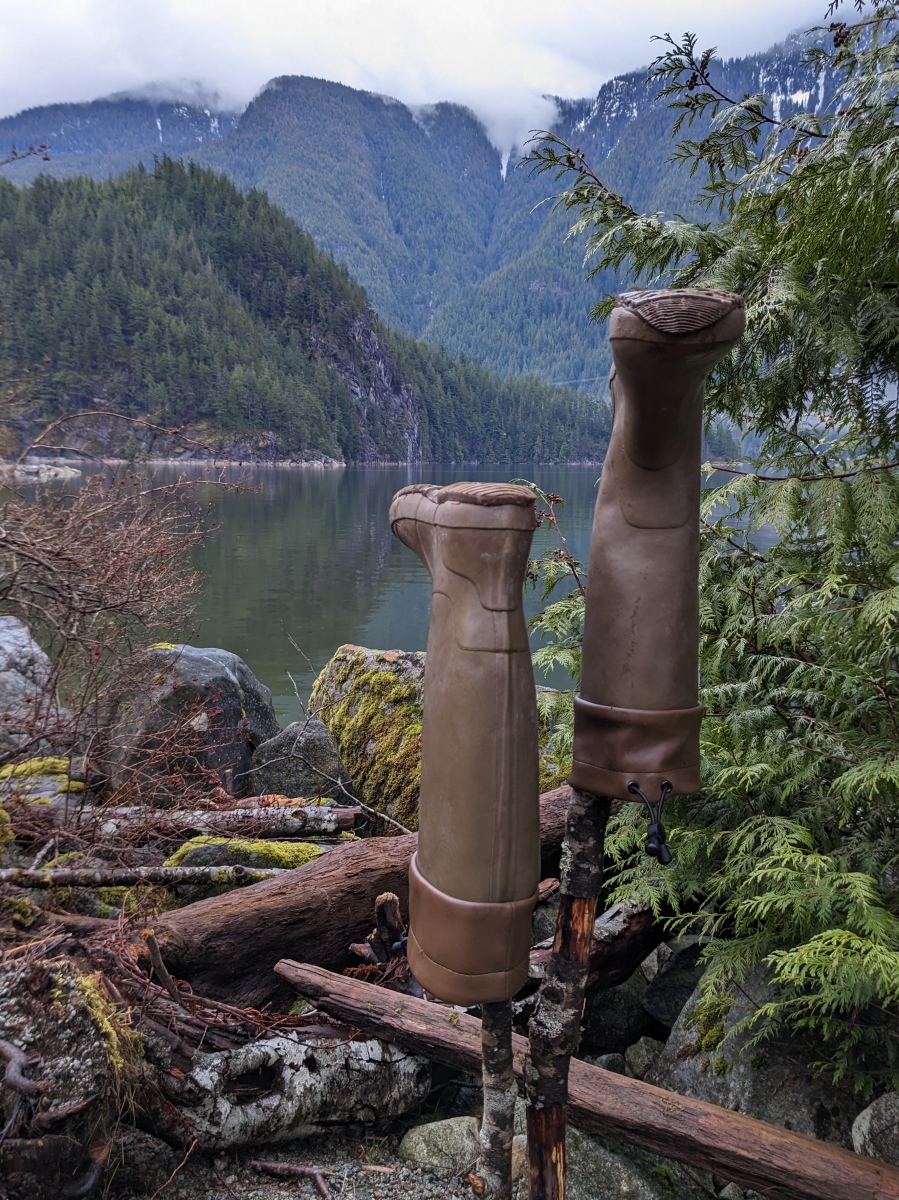
Another classic tarp configuration is the high centre point, with the sides sloping down to form a shallow (and not necessarily symmetrical) pyramid. You can raise that centre point from the inside or the outside. From the inside, it’s via a pole of some kind, store-bought or improvised from driftwood. Either way, the tip where the pole makes contact with the tarp fabric should be condomized with a stuffsack to reduce chafe.

showing a kitchen tarp rigged with a centre pole made from a driftwood log
A driftwood log, upended and with the low end buried deep in the sand, makes a secure centre pole for this cozy camp kitchen.

Raising the centre point from the outside maximizes usable interior space. If there’s a cooperatively placed branch above the tarp site, just sling a line over it, tie it off to the topside tarp tab, then hoist the far end of the line and tie it off to a tree trunk or branch. (Your D.O.T. mandated “buoyant heaving line” works a treat for this.) 

a tarp suspended pyramid-style over the vestibules of two tents.
Centre-suspended pyramid configuration. Hanging from an overhead branch, this tarp forms a rain-free “mud room” for both tents.

If there’s no handy overhead branch, run a line from tree to tree above the tarp, then attach a prusik knot to this line and hence to the topside tab. This way, you’ll be able to slide the attachment point along the high line to fine-tune the tarp’s position. 

The blue line runs above this tarp from tree to tree. It’s connected to the topside tarp anchor point with a short, separate piece of cord wrapped into a prusik knot.

At breezy kitchen sites, you’ll want to rig the tarp as a combination windbreak and roof, with one edge at ground level. This will block wind-blown rain and keep gusts from wicking heat away from you and your camp stove. Some folks just rig their tarp as a simple lean-to, but these flat surfaces are prone to inverting into a sail when hit by strong wind. So I prefer to do a sort of pyramid tilted on one side. With the tip of the pyramid pointed into the wind and anchored securely, the tarp is much more aerodynamic and wind shedding.

Showing a tarp rigged as a leanto windbreak.
The “tilted pyramid” windbreak configuration. On the outside of the black patch above my head, a line runs to the tree branch beyond, preventing the tarp from inverting when wind hits the far side.

Though I do carry a few pegs for my tarp lines, I generally prefer to tie the lines off to tree branches, driftwood logs or roots. Natural anchors are usually more secure than pegs.

To minimize wrinkles and maximize drainage, try to run the lines from the side of your tarp as close as possible to 90 degrees away from the centre ridgeline, and corner lines out at roughly 45 degrees. Where lack of anchor points or the presence of obstacles prevents running a single line at the optimum angle, attach two lines to a single tab or grommet, run them out to whatever anchors are available, and tension them differentially to rid the tarp of ruckles.

As anyone who’s ever schlepped even a 5-litre waterbag knows, it doesn’t take a vast volume of water to be seriously heavy. So you want to ensure your tarp setup won’t trap large rainpools, lest there be rending of fabric and gnashing of teeth. Preventing pooling isn’t always a matter of going higher with your tarp lines or steeper with your tarp slopes. Sometimes it’s as simple as creating drainage valleys at the lower edges of your tarp. Do this by suspending a light weight, such as a water bottle, stuff sack with pebbles, or small piece of driftwood from one of the grommets or tabs.   

Knots

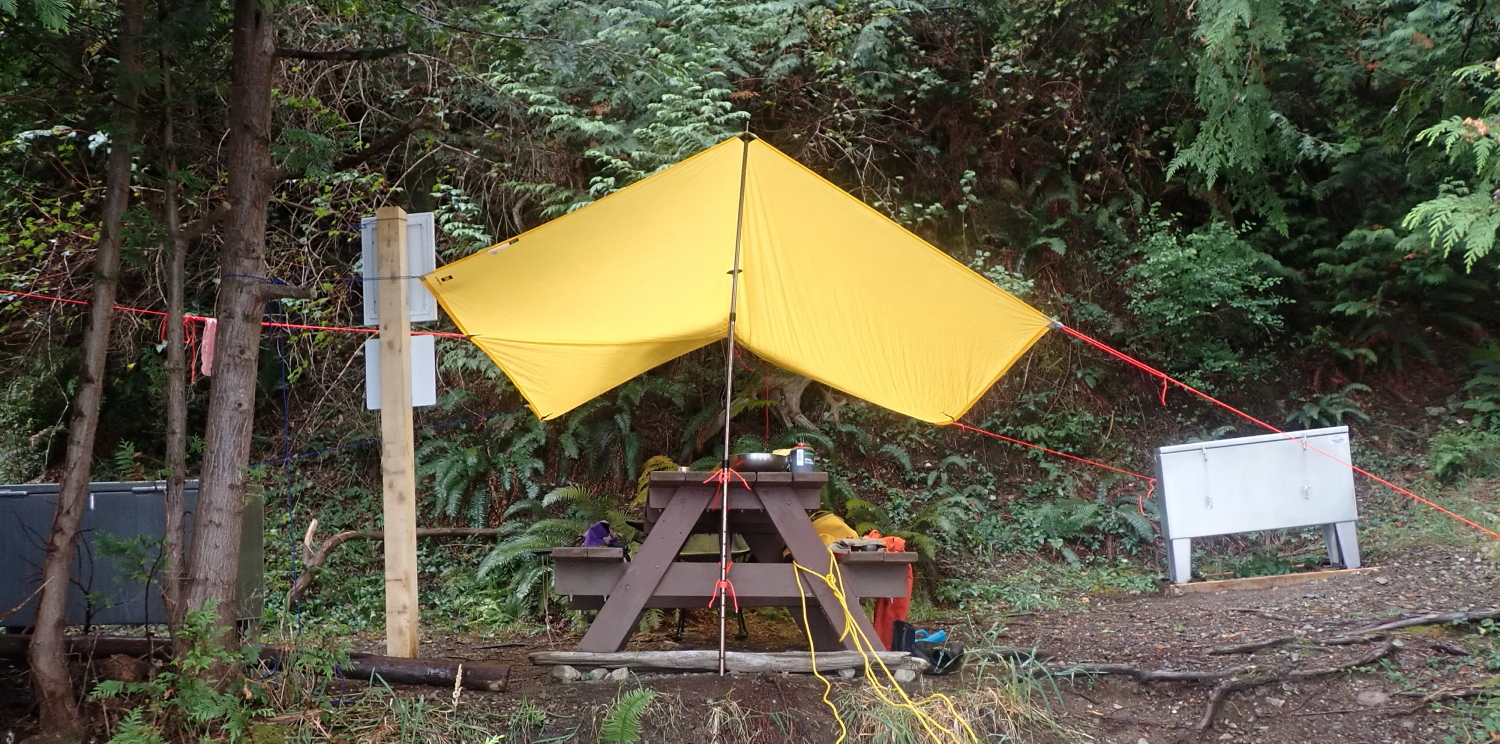
I have a pretty basic repertoire of knots that I mix-n-match as needed for rigging. The trucker’s hitch lets you apply a lot of tension to a line easily, so I tend to use it for the ends of the ridge attachment points, or for a tree-to-tree line that I’m going use a prusik hitch to suspend the topside attachment point from to form a high centre point pyramid. For the side or corner lines a tautline hitch usually provides enough tension. A simple square knot is great for splicing lines together to extend your anchor options. In the photo below, I used a pair of Japanese square lashings to secure the tarp pole vertically against the end of the picnic table. You can also use a square lashing to attach the ends of driftwood poles together to form an A-frame for one end of your tarp. 
Poles

If you can find one of suitable size on site, driftwood poles are an excellent option: they’re free, fully biodegradable, and take up no room in your boat. That said, I often carry at least one tarp pole for convenience and assurance I’ll have the right pole for my needs. I find the fully-telescoping type is easy to stow against the keel line of my kayak, but its minimum collapsed length is a few feet. If you have tighter hatches, you might need poles that fold tent pole style to fit through them.  

Tarps For Tents

Even if your tent’s fly is reliably waterproof, there are several reasons you might want an over tarp for it, especially on extended tours in persistent rain: 

Firstly, it’s wonderful to have a dry porch roof/mudroom where you can stand up to doff and don wetwear without getting the tent interior soggy. 

Secondly, in seriously heavy rain–the sort that hammers down in dollops rather than drops–bedtime in an unshielded tent can be like trying to sleep inside a drum at a heavy-metal concert. Intercepting the rain a foot or two above the fly dials down the din from crazy-making to practically cozy. 

Thirdly, like me, you may well be fond of breathing right through the night. Each of your hundreds of exhalations contains water vapour. The cooler and wetter your tent fly is on the outside, the more of that breath vapour will condense against its inside. Wet begets wet. In a really prolonged rain in cooler weather, so much breath moisture can condense against a fly’s interior that it looks–and feels–as though the fly is leaking. By keeping the outside of the fly dryer, an over tarp will vastly reduce this effect.  

Finally, by rigging the over tarp first and taking it down last, you can set up and pack up your tent out of the rain, and keep the interior canopy dry. Or at least dryish.        
Four Day Getaway: An Escape To Átl’ka7tsem/Txwnéwu7ts (Howe Sound)

Prologue: this spring, I scored an ancient Current Designs Expedition kayak at the Jericho Sailing Association’s bailiff’s sale (where they auction off boats that have not had the storage fees paid in a while.) For the princely sum of $240, I got a 1992 boat, old enough that it had been made in British Columbia, before Current Designs was sold to an American company and the manufacturing moved out of BC.

Obviously, a boat that old was a fixer-upper, and I did spend a fair bit of time patching gouges, swapping out the sliding footpedals and guillotine-like aluminum rudder blade for gas pedal pegs and a light, low-drag SmartTrack rudder blade. I also added sail mounts and found a deck compass that could be modified to fit the existing base from the long-lost original compass.

After sea trials to confirm the boat would float (and sail!), it was time to take it on a multi-day voyage. 

September 21, 2024

I intentionally arrived at my put-in at Xwawchayay/Porteau Cove in mid afternoon, so that by the time I launched the afternoon inflow winds would be tapering off.

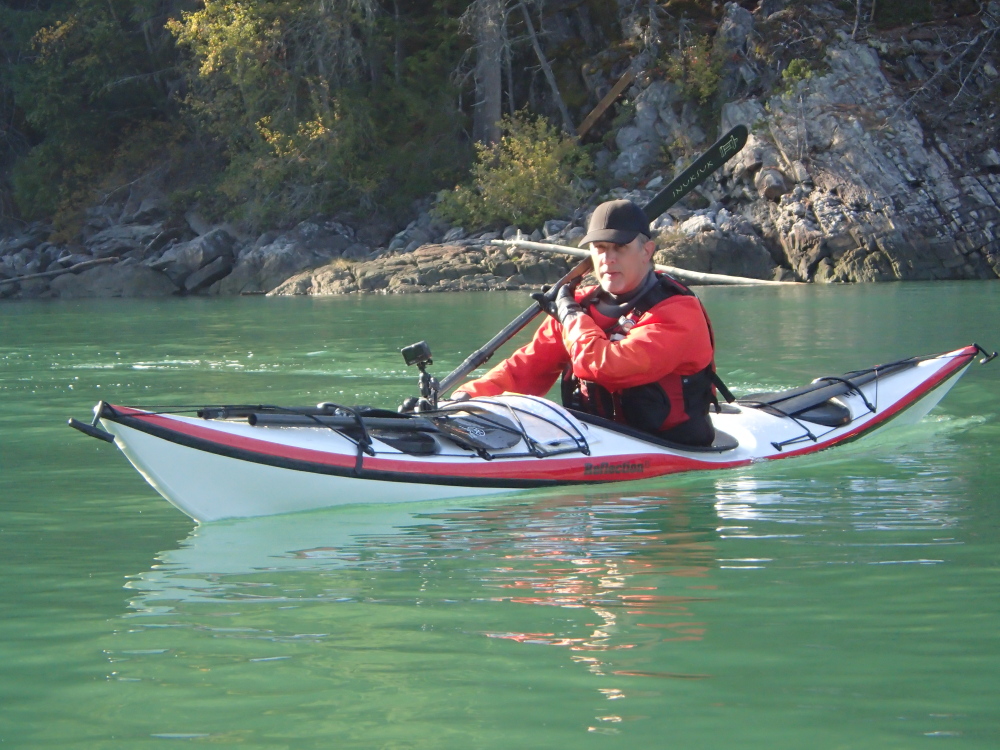
As I packed, one of the onlooking tourists wandered up to me and shot off a long paragraph in what I recognized as German. I had to tell her in English that I didn’t speak German. She switched to English. Her confusion had come from the fact that the spare paddle halves on my kayak deck were clearly labeled “Werner”. But that’s a brand name, not my name. I conscripted her husband to take a prelaunch photo of me, and exhausted my entire German vocabulary to thank him: “Das is gut, donkey-shine!”

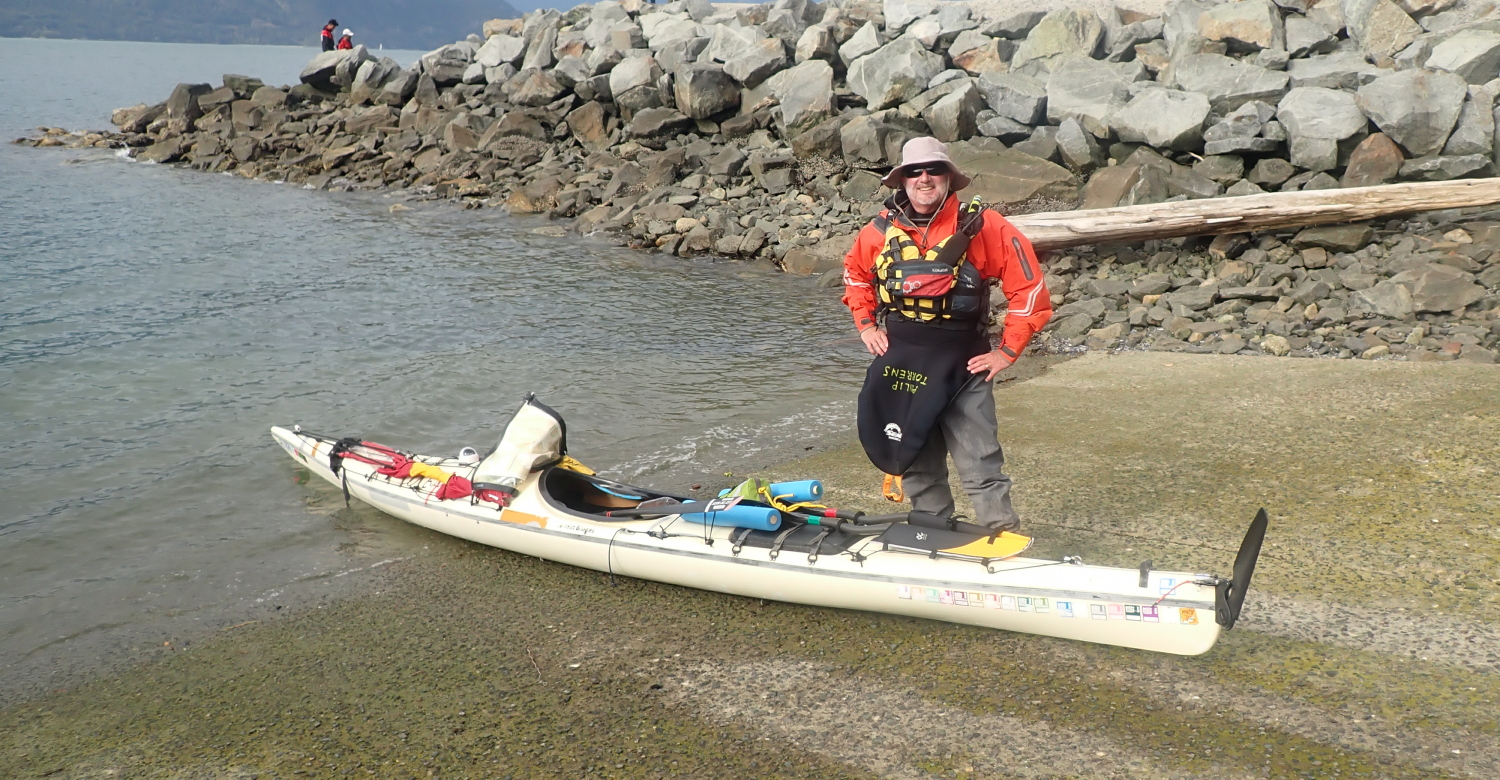
ready to launch my sea kayak at Porteau Cove, British Columbia
Out To Launch

I also briefly puzzled them by soaking down in the outdoor diver’s shower just before stepping into the boat (it was so I wouldn’t overheat in my drysuit on this sunny, warm afternoon.)

I launched just before 4PM. The fully loaded boat punched easily through the oncoming waves, scattering sun-silvered droplets across my bow. I was fighting the tail end of the inflow wind. As hoped, as I approached the southern tip of Lhaxwm/Anvil Island, the wind eased.

paddling South down Howe Sound, British Columbia

I had the golden hour pre-dusk light bathing Christie Islet as I crossed Ramilles Channel to Gambier Island. I landed at the Inaka Lhaxwm/ Ramilles Channel Recreation Site just before 7PM, to find two other paddlers already in residence. They had, naturally enough, taken the primo tent site with a large flat pad. Since I knew from talking with them they’d be leaving the next day, I set up my tent on a rather lumpy section of the path. 

Because I was on a shorter trip, I’d tried something different for my first night supper: a few days before the trip, I’d hit the Chinese takeout buffet at our local T &T market, and filled a container with a selection of my favorites. I’d frozen the container at home and kept it in a cooler bag in my car until just before launching, so it stayed safely cool until I reached camp. As I set up my tent, I reheated my supper in my Outback Oven (a great outdoor cooking gadget that is sadly no longer made.) A delicious novelty to be feasting on Chinese buffet in camp, especially those crispy spring rolls. 

Moderate alarms and excursions in the night. I’d been reading in bed, and initially attributed the slight twitches on my legs to muscle spasms. They turned out to be a small mouse scampering over me in search of the egress. After an exclamation (which it turned out was loud enough for my site mates to have heard), I evicted him. I’m sure we both slept better for it.

After that, I slept well, occasionally catching traffic noises from the Sea-To-Sky highway a few miles to the east.

September 22, 2024

In conversation with my two site mates over coffee, it came out that one of them has taken several courses from my employer, Jericho Beach Kayak, from fellow instructors I know well.

As they launched for their trip back to Lions Bay, I took a few photos to email them later (I know from experience it’s always nice to have pictures that include you taken from a bit further away than arm’s length.)

two sea kayakers in Howe Sound, British Columbia, with Anvil Island in the background


As soon as they had packed up their tent, I pounced on the primo pad for a property upgrade, literally leveling up from my lumpy site of the night before. I spent a happy hour cunningly rigging a super cozy campsite with a tarp over my tent (so nice to have a full porch in front of the tent where you can kneel out of the rain while entering or exiting). I also rigged a large tarp over the picnic table. Thanks to having brought a telescoping tarp pole, I was able to rig the seaside axis of this tarp in a high A-frame, giving me a million dollar view of Ramillies Channel and Anvil Island through the cedar branches. Whether by accident or design, the table is positioned so those trees conceal the cottages on Anvil Island. And the now steady rain created white noise (or perhaps wet noise), drowning out any traffic noises. The two effects combined to create at least the illusion of deep wilderness. Very cool, especially just an hour’s drive from downtown Vancouver.

a tent with a sheltering overtarp to reduce internal condensation
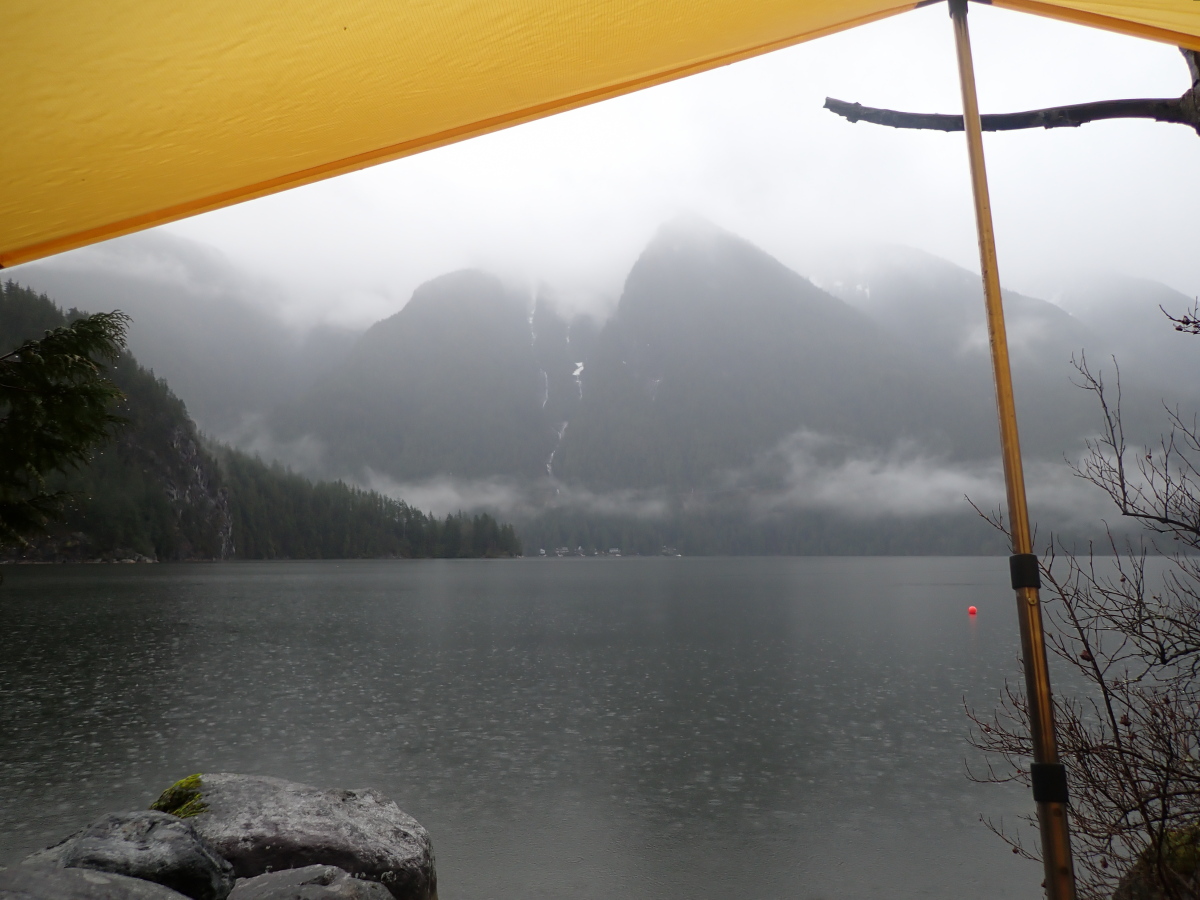
a view of Anvil Island, Howe Sound, British Columbia, from under a tarp on Gambier Island


With a good morning’s work of homesteading done, I settled down to enjoy a brunch of tinned hash and buttered bagel.

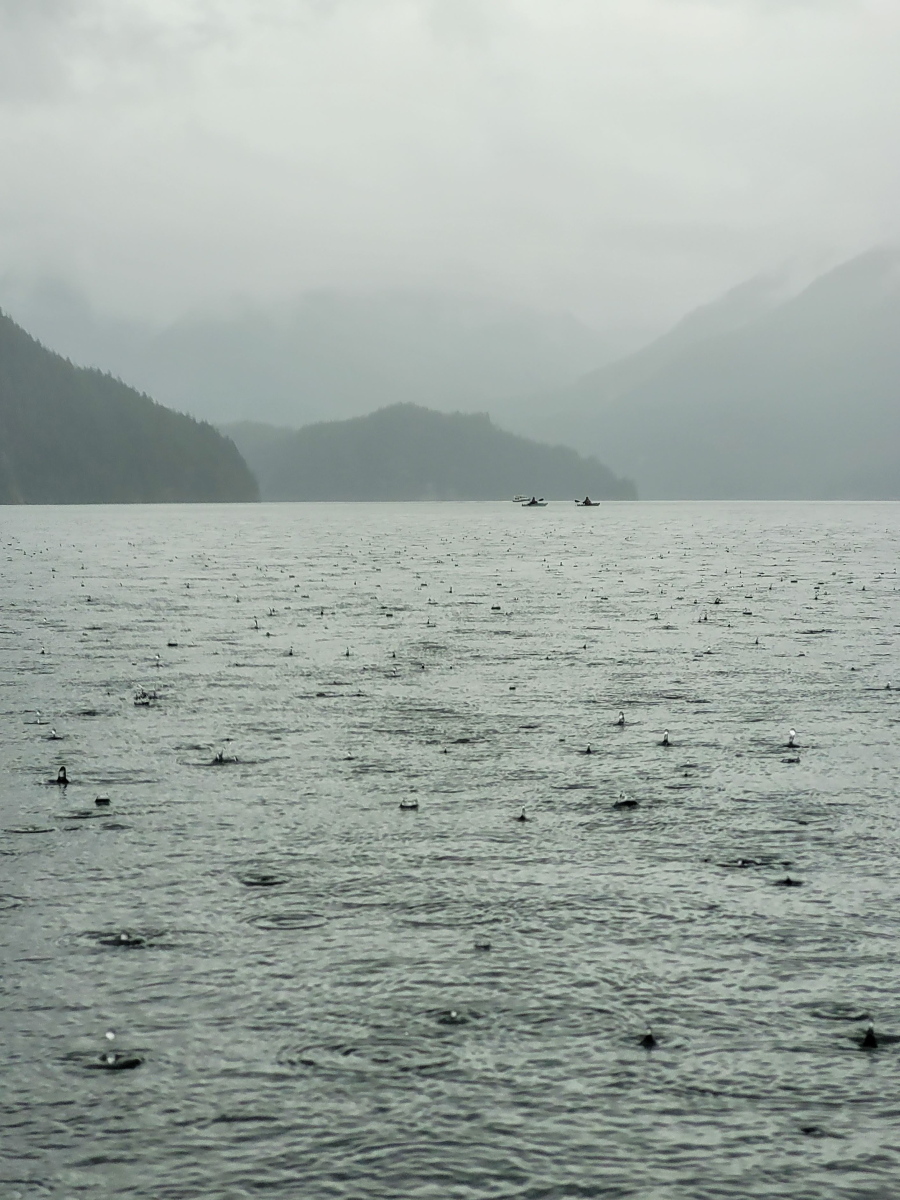
As I heated up water for an apres-brunch shower, an open aluminum skiff drifted into view a couple of hundred metres away, with a pair of fishers trolling their rods. Funny how your outlook on exposure changes with age. A half a lifetime ago, when I actually had a body worth ogling, I was pretty self-conscious about it. Today, my take is that if someone is so deprived of stimulation that the sight of my pudgy pink body in the distance is enough to drive them into some sort of erotic frenzy, it would be almost unkind to deprive them of this outlet. So I showered in full view without shyness. 

Since there seemed little likelihood of much sunshine–and this site is in the shade much of the time anyway–I set up my candle-powered clothes dryer in the tent. This is basically a three candle lantern, set carefully far enough below the tent gear loft not to melt or burn clothing. I then stacked my drysuit liner in the loft, so the rising hot air would dry it and save me having to climb into clammy layers next time I wore it. 


I set out my wok to collect rainwater draining off the tarp. I’d be leery of using tarp run-off for cooking or drinking, but I know from experience it will be fine for washing dishes or self.

In addition to my food, I’ve got my drysuit stored in the critter-proof aluminum cache. Nice to know it’s out of reach of salt-seeking rodents. (Years ago, I had the sweat-seasoned armpits chewed out of a doffed and inverted paddling jacket by mice in the time it took me to eat lunch.)

I spend the rest of the afternoon reading and zoning into that lovely zen state where what Buddists call “the chattering monkey” finally shuts up. 

My book is The Ancestor’s Tale, by Richard Dawkins and Yan Wong. It’s a revised edition of the book I read years ago on a circumnavigation of Princess Royal Island.

I supped on tinned beans and molasses. With plenty of rainwater and fuel available, I was able to give the dishes a thorough wash, and not the mere lick-and-a-promise of typical camp cleaning.

I am being buzzed by the occasional mosquito. My mild annoyance is tempered with gratitude that it’s warm enough this late in the season for them to be conducting flight operations.

September 23, 2024

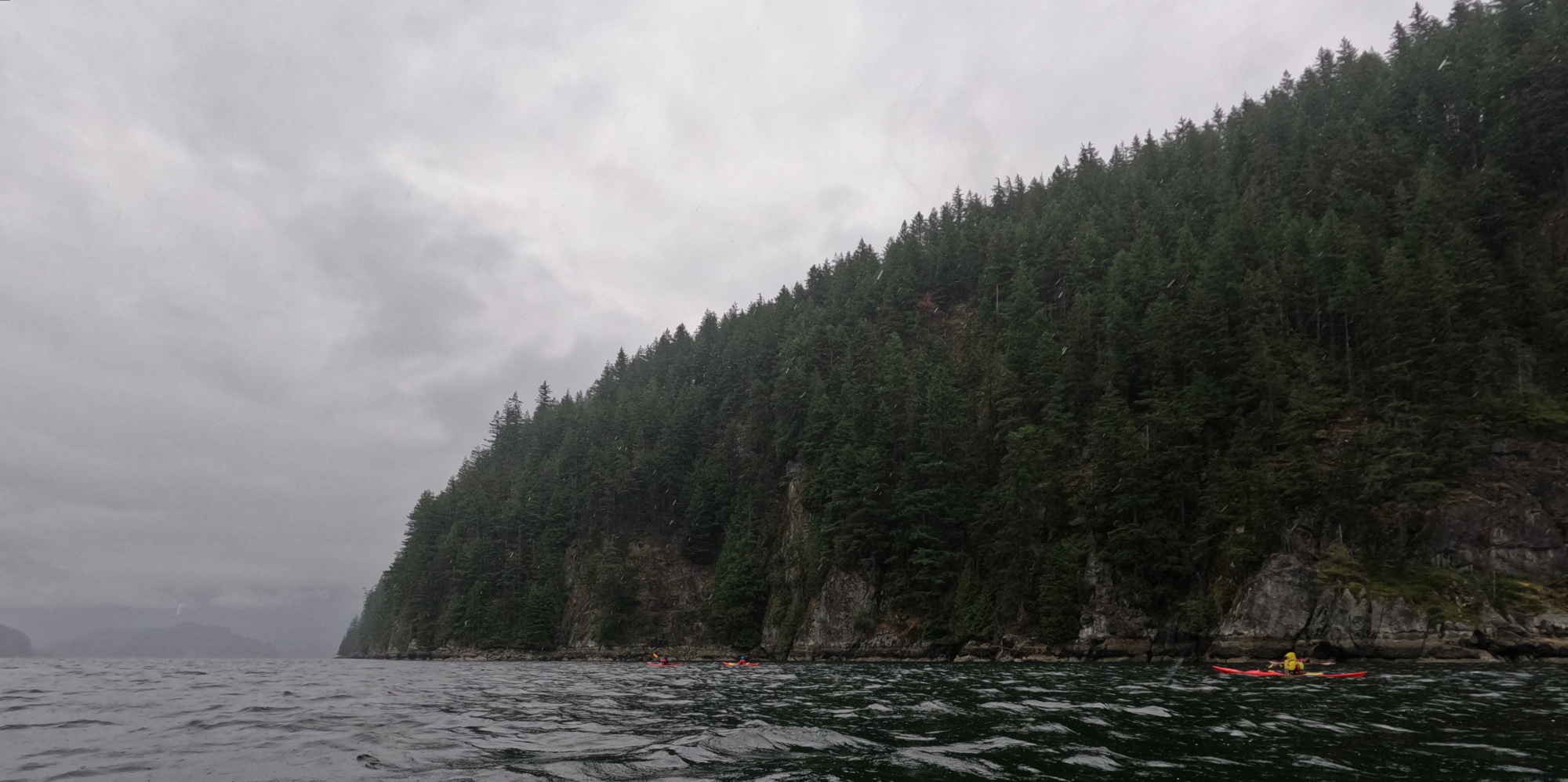
I awoke to low cloud, steady rain and limited visibility. Anvil Island is only a faint shadow looming through the rain. If this persists tomorrow, there won’t be the strong Northbound inflow wind typical of sunny days, and I won’t get my hoped-for glorious free ride back to Porteau Cove, courtesy of my sails. On the plus side, the water would be calm. Navigation would be no problem: in addition to my GPS, I’ve got a hiker’s compass, deck compass and a chart with many of the crossings pre-plotted. I’d aim for Anvil Island, follow its eastern shore to the northern tip, then paddle a compass course aiming off so I’d hit the east shore of Howe Sound south of Porteau Cove, turn left to go North and handrail along the shore to the Cove. 

I’m very glad of my folding travel chair. It’s much more comfortable for my not-fully-evolved-for-bipedalism back than the unsupportive bench of the picnic table would be. As always, I’m also happy to have brought what some would have considered a rather selfishly oversized tarp for a solo camper. But on rainy days like these, it’s nice not to have to crouch and prowl under a low, tiny roof. Instead, I have a high ceiling with plenty of head room, and a rain-free area that’s about equivalent to a reasonably-sized room at home. The tarp’s translucent yellow colour creates a warm, vaguely sunlit feel beneath it even on dark days. Add unlimited stove fuel, herbal tea and a good book, and it’s all very cosy.

As I fried up my brunch of pancakes and bacon, I flashed back more than half a century to (under)cooking fatty bacon purloined from mom’s fridge on top of a hobo stove. I’d made this chimney-like contraption out of a large apple juice can following directions from Boy’s Life magazine. It’s a surprise I didn’t die from trichinosis, taking my too-trusting younger sister with me.

There are lulls in the rain during the afternoon. I take advantage of them to explore the site a bit more, finding a second tent pad further in the trees along the path to the east (it would have been too much in the personal space of my site mates to have pitched my tent there on the first night.) Further east still, there’s a beach-access-only site. I’d already noted another cleared site just below the outhouse, but that would be a last resort only option for me: it’s up a steep and slippery climb, which would be even more awkward when portaging gear. Plus, who wants to be serenaded by the sounds of their site mates’ bodily functions in the night?

Although I have other options in my larder, I opt for quick, easy and spicy Korean ramen noodles for supper, with a fruit cup cocktail for dessert to ward off scurvy.  

a spider's web, backlit, with a sea kayak visible on the beach behind it

Shades of Robert The Bruce, I fall into a reverie watching a spider whose web hangs off tree branches just beyond my tarp. He’s been patiently sitting in the centre of his web all day. More insects are buzzing about in the gloaming, and soon a hapless fly hits the trap. The spider instantly scuttles towards its victim. We need to avoid anthropomorphizing other animals, but I can’t help but wonder if insects feel something akin to terror when caught like that? Obviously, they wouldn’t experience the full gamut of human emotions, but neither can they be merely the Cartesian automata that ol’ René imagined. But just where on the continuum would they fall?

a tent and its covering tarp glow from the internal light

September 24, 2024

a foggy beach on Gambier Island, British Columbia, with Anvil Island faintly visible in the background

Heavy rains in the night, but I awake to blue sky visible above a low fog. Confident it will burn off, I take my time breakfasting and breaking camp, and launch a bit after 11AM. With visibility now clear, I opt for a dogleg detour to check out Christie Islet. As a Migratory Bird Sanctuary, off limits to boat landings, it swarms with seagulls, cormorants, and seals.

cormorants on the cliffs of Christie Islet, British Columbia

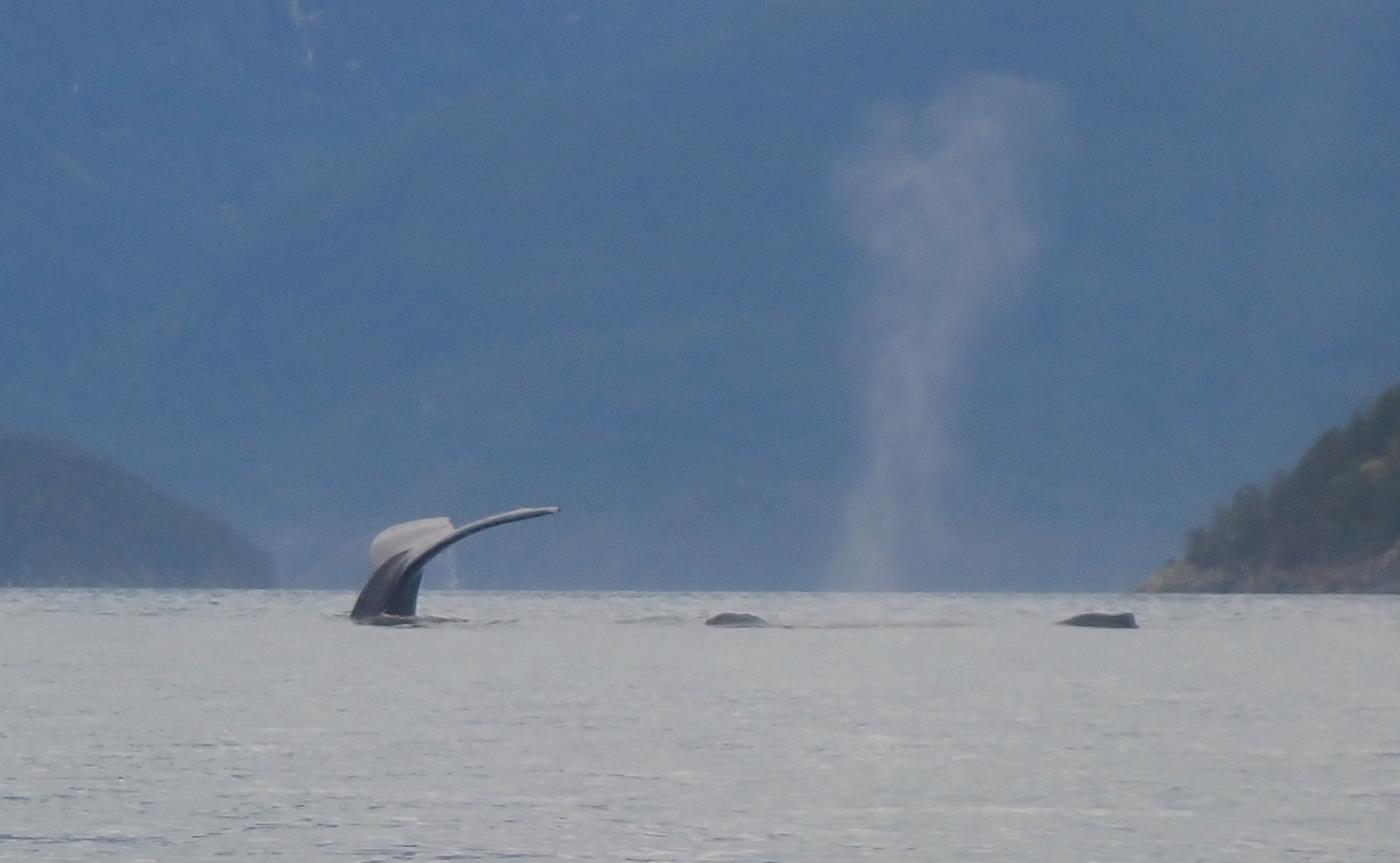
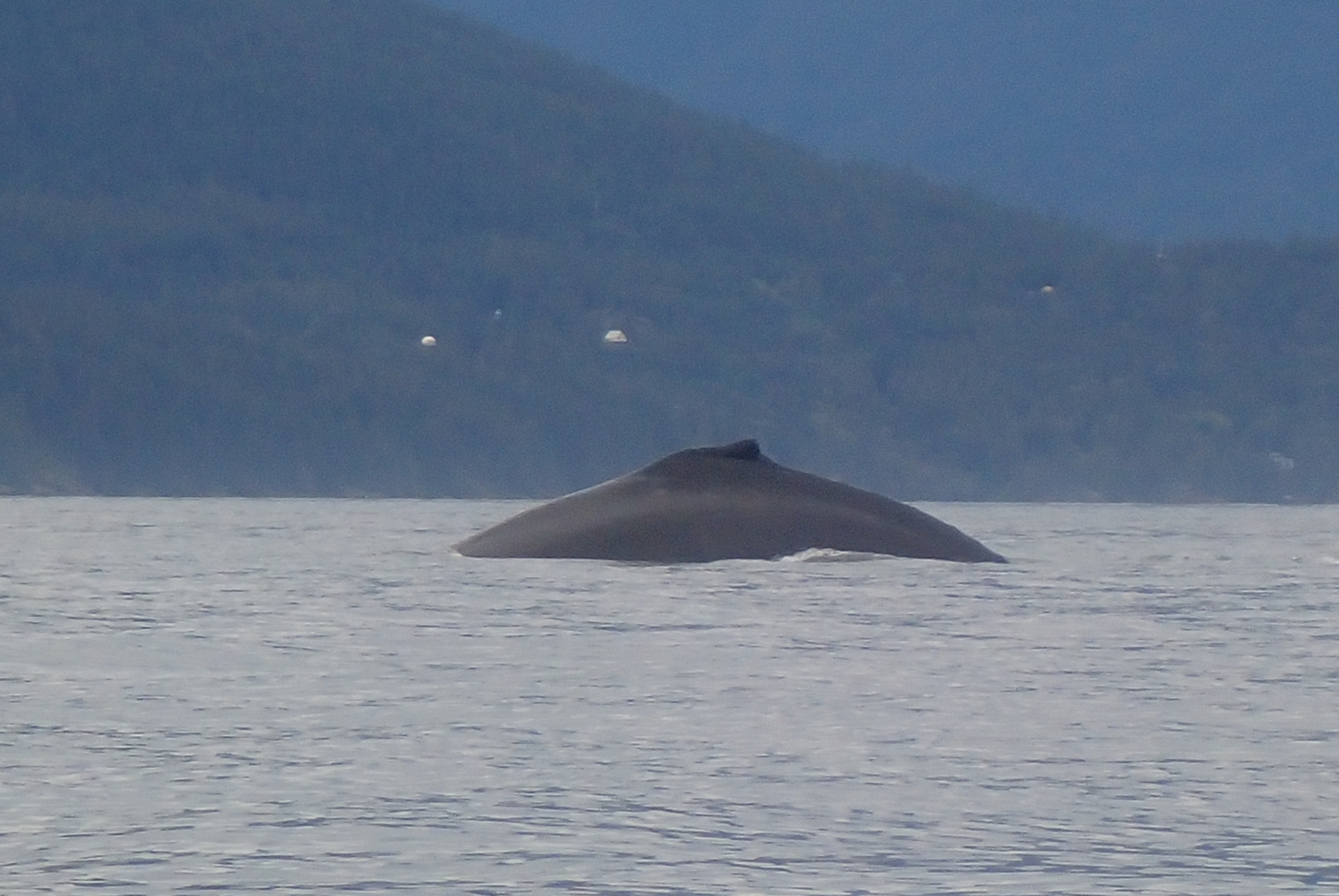
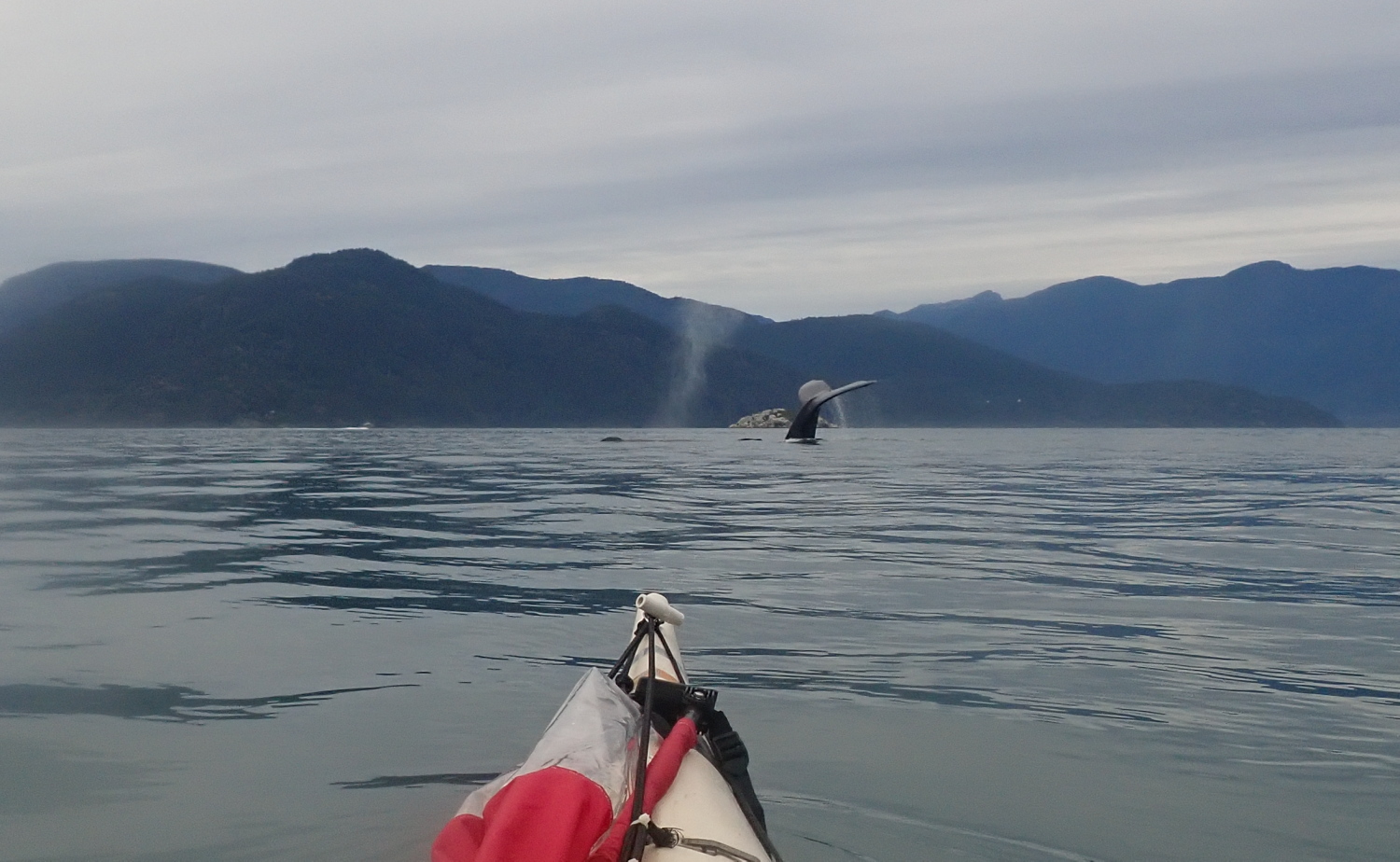
Turning north, I briefly put up my forward, Pacific Action sail. But though I am filled with hope, it is not filled with wind. I am reduced to actually having to paddle my kayak again. The horror! The horror! But I’ll soon be amply recompensed for this loss. As I’d been admiring the birds on Christie, I’d noticed out of the corner of my eye a jetski stopping in the middle of Montagu Channel, north of me. I’d wondered if they’d had a breakdown. As I altered course to swing close and offer to use my marine VHF to call for assistance if they needed it, I discovered the real reason they were stopped: a mother humpback whale and her calf were putting on an amazing show of synchronized swimming, plunging deep, under long enough that they must have been feeding on the seafloor more than two hundred metres below, surfacing with loud huffs and vast plumes of steam, and repeating the process as soon as they’d caught their breath. 

the tail of a diving Humback whale, with her calves visible on the surface behind her. Howe Sound, British Columbia

The jetski leaves soon after, but I stay, entranced. An occasional other boat joins me, grabs their requisite social media selfies, then zooms away. But everytime I try to get out, those whales pull me back in. I linger for about two hours, paddling a bit north, drifting south again as I stop to watch them surface, rinsing and repeating. It was magical, visiting with my cousins a few tens of millions of years removed.

a Humpback whale prepares to dive. Howe Sound, British Columbia'
The arc of a diver: moma Humpback prepares to sound
Humpback whales in Howe Sound, British Columbia

Eventually, I did have to go. I even got to paddle sail for a short while. And I approached Brunswick Point, more whales! Too far away for worthwhile photos, though.

By now it was late afternoon, and the need to pump my personal bilges was becoming ever more urgent. Not wanting my drysuit to become a wetsuit, I landed at the south end of Porteau Cove park, where the walk-in camping sites are, clipped the painter of my kayak to a convenient tree root, and scuttled to the outhouse. Much relieved, I reboarded to paddle the remaining few hundred meters to the boat ramp takeout. 

My timing was perfect: the wind was increasingly downchannel as I packed my car and reloaded my trusty kayak, and the rain began to fall just as I finished and got behind the wheel. An excellent four day getaway.

Epilogue: I don’t know whether the original owner of my new-to-me boat simply aged out of kayaking, or whether they’ve gone to the great sea in the sky. Either way, I like to imagine they’d be happy to know their boat is getting out and about once more. Just goes to show that even old sea kayaks–and old sea kayakers–are still good for a few voyages yet!   

PSA (Paddler’s Service Announcement): If you are not already a member of the BC Marine Trails Association, you totally should be. Not only does this group inventory all the water accessible campsites along the BC coast, they also help create them, including negotiating access to First Nations land (such as the Inaka Lhaxwm/Ramilles Channel Recreation Site where I camped on this trip. It’s part of the Sea To Sky Marine Trail.) This negotiated access is increasingly important as Canada works its way towards justice regarding the unceded traditional territories of the various First Nations. Thanks to Sḵwx̱wú7mesh Úxwumixw/Squamish Nation for allowing access to their lands, to the BCMTA for helping create these campsites, and to SKABC for maintaining them.

Leveling Up: assisting on a Paddle Canada Sea Kayaking Level 2 course

Featured

I hugely enjoy my work as a sea kayak instructor, but since I’m only certified to teach up to Paddle Canada’s Sea Kayaking Level 1 on my own, I usually just get to paddle locally in the Iy̓ál̓mexw/Ayyulshun (Jericho Beach/English Bay) area with my students. So when the opportunity arose to assistant-instruct on a Paddle Canada Level 2 Sea Kayaking course, with three days and two nights away in Átl’ka7tsem/Txwnéwu7ts (Howe Sound), I was in faster than you can say “re-entry roll”!

Sweetening the pot was the fact that my friend and colleague, Mike McHolm, would be the lead instructor on the course. I’ve known Mike since he was a customer at the late, lamented Ecomarine. Mike absolutely caught fire as a kayaker, and recently earned his Paddle Canada Sea Kayaking Level 4 (for those not in the know, that’s about one step below being able to calm the seas and walk on the water.)

Mike and I have co-instructed on Paddle Canada Beginner Sea Kayaking and Intermediate (Level 1) courses before, and found we have nicely complementary skill sets: he’s the master of advanced strokes, braces, scrambles and rolls; I’ve got a solid background of practical experience with extended touring and navigation.

The prep for the trip portion of the course included two intense days of on-water and on-shore instruction at Jericho Beach over the September 16-17 weekend. As it happened, three of the six students in this Level 2 course were graduates of a Paddle Canada Level 1 course I’d taught the weekend before.    

September 29, 2023

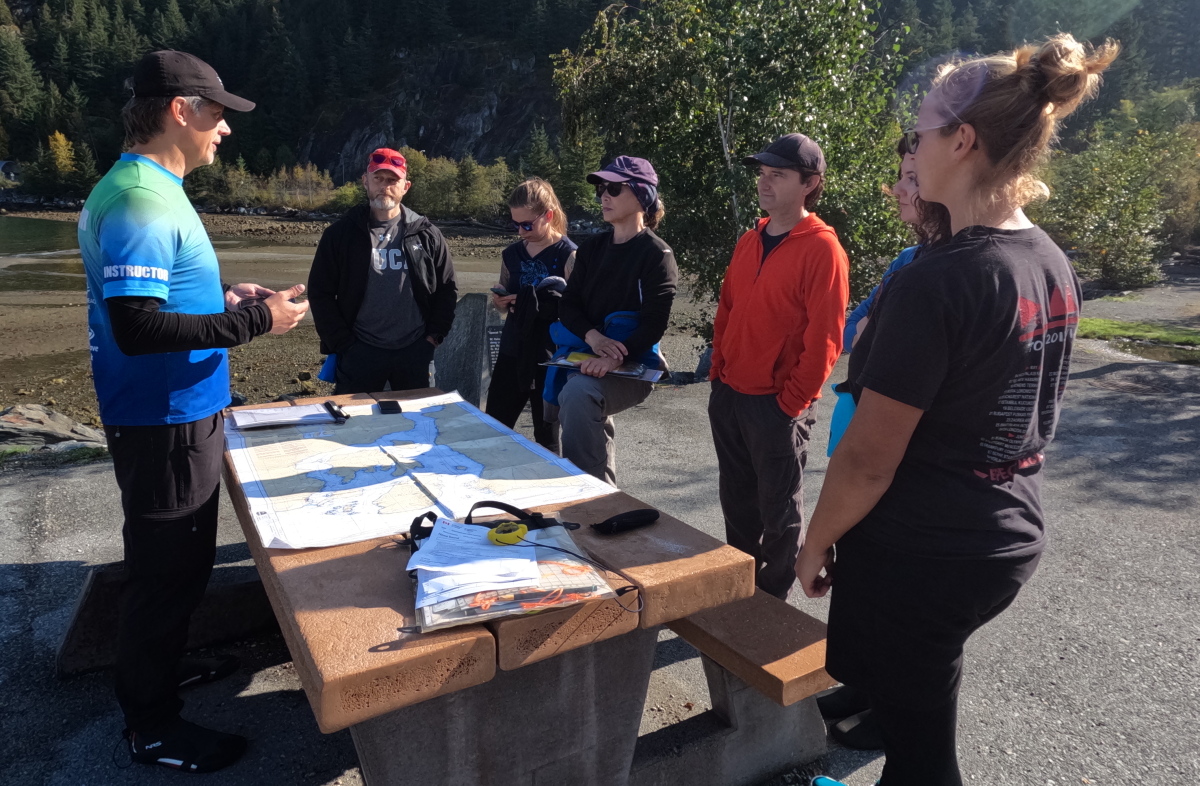
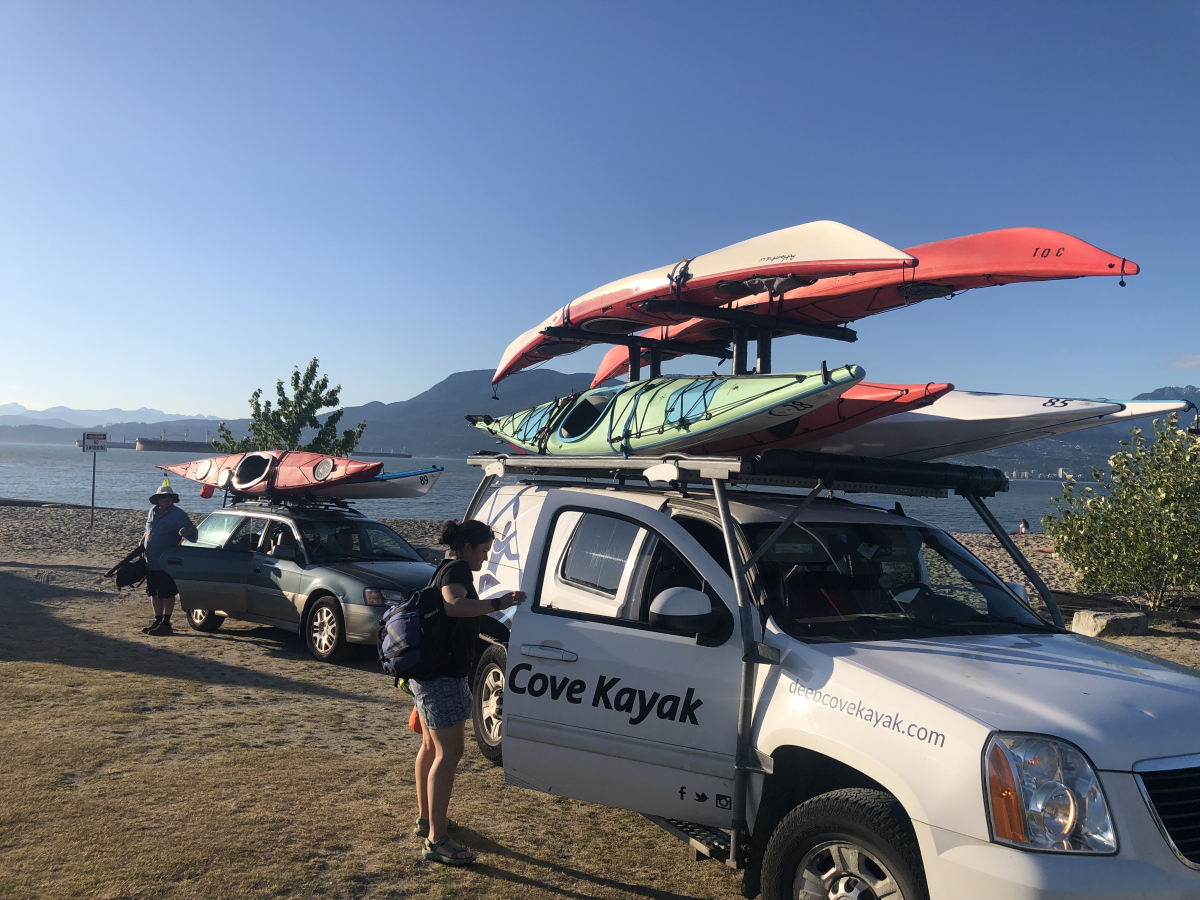
A bit after 8AM, Mike and I rolled into Xwawchayay (Porteau Cove) in the Yakmobile (a Yukon truck with a custom-made roof rack that can accommodate up to ten kayaks). As we offloaded the boats, our students joined us. The usual knocked-over-anthill scurrying about ensued, as we all packed our kayaks for the first time on this trip. Next, we had a pre-launch meeting, where we went over “Me, We, and The Sea”, reviewed some compass navigation and dead reckoning techniques, confirmed our planned route, and designated lead and sweep paddlers.

sea kayak students at a prelaunch briefing
prelaunch briefing at Xwawchayay/Porteau Cove

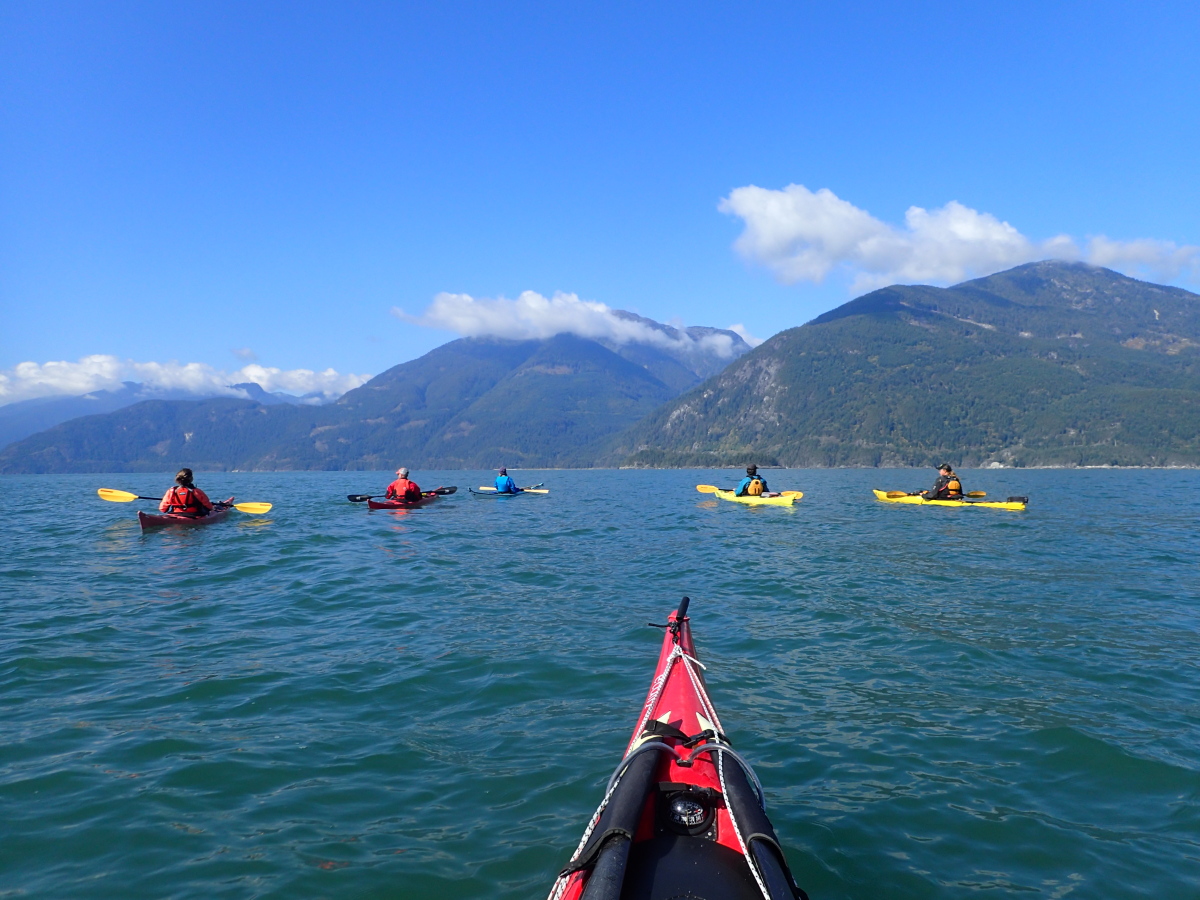
We launched around 12:15PM onto calm and sunny seas, course set for the Defence Islands. About 45 minutes later we hit the gap between them, pretty much bang on our time-distance-speed prediction. 

sea kayakers crossing to the Defence Islands in Howe Sound, British Columbia
Crossing to the Defence Islands

From there, we handrailed along the shoreline to Ts’itpsm (Zorro Bay), practicing our bow and stern rudders as we went. The slight inflow wind that had picked up nudged us gently on our way.

Our class included many with prior sea kayaking experience, including Chessy, who’s previously paddled with Mike in some serious seas. She entertained us (and cooled herself off) by nonchalantly popping off both paddle and hand rolls enroute.

a sea kayaker handrolls her kayak
Chessy handrolls

We arrived at Zorro Bay to find, amazingly for a long weekend with such nice weather, that we had it all to ourselves. Some of us doubled up our tents on the pads sites to leave at least one platform open for possible later arrivals.

sea kayakers arriving at Zorro Bay/Ts’itpsm, Howe Sound, British Columbia
Arriving at Zorro Bay/Ts’itpsm. That’s me in the attractive orange Nor’western hat. Thanks to Julia for this image.

At about 15:30, we relaunched into the bay to work on bow and stern rudders and hanging draws. The shallow waters of the bay were turquoise, which combined with the sunshine to create an almost tropical vibe.

Actually performing a roll is not a requirement to pass Sea Kayaking Level 2: you’ve just got to be able to demonstrate you understand the theory. But Mike had led a rolling session during our pre-trip prep weekend, and some students had really gotten into it, among them Leah. Spotted by Chessy (she who had demonstrated hand rolls earlier), Leah pulled off a few paddle rolls herself before coming ashore.

Mike McHolm sea kayak instructing

stern rudder practice in Zorro Bay

Evening class was on knots and ropework as related to rigging tarps over tents and kitchens. Fortunately, this was all merely theoretical, as the clear skies continued.

With all this learning, we dined European-style late. The main course was a spicy dish of noodles in peanut sauce with stir-fried veggies, including wild-harvested mushrooms courtesy of Claus and Alysia (since none of us started tripping out or tripping over, we can assume they know their ‘shrooms.) For dessert, I heated a deep-dish apple pie in my Outback Oven ‘til it had a convincingly fresh-baked feel, then topped it with real, albeit aerosol-can, whipped cream. (In response to questions from the class, I did acknowledge that I’m not always sure whether I eat in order to kayak tour, or kayak tour in order to eat…)

I got to bed about 10PM. Initially it was warm enough that I merely draped my winter-weight down bag over myself duvet-style, but later in the night things cooled down enough that I burrowed into it full mummy-style, and was glad to have the option: crawling out of bed pre-chilled in the morning is not inspiring for a day of challenging paddling.

September 30, 2023

I made my way down to the beach to find warm and sunny conditions, with the water outside the bay windy with whitecaps – perfect Level 2 conditions (it’s a requirement for passing the course that students complete at least some paddling in waves with winds in the 19 knots range.) Tragically, the wind and waves died shortly after we launched at about 10:40. So all the students, who were attempting cowboy scramble re-entries (and reverting to paddlefloat re-entries if they couldn’t pull one off), got to swim in calm water.

It’s worth noting that Level 2 is the point at which instructors begin to stress test students a bit. It’s not stress for the sake of stress: it’s because, as Mike noted during class, overnight trips are getting into life-and-death decision territory, so it’s better to learn lessons from mistakes in practice than “for real”. It was in that spirit that I yanked an insufficiently-secured paddlefloat off the end of one student’s paddle during their re-entry. As I explained to them later on shore: if you think I was being harsh and unforgiving, imagine how harsh and unforgiving one metre seas would be. Fortunately the student understood my point completely, and no hard feelings resulted. 

After reviewing the bow and stern rudder and the hanging draw, we handrailed south along the shore towards Lhemlhemḵwús (Islet View) campsite. Enroute, Mike encouraged the students to head at maximum speed straight at a convenient cliff. This was not so much to test the strength of their kayaks; it was more to encourage them to deploy a low or high brace turn effectively!

sea kayak practice: a paddler uses a high-brace turn to avoid ramming a cliff with their kayak.
Putting his money where his mouth is: Mike McHolm uses a last-minute high-brace turn to avoid turning his very expensive sea kayak into very expensive kindling.

We landed at Islet View about 12:40. Shortly afterwards, a family arrived in a small RIB stacked high with camping gear and were visibly relieved to discover that the eight of us paddling riff-raff were just there for lunch. As Mike went over the shore lesson (the signs of and responses to hypo and hyperthermia), several of his friends from SKABC paddled in.

Ashore at Lhemlhemḵwúss/Islet View campsite, Howe Sound

We relaunched about 14:20, and did tows with both throwlines and towlines, working up to towing a victim who needed to be stabilized by being rafted with a second rescuer. This culminated in teams of three – two rescuers, one hypothermic capsize victim – towing a patient back to Zorro Bay, and setting up a rewarming “burrito”.

sea kayak rescue practice:  as one rescuer tows a "hypothermic capsize victim" a second rescuer is rafted up with the sometime swimmer to prevent a recapsize.
Tow me the way to go home: as one rescuer tows a “hypothermic capsize victim” a second rescuer is rafted up with the sometime swimmer to prevent a recapsize.
sea kayak rescue practice: rescuers help a simulated hypothermia victim out of her boat and onto the shore
Helping hands: the rescuers help the hypothermia victim out of her boat and onto the shore.
sea kayak rescue training: as a simulated hypothermia victim waits in the recovery position, two rescuers lay out a "burrito" for rewarming her.
Taco Time: as simulated hypothermia victim Chessy waits in the recovery position, Julia and Drew lay out a “burrito” for rewarming her.

Leah was once again keen to practice her rolls before supper, so I spotted her, occasionally offering my bow for a bow rescue. She returned the favour when I was ready to try a few. Fortunately for my instructor honour, no bow rescue was needed — all my rolls worked, though it has to be said that none of them were pretty or “demonstration quality.” Leah generously proffered the rationale that this was because we’d had a long, tiring day, and I gratefully seized on this pretext like, er, a kayaker who’s repeatedly failed their roll grabbing a friendly bow.

My drysuit insulation layers were mildly damp from a combination of sweat and slight seepage during my rolls. It was too late in the day to sun-dry them, so I used a trick from my days touring on the Northern wet coast: layering them onto the gear loft in my tent, then suspending a lit candle lantern a safe distance below. The gentle heat dries out the moisture and, as a bonus, provides a welcoming beacon for finding your tent after dark.

Drew and Julia were on supper duty, and did not disappoint: an excellent home-made chili with grated cheese, sour cream, bread and all the trimmings. I was once again the dessert chef. Tonight’s course was assorted Auntie’s Puddings. I hadn’t been able to fit the microwave oven recommended for reheating them into my skeg kayak, so I simmered them in hot water for 20 minutes instead. While that was happening I whipped up the instant custard without which no proper English dessert is complete. (I briefly thought I’d made far too much custard, but Leah and Julia actually hoarded the surplus in a water bottle overnight and added it to their breakfasts the next morning in lieu of milk!)

We were not the only mammals who dined well: as a shriek from the direction of the food cache box announced, Mike’s improvised fix to the box’s rusted-out bottom (piled-up gravel and rocks) had failed to keep out the mice. Fortunately, nothing critical was spoiled, and we moved our remaining provisions to the greater safety of the kayaks.

It was a working supper: as we ate, we covered Collision Regulations, Environmental Impact, Tool/Repair Kits and Indigenous Relations and Considerations (the latter especially appropriate as today was the National Day for Truth and Reconciliation, plus we were camped on First Nations Land generously made available as a water-access site.)

October 1, 2023

Determined not to be robbed of rougher conditions again, Mike had us all on the water shortly before 9AM. The sea state was a satisfactory brew of whitecaps and wind.

Making waves: rescue practice in rougher water
sea kayaking rescue practice: one sea kayaker offers the bow of her kayak to a capsized paddler, so the upside down paddler can roll up without having to wet exit their boat.
Bow rescue practice. For her first several capsizes, Chessy instinctively rolled up before Leah could “rescue” her. She had to make a conscious decision to refrain from rolling for this attempt.
sea kayak rescue practice: one kayaker uses the T-rescue technique to empty the boat of a capsized paddler prior to helping them reboard.
Returning the favour: Chessy T-rescues Leah in Level 2 conditions.

As expected, the class found all their maneuvers, from turns to re-entries, rather more challenging in sporty water. But when you think about it, bouncy seas are exactly the conditions in which you’re more likely to need braces, rolls or re-entries. So best to practice in realistic conditions. Enroute back to shore, the class got to use their stern rudders “for real” to keep their boats from being broached by the following seas.

We packed up camp while eating an early lunch, then launched for Porteau Cove, via a dogleg at Furry Creek. Enroute, Mike and I debriefed several of the students two-on-one.

Once we were just off Porteau Cove, a bit inshore of the buoys marking the sunken ship dive site, we did the final class exercise: an “all in” with everyone wet-exited and helping one another back into their boats.

Everyone in for the swim: an “all in” rescue at Porteau Cove

We landed, took advantage of the outdoor showers meant for the Porteau Cove divers to rinse the salt water off our immersion wear, skirts and PFDs, then packed up, including reloading several kayaks onto the yakmobile — that went a lot faster with a crowd of willing hands than it had on Thursday evening when Mike and I had been doing it ourselves at Jericho Beach Kayak. As we completed all this, we could see rain clouds moving in, proof that our timing had been perfect, weather-wise (and it was wonderful when unpacking at home not to be wrestling with wet and muddy gear).

Mike and I finished debriefing the remaining students, then said our congratulations and farewells. Holiday traffic meant it was fairly late in the day by the time we were back at Jericho Beach Kayak and offloading the boats, so we were both pretty bushed, and much overdue for showers (drysuits keep out the brine but seal in sweat and body odour with equal effectiveness). However, the satisfaction of having worked with a wonderful group of people and helped them towards new adventures kept us energized!

Putting the best face on things: all students and instructors looking alert!

Update: my fellow instructor Mike made a short video about the weekend that will give you a better sense of what dynamic water looks like.

Guiding Light: 2023 Jericho Beach Kayak staff trip to Halkomelem: səl̓ilw̓ət (Indian Arm)

Featured

One of the things I love about working as an instructor-guide with a raft of mostly younger colleagues is the chance to spark off their energy and enthusiasm. But at work, the longest paddles we typically do together are day trips. So getting away for three days and two nights up Halkomelem: səl̓ilw̓ət with many of them gave me a chance to feel like I could pay things back a little by demonstrating some campcraft, backcountry cooking and compass navigation to co-workers who might not have done a lot of kayak touring.

Read more: Guiding Light: 2023 Jericho Beach Kayak staff trip to Halkomelem: səl̓ilw̓ət (Indian Arm)

June 9, 2023

Having swung by Jericho Beach Kayak to pick up boats, we arrived at Deep Cove mid morning. I, like several others, was waffling back and forth about whether to bring my wetsuit or my drysuit on this trip. At the present, it was cool and cloudy, with showers predicted, but it was scheduled to get warmer and dryer later in the weekend. In the end, I opted for the drysuit, which proved to be the right choice. At least mostly.

Launching at Deep Cove
Heading out of the Cove. Note the marine sighting compass tucked under my decklines.
Tethering up the boats at the Twin Islands dock

As we lunched on the Twin Islands, the rain began to patter down. Shortly after we left the Islands, it upgraded to full showers, with a following wind. I’d stowed a folding sail on the back deck of my boat (I was paddling a kayak borrowed from JBK, and suspected my boss would not appreciate me drilling holes in it to mount a permanent sail, so the clip-on Windpaddle Sail it was.) My cunning plan had been to effortlessly cruise past, or at least alongside, my colleagues. But with the cloud, the wind was not the strong atabatic it would have been on a sunny day, so my sailing was significantly slower than I’d hoped. In the end, I did a series of leapfrogs – sailing until I was a few hundred meters behind the pack, then sprinting with the paddle to catch up, then taking a sailing break again, and so on. The end result was me landing pretty much with the pod at Granite Falls in the late afternoon.

Running through the wind and rain. Croker Island is faintly visible in the distance.

On this rainy Friday night, there were only a few other campers, which gave us a nice selection of sites. Some of our group doubled up tents on one pad, since we suspected the Inn would be much fuller tomorrow (we knew at least three more of our own group would be joining us.)

Landing at Granite Falls, Indian Arm, British Columbia
multi-person portage at Granite Falls

EJ, our fearless leader, had rigged the kitchen-dining tarp by the time I had set up my tent and changed into shore wear. Very necessary as the rain was falling heavily now. Audrey was my meal mate for making the group supper this first night, and was very patient with chopping vegetables (I was making this dish, but with the Chorizo fried separately to be added downstream by the non-vegetarians in our group.) I also managed to subcontract grating the Parmigiano Reggiano to Mika, which left me free to concentrate on toasting the pine nuts, frying the veggies in proper order and boiling a huge pot of pasta. It looked like a lot, but eight hungry kayakers made short work of it. Good thing I’d also brought a strawberry-rhubarb pie to heat in the Outback Oven. And hot custard to pour over it.

June 10, 2023

It continued to pour heavily through the night, so I was glad of the overtarp on my tent. The precip lightened off by the morning, but we were still glad of the kitchen tarp as we enjoyed oatmeal with a range of toppings, courtesy of Chris and Mika.

Paddling past Granite Falls

Then it was to the boats and off to the mouth of the Indian River. We’d planned to arrive at near high tide in order to get as far up the river as possible. With EJ demoing, the group got to practice paddling in currents. Though I used to run whitewater back in the day, being in an unfamiliar boat with a rather loose skirt, I opted to eddy out just below the sandbar the rest of the group made it to, and go birdwatching while they walked further upstream. During all this, we got the call on my VHF from the trio that were joining us today – Natalie, Maggie and Mark. I was pretty impressed that the handheld radios worked with us so far up the river.

Entering Indian River

After the exploration, we ran effortlessly downstream. The falling tide had made the river significantly more boney than it had been on our way in, but we got to a sandbar in the estuary without anything more serious than some sacrificed gelcoat. There Lyra and EJ laid out a beautiful buffet lunch for us. I got a chance to demonstrate a marine sighting compass and the use of a modified Douglas protractor to the group. After a bit of a learning curve with the sighting compass, the group did plot an LOP off the west side of Croker Island that put us where we already knew we were (how awkward if it had been otherwise!)

lunch at the Indian River buffet

On the way home, we both played and learned, experimenting with a variety of old and new strokes. Back at Granite Falls, as we’d expected, there’d been a massive population explosion, but everyone was being considerate of one another, and no-one was operating loud musical devices. (A sensible precaution, as it has been known for boom boxes at backcountry campsites to fall in the water, even from well up on shore. Funny that.) Natalie and Alex fed us to repletion on amazing ramen.

Paddlers in the hood

Mark is a stand-up guy!

June 11, 2023

Sunday lived up to its name, dawning clear and dry. I helped Marc and Maggie configure the campstoves to set up a pop-up IHOP, with excellent pancakes and a wide selection of toppings, including whipped cream! To tamp down breakfast, Alex led us all in some improvised yoga paddle warm-ups.

a magnetic tool with grains of local ferrous rock stuck to it.
This little magnetic stove tool is made to plunge the jet cleaner needle up and down. Turns out it’s also great for identifying ferrous rocks!
yoga posers
Sunday morning service

Natalie chills out on a water bed

Even with my lightest layers on under the drysuit, it would have been a boil-in-bag experience save for the fact I was wearing a Mustang Hudson suit, with a neck seal that could be loosened for a bit of ventilation.

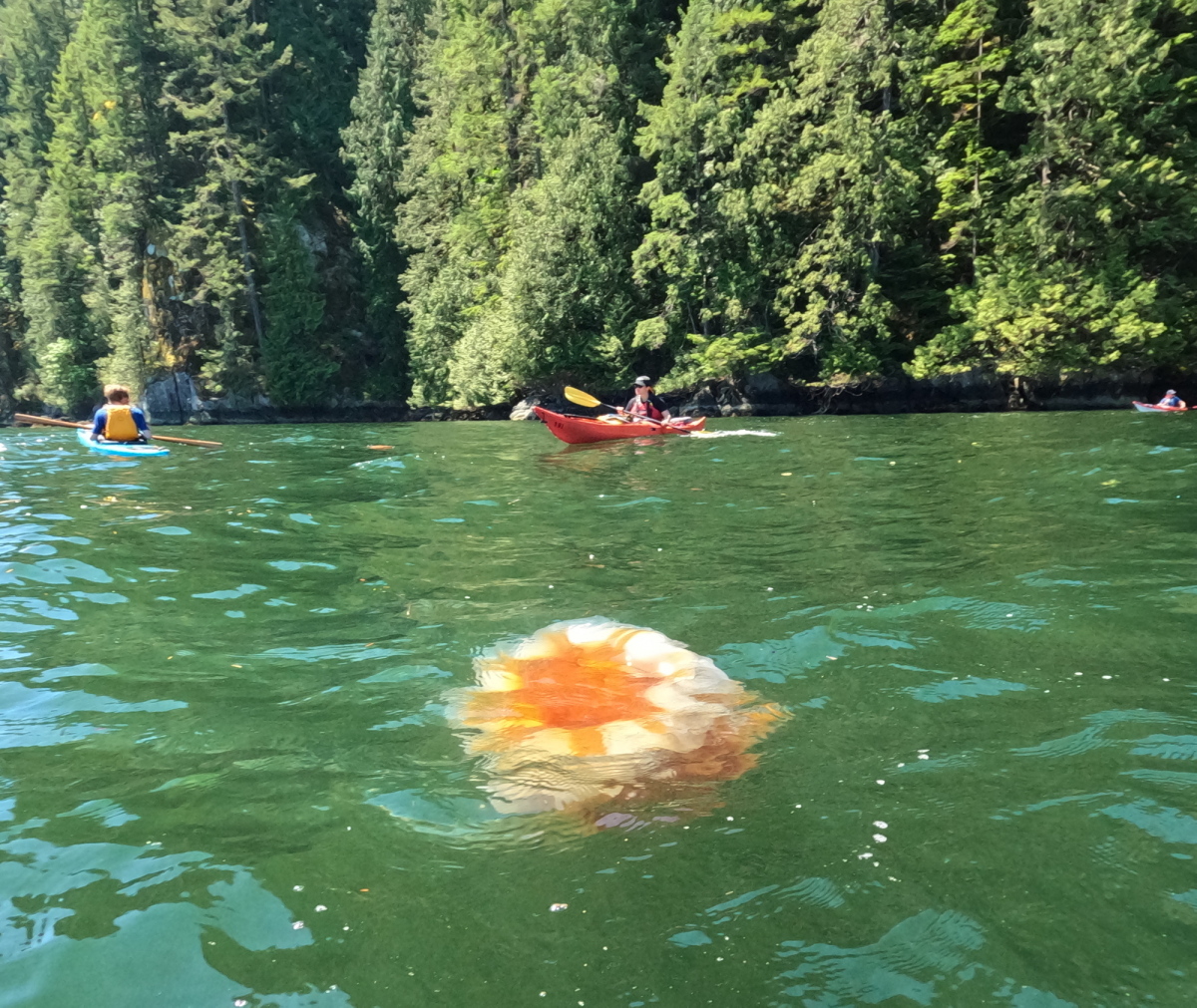
We frolicked down the east side of Croker Island, with Marc and EJ giving us an on-water clinic on the use of cross-bow draws and hanging draws to slip along right next to the rock walls. Just off Silver Falls, the water was thick with Lion’s Mane jellyfish, including one monster that must have been a couple of feet across.

big ass jellyfish

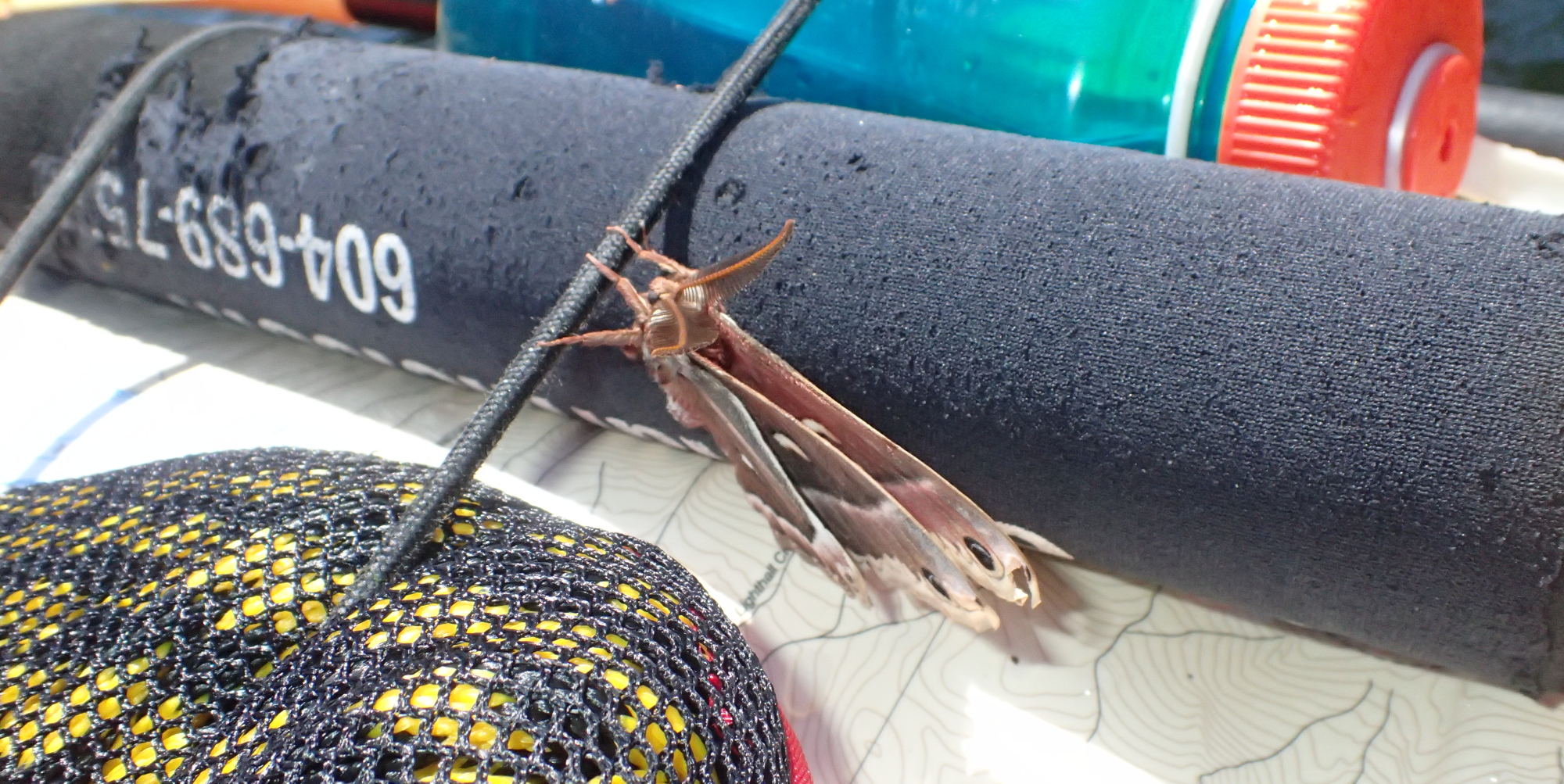
As we made our way south, the kind-hearted Mika fished a winged warrior out of the water, where it had somehow crash-landed and stuck. With its wings dry, it was able to take off again from our lunch stop.

With the sun out, the inflow wind rose steadily as we clawed our way towards Thwaythes Landing for lunch. (Where was that wind a couple of days ago when I needed it to race north to Granite Falls?) Elaine and Rita laid out a zesty tortilla wrap buffet for lunch. Since I’d been lagging significantly behind the group just prior to lunch, I opted to launch earlier than them after lunch to get a head start and not hold the fleet back. (By prior arrangement, we were in touch on Channel 69 on the VHF.) Though I was nominally the navigator for the fleet, they assured me they were capable of “keeping the land on the right” until they reached Deep Cove. And so it proved.

Thwaythes Landing

By hugging the shore and finding back eddies from the wind, I made pretty good time back to Deep Cove, maintaining my 30 minute lead. The sea just in front of Deep Cove beach looked like a pond of mutant water lilies, with paddlecraft and inflatable rafts of every colour and size wafting about under varying degrees of directional control.

I tried to put my advance landing to use by running to Honey Donuts, hoping to greet the main invasion force on the beach with a box of a dozen gooey treats. But the weekend line-up was insanely long, so I instead grabbed a quick shower and fetched my car back from the long term parking.

It was evening by the time we got back to the Jericho Sailing Association, offloaded boats, and headed home in that happily weary way that ensures a sound sleep and sweet dreams.

Thanks to all my colleagues for sharing their knowledge, the pleasure of their company, and their photos!

April Showers bring… April showers

Featured

April 7, 2023

We’d laid plans for this trip with an Option A (Howe Sound/Átl’ka7tsem) and an Option B (Indian Arm/Nuth Khaw Yum Provincial Park). The predicted winds made Howe Sound sound rather too exciting, especially given that if we were crossing from Porteau Cove to the Islets View site, we’d have the wind and waves on the beam coming and going.

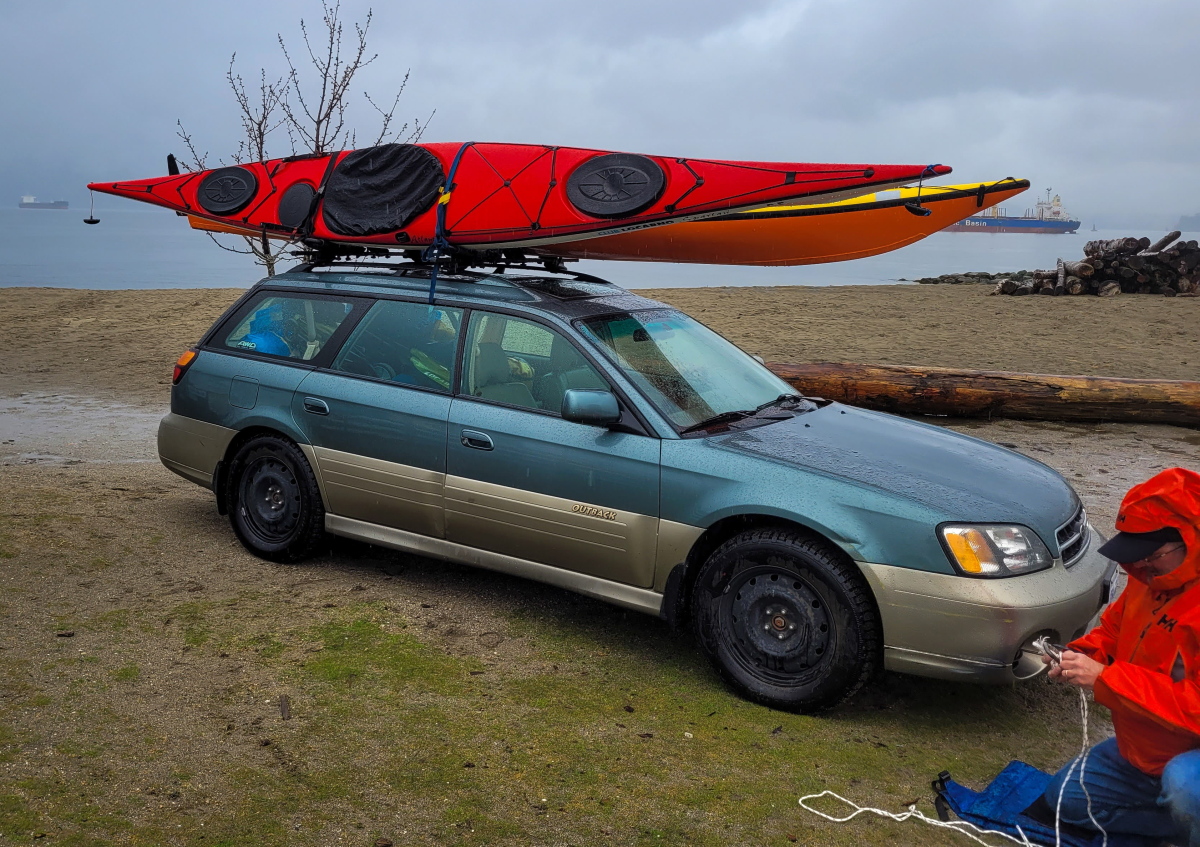
Rack n’ Roll: securing boats to the trusty Subaru
Read more: April Showers bring… April showers

So Indian Arm it was. Rhian and I swung by the Jericho Sailing Association compound to grab our boats, then met our accomplices, Paul and Nessa, at the Deep Cove put-in. A light drizzle washed us as we loaded and launched. 

Paul and Nessa snap a selfie at the Deep Cove put-in as Rhian and I demonstrate precision kayak maneuvers in the background.

Things cleared a bit as we made our way down the Arm, becoming what the Irish would call “soft”. Scraps of blue sky even appeared, lulling us into a false sense of security.

We paused to frolic briefly in the currents below Silver Falls, then pressed on.

Premature Exhilaration: Paul and I celebrate the blue sky. North Twin Island is visible on the horizon behind my outstretched left arm.
Sea kayak siren self-portrait: Rhian’s selfie


The rain held off as we landed at Bishop Creek (Berg’s Landing) in the late afternoon, letting us all rig both our tents and the overtarps for them. It began to foreshadow the coming deluge as we rigged the kitchen-dining tarp.

Nessa and I approach Bishop Creek/Berg’s Landing on the left. Croker Island is visible just beyond us.
Overtarps are de rigueur in heavy rain to reduce interior condensation in tents. So de rigger set’em up!
Paul and Nessa’s backcountry pied-à-terre. Happily, the grey overtarp I lent them accessorized well with their tent, else I’m sure they would have refused it.

Fortunately, the group consisted of seasoned outdoor folk, who understand that when it comes to weather, things are what they are. Plus, we had brought a lot of good cheer (mostly of the fermented-red-liquid-in-bags kind.) And, as this group’s now-traditional dessert, we heated a pie in the Outback Oven until it was as warm as though fresh-baked, and drizzled it with hot custard. 

April 8, 2023

Throughout the night, the temperature continued to fall, as did the rain. In fact, it cranked up to a volume that made last evening’s showers look like a desultory drizzle. Even landing on the tarp above the tent canopy, it drummed loud enough to preclude sleep. So I stuck in my ear plugs – not usually a recommended procedure in bear country, but honestly, unless Brother Bruin were clashing cymbals to herald his approach, I’d never have heard him over the rain anyway.

I was on breakfast duty and had massively underestimated the time needed to cook a “full English” for everyone in the group. It could only have gone slower if I’d started by planting the potatoes and fattening the pigs. Fortunately, no-one was in any hurry to leave the sheltering tarp, so the meal evolved into a leisurely “full English brunch”, washed down with endless cups of tea and coffee.

Camp kitchen, complete with cold and colder running water (under your feet)!

The ground under the kitchen tarp had gone from fairly damp last night to full swamp this morning. Fortunately everyone had waterproof pants for kneeling to cook or fill plates, and full-frame, above-the-flood chairs for actually eating.

By this point, all of us were wearing every layer we had when outside our tents, and counting our blessings that we’ll all brought winter-weight sleeping bags, pads and clothing. Entering and exiting the tents involved elaborate doffing or donning rituals that would have looked familiar to a hard-hat commercial diver. Vapour hung in the air with our every breath.

In the afternoon, Paul and Nessa, ever the bold and energetic ones, launched for a daytrip to Granite Falls. Rhian went on a wet weather photo safari, finding the beauty in the rain. I did likewise in my own way, hanging out under the tarp and admiring the way the swirling low clouds concealed and then revealed the various peaks and crannies in the fjord walls opposite our camp. And I pondered an additional point I would emphasize to the students in my Online Trip Planning Class: in the Marine Weather class, we typically talk about the importance of being dressed appropriately for whatever on-water (and possibly in-water) conditions prevail. But frankly, if everyone in our group had not been equipped with not just drysuits and appropriate layers, but winter-weight shore wear and sleeping equipment, we’ve have at best been trying to call a water taxi for the trip home and at worst needed to be medi-vaced for hypothermia.

Supper was tamped down with our also now-traditional hot Auntie’s Puddings and custard. (Are you sensing a theme here?)

April 9, 2023

Wanting to be back home at a reasonable hour for what promised to be several days of drying tarps, tents and selves, we’d agreed the night before to aim for a 9:30AM launch. Typically this means we’d actually launch nearer 10ish. But we were all apparently very motivated, and were sliding the boats off the cobbly, shelly beach at the appointed hour. Even with all four on each boat for the portage from the loading station to the water, we all walked very gingerly – one slip on the slimy, lumpy and shifty rocks would have been an excellent way to twist an ankle or break a leg.
Undamped spirits or contagious rictus? We Report; You Decide.
Rhian and Nessa model this winter’s must-have kayak cruise wear. From the high (and watertight) necklines to the little-black-cockpit skirts, they’re sure to make a splash wherever they go!

My three companions, all younger than me, set a smart pace back to base. At first, I kept up well, and was even in the lead for a bit. But gradually, I fell behind. If there had been a Captain Oates Award For Best Straggler, I’d have been a shoe-in. Fortunately, the situation was not quite dire enough for the others to suggest I go outside for some time. Besides, we already were outside.

About an hour out of Deep Cove, we got hammered by a headwind squall and blinding rain. In the low vis, I mistook two other paddlers who were bee-lining for their shoreline cottages as Paul and Nessa, and wound up paddling for sometime at a tangent to the rest of the group. But once the weather cleared, we re-united.

On the final leg to Deep Cove, the wind shifted, and I kept hoping I would get a least a sail assist to catch up with my friends. But the wind just toyed with me – repeatedly inviting me to rig the sail, glide through the water for a few seconds, then dying off. My companions were remarkably patient with all this faffing about. And even with it, we landed at Deep Cove shortly after noon.

The rain continued to fall so hard that Rhian and I simply stayed in our drysuits for the drive back to Jericho and dropping off our boats. Even with the wipers on full blast, the windshield often looked as though it were iced over. The heavens poured one last contemptuous dump on us as we offloaded the kayaks. And naturally, as I drove Rhian home from Jericho, the showers ceased and the sun began to peek coyly out from behind the clouds. That sun of a bi …!

Big thanks to Rhian, Paul and Nessa for sharing their companionship and photos!

Sea Kayak Navigation: natural ranges and pre-plotted LOPs

Featured

In a previous post, we talked about Lines Of Position and about two kinds of LOPs: the shoreline, and compass bearings taken from recognizable landmarks.

But sometimes we just don’t want to break our paddling flow to stop and take compass bearings. And sometimes exuberant waves make shooting and transferring bearings onto a chart that’s bouncing off the trampoline of a sprayskirt deck rather like working on a crossword while riding a Tilt-A-Whirl. At such times, it would be great to have “self-shooting” LOPs. Happily, these exist: they’re called ranges*. They come in two flavours: artificial ranges, which kayakers generally avoid, and natural ranges, which we embrace like the tree-huggers we are.

* Or “transits” if you’re British. They do have a strange habit of coming up with odd new words for things when there are already perfect serviceable ones in English. See truck/lorry, glasses/spectacles, trash can/dustbin, etc.

Read more: Sea Kayak Navigation: natural ranges and pre-plotted LOPs

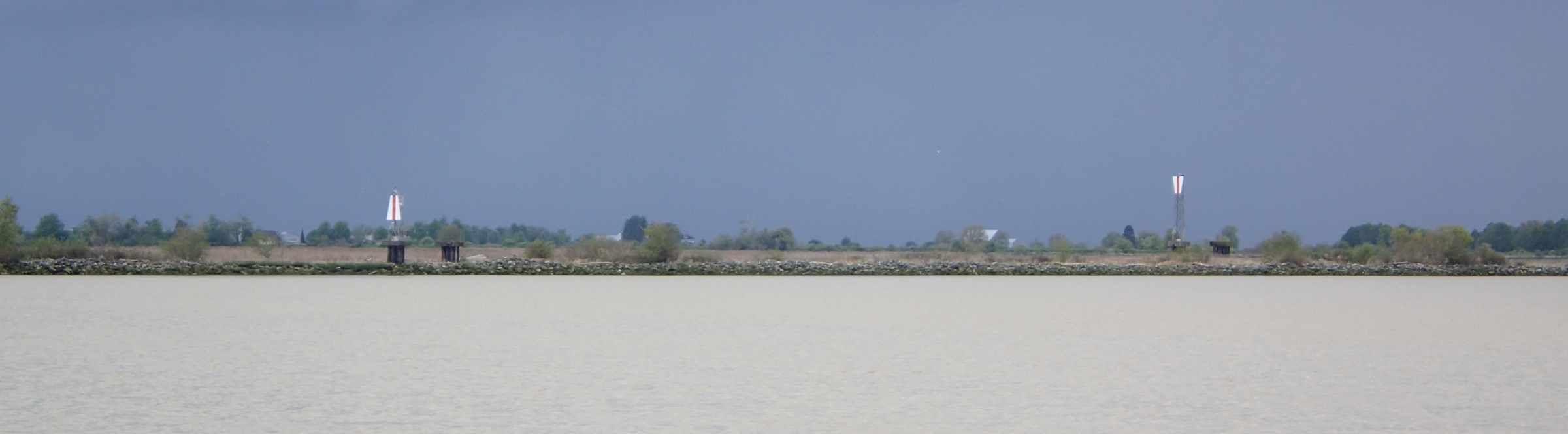
Artificial ranges are often erected along narrow channels and tricky harbour approaches for the benefit of bigger boats. They’re typically a pair of brightly-coloured trapezoids mounted on frame towers a few hundred metres apart. When the captain of a ship sees them lined up, one directly above the other, it tells them they’re in deep water, in the centre of the marine traffic lane, right where they want to be. When the captain of a kayak sees the same thing, it tells them they’re in deep doo-doo, in the centre of the marine traffic lane, right where they don’t want to be. At best a kayaker may acquire an expensive ticket for interfering with bigger boats; at worst they might be pureed in the prop of an overtaking freighter. So take advantage of your kayak’s much shallower draft and hug the sides of any such vessel traffic lanes you must follow. (But also remember that the wake from big boats will get steeper and more spilly in the shallows.)

A photo of two navigation ranges, showing their appearance in real life.
A pair of artificial ranges. If you were piloting a ship downriver, you’d want to move far to the left to get the ranges to line up one over the other and put your craft in the deep water channel until you hit the 12A marker shown on the chart section below.

A section of a nautical chart showing how navigational ranges are indicated.
The same ranges, both circled in blue, as they appear on a nautical chart. The bright green circle shows approximately where the photo above was taken.

Natural ranges occur wherever two distinct landmarks line up from the paddler’s point of view. They’re the same sort of landmarks we’d be looking for when taking a compass bearing: the end of an island, a navigation buoy or marker, or the tip of a point.

Showing two landmarks as a natural range, creating a Line Of Position. The eastern tip of Gossip Island is lined up with Laura Point on Mayne Island.
Looking north from the shoreline of Miners Bay on Mayne Island. Laura Point, in the middleground on the right, is just overlapping with the eastern tip of Gossip Island, visible in the far background, beyond Rip Point and Burrill Point on the left.
A section of marine chart, with a line drawn showing natural ranges for determining your position.
The natural ranges from the photo above as they line up on a chart. Where the orange line meets the shoreline of Miners Bay is your location. (The large public dock you’d be floating beside would also be a good clue to your location, but you can’t always count on having such infrastructural validation, especially when you’re paddling in remote areas.)

Update March 2024: for another example of a range as an LOP, see the second half of this posting.

You can mix-and-match the intersection points of all types of LOPs to find your position. If all your LOPs are shorelines and natural ranges, you can usually count on them to be pretty accurate (islands and buoys generally don’t move around much). But if one of your LOPs is a compass bearing, it’s not a bad idea to take a second bearing off another object, just to offset errors in taking the first shot and transferring it to the chart.

The next best thing to a natural range as an LOP is a pre-plotted compass bearing. Especially when searching along a shoreline for a not-obvious-from-seaward campsite, a pre-plotted LOP can save a lot of anxious vacillation between “We should spot camp any minute now” and “We’ve overshot it and need to turn around.”

To pre-plot a compass bearing LOP, identify a landmark on the chart you’re confident will be visible as you’re approaching the target campsite in real life. Next, use a ruler or parallel rules to draw a straight line from the campsite to the landmark. Then, using either a hiker’s compass or a string-equipped Davis protractor, determine the magnetic bearing from the campsite to the landmark. (If you do all this at home or ashore in camp, it will be much easier to plot accurate bearings and draw straight lines.)

Pay no attention to the waterfall! We’re navigating by chart and compass, dammit!

For a worked example, let’s go back to the chart we used in this post. But now let’s pretend that instead of making a crossing from Elephant Point to the campsite, we’re paddling north along the shoreline of Granville Bay looking for it. (For purposes of this exercise, we’re going to ignore the fact that in real life, just north of this campsite, there’s a fourteen-hundred foot waterfall thundering down the cliffs as a subtle visual and audio clue to your whereabouts!)

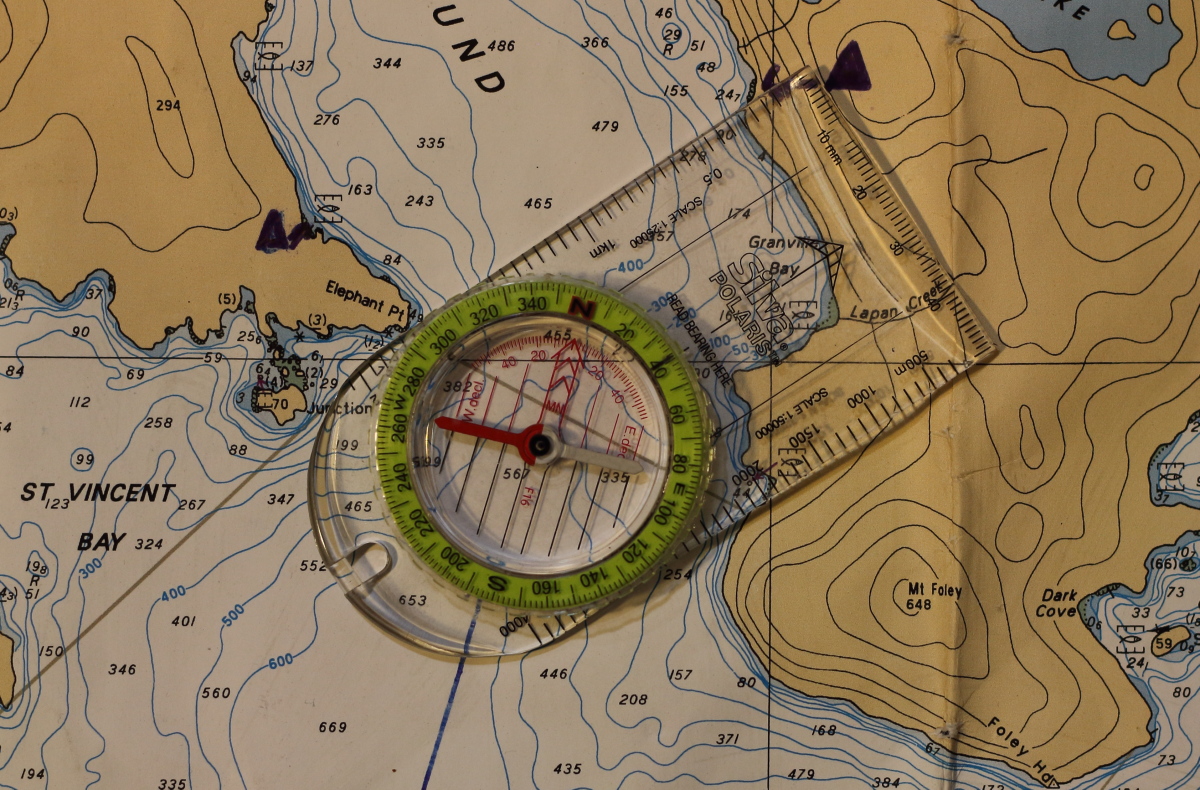
A section of marine chart, with a hiker's compass used as a protractor to determine a bearing from one location to another.
How we determined the bearing from Elephant Point to camp using a hiker’s compass. The “Read Bearing Here” indicator on the compass shows 39°, which we rounded to 40° for practical purposes.

To determine the magnetic bearing from the campsite to Elephant Point with a hiker’s compass on the chart, we could just reverse the procedure shown in the photo above. We’d lay one edge of the compass baseplate running between camp and Elephant Point as before, but this time with the Direction Of Travel arrow pointing the opposite way. Next, we’d turn the compass bezel to make its meridian lines parallel to the blue magnetic North lines on the chart, then note the degrees shown at the Read Bearing Here indicator. But we’ve already done all the same sort of work to determine the bearing from Elephant Point to the campsite, as shown in the photo. That bearing was 40°.

You’ve probably heard the slang, “Doing a one eighty!” to describe turning right around to head straight back to where you came from? It’s a handy way to remember how to work out the reverse (technically called the reciprocal) bearing from B→A when you already know the bearing A→B. In this case, we know the bearing from Elephant Point to the campsite is 40°. So we add 180° (“one eighty”) to 40° and get 220° – the reciprocal bearing from the campsite to Elephant Point.*

*When our original bearing is 180° or less, we add 180 to determine the reciprocal. If the original bearing is greater than 180°, we subtract 180 to get the reciprocal. So if the original bearing had been 270°, the reciprocal would have been 90°. Why this way rather than just always adding or always subtracting? Because, for tediously complicated historical reasons, compasses use 360°circles. So unless you’re Captain Jack Sparrow, your compass won’t show a course higher than 360° or in negative degrees.

A section of nautical chart, with a Davis protractor, showing how to determine the compass bearing from one location to another.
How we determine a bearing from Elephant Point to camp using a modified Davis Protractor. Happily, the indicated bearing is 40°, same as for the compass method above. Alert readers will note that the reciprocal bearing, 220°, is also shown on the edge of the protractor, saving us from having to do the addition or subtraction described in the paragraphs above to get the bearing from camp to Elephant Point.
A section of a marine chart, with a pre-plotted bearing line from camp to Elephant Point.
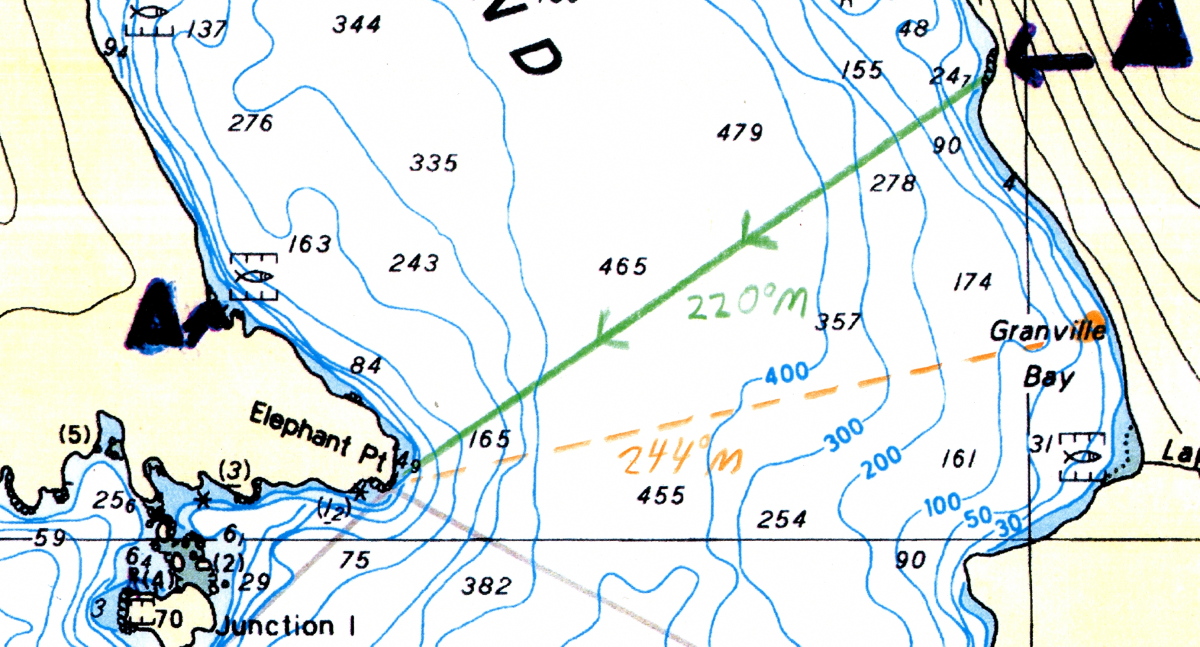
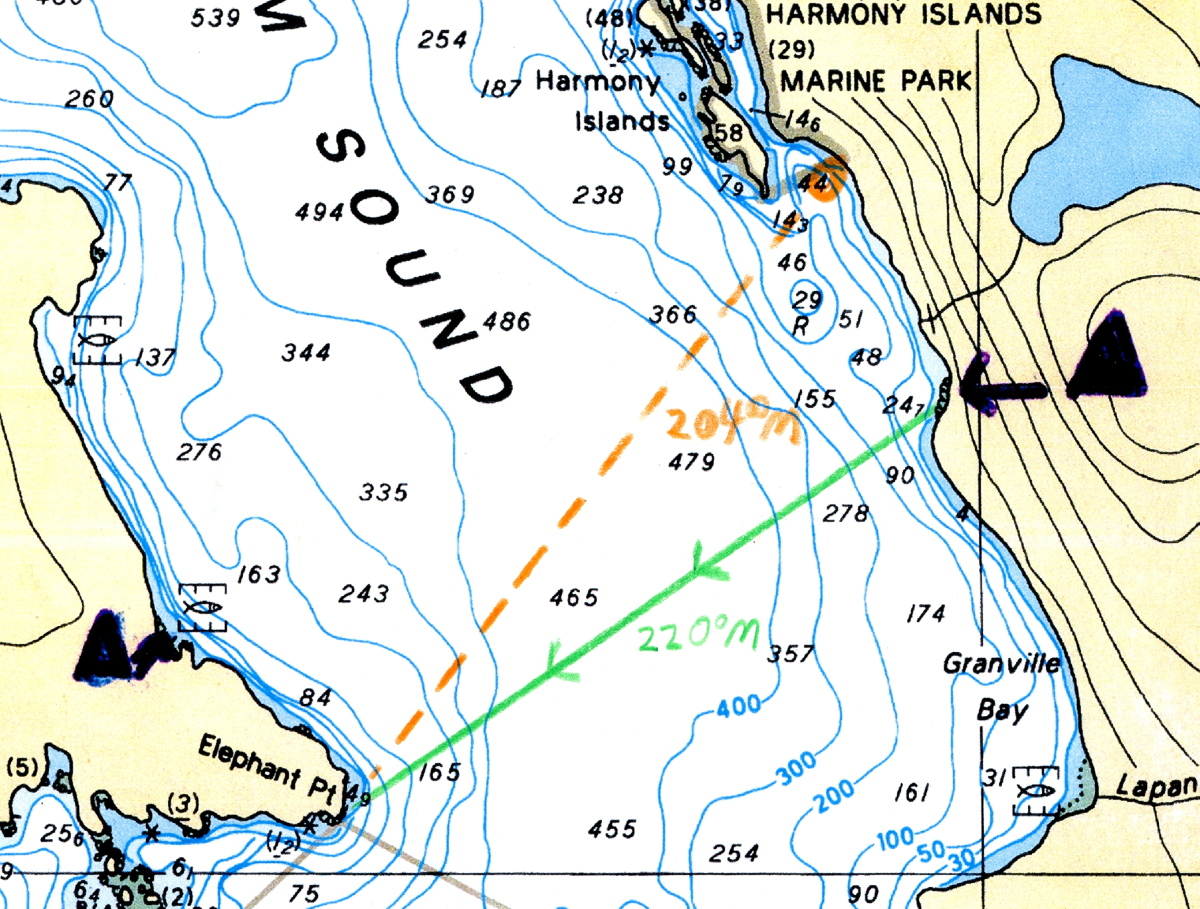
A pre-plotted bearing line in green. The letter “M” after the noted 220° reminds us that this bearing is relative to magnetic North rather than true North. The arrows on the line indicate that the bearing shown runs from camp to Elephant Point.

So now we note the 220° bearing from the campsite to Elephant Point on the green line drawn between the two. As we make our way north up the shoreline of Granville Bay, we periodically take a shot of Elephant Point with our hiker’s compass or our deck compass. If the bearing we get is greater than 220° (I.E. further south), we know we’re not quite there yet; if it’s less than 220° (I.E. further north), we know we’ve overshot.  

A section of a marine chart with a pre-plotted bearing and a taken bearing south of it.
Imagine we are paddling north along the shore of Granville Bay and are at the orange circle over the end of the word “Granville”. If we were to take a bearing to Elephant Point from here, using either our hiker’s compass or deck compass, we’d get a reading of about 244°. That’s south of the 220° pre-plotted bearing to camp, so we’d know we weren’t there yet.
A section of marine chart showing a pre-plotted compass bearing and a bearing taken from north of it.
If we found ourselves at the location of the orange circle shown here, a compass shot to Elephant Point would give us a bearing of about 204°. That’s north of the 220° pre-plotted LOP to camp, so we’d know we’d gone too far.

It’s good practice to er, practice with LOPs of all kinds even in waters you know like the back of your hand. In fact, especially in waters you know like the back of your hand. That way you’ll quickly recognize any errors you’ve made. Then, hopefully having made all your mistakes in low-consequence situations, you’ll be more confident and competent when applying those skills “for reals” in unfamiliar environments. 

Sea Kayak Navigation: Plotting Your Position With A Compass

Featured

In an earlier post, we discussed how to use a chart and compass to find a compass bearing we could follow to a desired destination. But all those techniques for heading somewhere new require us to know where we are now. As any kayaker who’s ever done a longer crossing or paddled along a featureless shoreline can confirm, it’s easy to lose track of your precise location. How do we find it again? 

First, a quick detour into a concept called a Line Of Position (LOP). You’ve almost certainly used LOPs before, even if you didn’t call them LOPs. If you were wandering around a city (for example, Vancouver, British Columbia) with a paper street map, you might have known you were somewhere on Granville Street, but not sure where along Granville. So you walked down to the next corner and checked the signs for the cross street. Finding it was Broadway, you now knew your exact location: the intersection of Granville and Broadway. Each of those streets served as one LOP for you. Where the two LOPs intersected was your location.

A section of roadmap showing the intersection of Broadway and Granville in Vancouver, British Columbia. Demonstrating the concept of Lines Of Position.
Granville Street is one Line Of Position. Broadway is a second Line Of Position. Where they intersect is your location. See, you’re already a navigator!

To determine our location when sea kayaking, we do exactly the same thing: we find the intersection of two or more LOPs. The only difference is that we use lines other than streets as our LOPs.

Even for novice kayak navigators, there’s one Line Of Position that’s so obvious you’ve probably used it without even thinking about it: the shoreline. (Yes, most shorelines are curvy and crinkly rather than straight. But there’s no requirement that every Line Of Position be a straight line. In my hometown of Vancouver for example, Kingsway Road has lots of jinks and bends, but I can still use it to clearly define a position such as “the intersection of Kingsway and Broadway.”)

Bendy LOPs? No problem: where they intersect is still your position.

So, if we only ever intend to navigate along shorelines, why would we ever need a second LOP?

Imagine you and I and several friends are kayaking close alongside the southwest shore of North Pender Island, admiring the undersea flora on the rock wall and petting the passing Orca. Distracted by all this merriment, we’ve lost track of how much time we’ve spent paddling vs drifting. Plus, the tricky currents on this coast have sped us up or slowed us down unpredictably. So now all we’re sure of is that we’re somewhere between Boat Nook and Smuggler’s Nook. We need a second LOP to show us exactly where between those points.

A section of marine chart, showing the lines of magnetic North drawn in with red, to allow plotting Lines Of Position without adding or subtracting for compass variation.
A section from CHS Chart #3441. Look for Canoe Rock (below the purple compass rose) and Pelorus Pt (on the right/East side of Moresby Island). The red lines I’ve drawn in point to magnetic North, 16° East of truth North. (Why 16° East? The purple compass rose shows true North, magnetic North as of 2005, and a predicted change in the magnetic variation of 8’ Westward annually. So in in the 18 years since 2005, the variation is predicted to have reduced by 2° 24’ (18 years x 8’ = 144’ or 2° 24’). The variation in 2005 was 18 1/2° or 18° 30’. Subtracting 2° 24’ from that gives us 16° 6’ East. This matches pretty closely with the 15° 46’ East predicted for this area by the online declination calculator. We can round either figure to 16° East for practical purposes.)

To lay out a second LOP, we need to take a compass sighting (AKA a bearing) from any clearly identifiable location shown on the chart and visible from where we are in the real world. A lighthouse, the tip of a cape, one side of a known island, or a distinctive mountain peak would all be excellent options. 

Looking out to sea from Pender Island, we find a highly distinctive landmark to take a bearing from: the red-and-white marker on Canoe Rock. Even better, it’s at roughly a right angle to the shoreline. (It’s a good habit to pick your landmarks so that your LOPs meet at as near to right angles as possible; this creates a much clearer intersection point than sharp acute angles or almost parallel obtuse angles.)

Taking a bearing from a real-world object (in this case, the orange thingie representing the marker on Canoe Rock) using a hiker’s/orienteering compass. Step 1. Holding the compass as level as possible, aim the Direction Of Travel arrow towards the landmark. Pro tip: this is much easier and more accurate if your body is facing the landmark. Which means your boat should also be pointing in at least the general direction of the landmark. Notice that at this time, the compass bezel dial is in a random direction relative to the magnetic compass needle, with the N (for North) on the bezel not aligned with the red needle tip. 
Taking a bearing from a real-world object using a hiker’s/orienteering compass, Step 2. While keeping the Direction Of Travel arrow aimed at the landmark, twist the bezel dial until the meridian lines in the bottom have put “Fred in the shed” — that is, the red box on the bottom of the bezel is enclosing the red half of the magnetic needle, and the N on the bezel is directly in front of the red needle tip. Read off the degrees at the Read Bearing Here indicator. In this case, the bearing to Canoe Rock is 224°. (BTY, if this whole process feels exactly the same as taking a bearing to a visible landmark you want to paddle to following a compass course, that’s because…it is!)

Great. We have our bearing off Canoe Rock. So now what? So now, we’re going to transfer that bearing into an LOP on our chart.

A section of marine chart with a hiker's compass, bezel parallel to the lines of magnetic North. Showing how to draw a Line Of Position on a chart.
Using a hiker’s compass to transfer a bearing onto a chart as an LOP. We keep the bezel dialed to 224°, from when we “shot” our bearing to Canoe Rock. Keeping the meridian lines on the bottom of the compass bezel as parallel as possible to the red magnetic North lines on the chart, we put one edge of the compass baseplate on the Canoe Rock landmark on the chart. That baseplate edge is now a Line Of Position. Where that LOP intersects the shoreline is our location. In this case, the baseplate doesn’t quite reach to Pender Island, so we extend the LOP by eye and pencil it in. (Notice that we don’t care about where the compass needle is pointing now: we’re just using the compass bezel and baseplate as a protractor.)

Woot! We are unlost! We are right where the shoreline (the first LOP) and the bearing from Canoe Rock (the second LOP) meet. High fives everyone! 

BUT…

We took that compass bearing with a hand-held land compass from the cockpit of a kayak rocking in the waves (landing to take the bearing wasn’t an option on the cliffy shores). And we extended that LOP by eye from where we ran out of compass baseplate. So there have been lots of opportunities for errors to creep in. How can we cross-check our apparent position? By determining a third LOP.

Happily, our pod of paddlers includes the excellently-equipped Greta Geerweenie, so we can not only shoot an entirely separate landmark, we can do so using a more accurate instrument. Because Greta’s kayak boasts a deck compass, aligned with the keel line of her kayak. So to take a bearing, she simply aims the bow of her boat toward her chosen landmark (Pelorus Point on the east side of Moresby Island), and reads the bearing in degrees at the lubber line.

A model kayaker with a real, full-sized marine compass pointing towards a marker. Showing how to take a bearing on a landmark with a deck-mounted kayak compass.
Taking a bearing with a deck-mounted marine compass. With the kayak pointing towards the real-world landmark (the orange thingie now representing Pelorus Point), we read the bearing directly from the black “lubber line.” In this case, it’s 172°. (No bezel twisting required. Because instead of the needle on a hiking/orienteering compass, a marine compass has a floating, degree-marked dial that rotates to line up with local magnetic North.)

But Greta’s opportunities to flaunt her superior gear don’t end with the deck compass. Now it’s time to transfer the bearing she shot onto the chart as that third LOP. Rather than roughing it with the hiker’s compass, she whips out her modified Davis Protractor, complete with String™ that extends much further than the baseplate on a hiker’s compass.

A chart with string-added Davis Protractor. Showing how to use the string as a Line Of Position to determine your location based on a compass bearing to a known landmark.
Using a string-equipped Davis Protractor to transfer a bearing onto a chart as an LOP. Position the protractor’s centre point over the landmark we took the bearing on (Pelorus Point). Pivot the protractor until its North-South grid lines are parallel to the red magnetic North lines on the chart. Pull the string taut across the degree reading we got with the compass (172°) on the outside edge of the protractor. Where the string intersects the shoreline is our location. Reassuringly, it’s pretty much the same place as the LOP from the first landmark showed us. (And remember how we said we don’t care about where the compass needle is pointing for this step? The Davis Protractor doesn’t even have a compass needle to distract us!)

We won’t always be paddling with a Greta Geerweenie. But we still can (and should) cross-check our plotted position wherever possible by shooting at least two landmarks as bearings and bringing them down onto our chart as LOPs, even if we’re only using a humble hiker’s compass for everything. It’s also true that in the real world, our multiple LOPs won’t usually intersect with the suspiciously perfect agreement they have in this story: typically they’ll form a triangle. You’ll know you’re somewhere inside that triangle, and as long as it’s small enough, it will be good enough for navigation purposes.

A PLOT TWIST!

Clever readers (which is all of you, of course) will have realized something: once we’ve intersected two or more LOPs based on compass bearings, we don’t need the shoreline LOP anymore to know where we are. That’s exactly how bigger, deeper boats, who need to stay further from the shore than kayaks, do it. And exactly how you can do it as you graduate from simple shoreline paddling to longer crossings. There are even other compass-free LOPs you can use when away from the shore. But we’ll save those for another post.

And that “another post” is now up here.

Freshwater Get-away

Featured

September 30, 2022

Wanting a trip that was low in cost and complications, we’d opted for a fresh water adventure on Alouette Lake in Golden Ears Park. This avoided the time and deadlines of ferry trips, and let three of us revisit a campsite we hadn’t been to in many years. The expedition consisted of myself, my friend Rhian, and Paul and Nessa, two longtime friends I hadn’t seen in person since before the pandemic.

Rhian and I met the other two expeditioneers at the boat launch on Alouette Lake about noonish. As anticipated, with all the faffing about, we didn’t launch until about 1:30 – just in time for the afternoon wind to have ramped up in our favour.
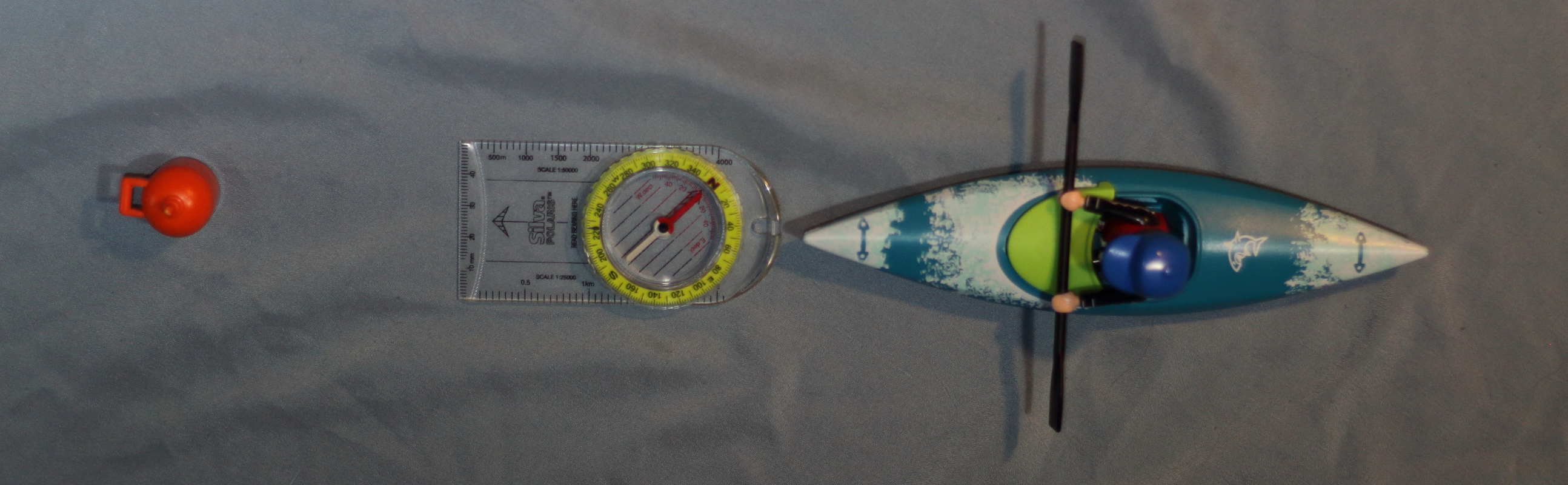
The fleet ready to launch. The Narrows is visible in the distance as the gap between the taller mountain on the left and the much lower hill on the right. Photo courtesy Paul Richards
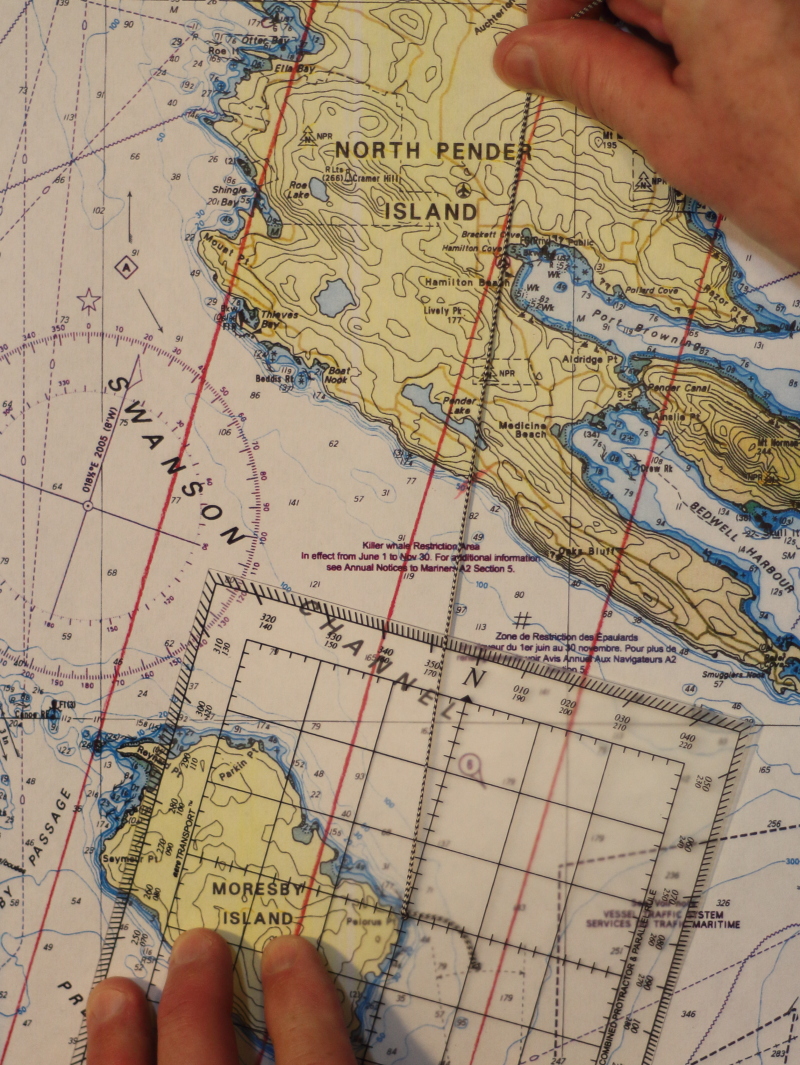
Continue reading

Different Angles On Sea Kayak Compass Navigation

If you’ve done any map/chart and compass navigation at all, you’ve wrestled with the inconvenient truth: with some very limited local exceptions, in most parts of the world, the needle on your compass does not point to the true North pole (the Northern tip of the axis around which the Earth revolves, also known as the geographic North pole); instead, that needle usually points to the magnetic North pole. Sort of. Because what that needle is actually doing is aligning itself with the local magnetic field of the Earth. And those local fields are heavily influenced by currents and counter-currents in the sea of molten iron that swirls far below the Earth’s outer crust.

kayak deck compass with sail reflection
Continue reading

Shoulder season on the Sound: Hotham Sound

Featured

September 30, 2021

During the drive to Earl’s Cove, heavy rain showers coated the winding road with sheets of water a centimeter deep at times. It was uninspiring, but by the time we arrived at the ferry terminal, it had cleared.

As we approached Saltery Bay on our second ferry ride of the day, we could see Freil Falls (AKA Harmony Falls) in the distance off the starboard side. Shortly afterward, the ferry crew announced whales cavorting off the port side. I snapped a couple of photos of the “you can’t quite make it out, but this black blur is a whale” variety.

The Falls in the distance
A humpback whale spyhops in the distance

By the time we’d landed it was late afternoon. Packing the boats for the first time on any trip always involves a couple of hours of faffing about, especially when you have to go park the car several hundred meters from the put-in after offloading. So we opted to car camp at Mermaid Cove that night, and make a single hop, all by daylight, to our intended destination at Elephant Point the next day.

Continue reading