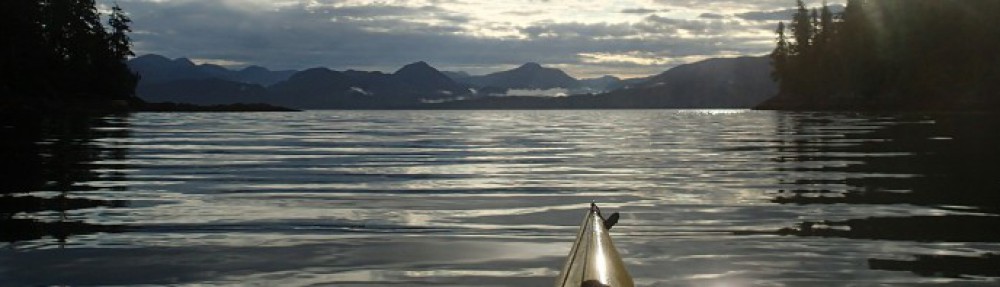
VHF Marine Radio: A Lifeline for Sea Kayakers

a chart showing the Canadian Coast Guard coverage area for DSC equipped marine VHF radios
The DSC system covers most places a sea kayaker would want to go on the BC coast. These antennas are not like cellphone repeater towers: they will let you communicate with the Coast Guard; they will not retransmit your calls to other VHF users. [From https://www.ccg-gcc.gc.ca/publications/mcts-sctm/ramn-arnm/part4-eng.html ]

“Hello? Hello? Is anybody out there?” The call came faintly over my handheld radio, secure in its holster on the shoulder of my PFD. No details on what they were hailing about: was it a life-threatening emergency, were they wanting weather information, or were they simply lonely and thought marine VHF worked like CB radio for casual chats with random strangers? Whatever it was, the only thing they had communicated was that they didn’t know what they were doing. I just had time to hear the Canadian Coast Guard respond before my attention was taken up by one of the guests in the kayak tour group I was leading.

Calls like that underscore why it’s common sense, as well as the law, to get your Restricted Operator’s Certificate, Maritime (usually shortened to ROC [M] and pronounced “rock ’em”) before using a marine radio. It’s not a black art: a few hours of study and a short exam will get you in the game, all ready and legal. It’s just that, as in other fields, a specialized vocabulary and specific protocols allow quick and unambiguous communication. Had that muddled radio user known them, it would have been clear from their first transmission what the nature and purpose of their call was.

But, I hear you ask, why would I, a humble sea kayaker, want a marine VHF in the first place?

Some sea kayakers might feel it’s a bit pretentious to sport a full-fledged marine radio—after all, we’re not large craft. But I’ve always treated sea kayaking as real seafaring, albeit with everything—boats, crossings, crew size—scaled down. So a miniature version of the “big boys’” radio makes perfect sense to me. 

Other paddlers might feel a radio is superfluous: they have their trusty cellphone in a waterproof baggie. And you can indeed reach the Canadian Coast Guard by dialing *16 on your cell. But shockingly, the Coast Guard isn’t always going to have a rescue boat just around the corner from where you are. In many, if not most, cases, they will be getting on their VHF radio to see if there might be a nearby good Samaritan who could help you faster. Putting out a call for help on a marine radio allows you to communicate directly with any “vessels of opportunity”, eliminating the need for the Coast Guard to act as a middleman.

Then there’s also the fact that if you’re voyaging to the remote outer and North coast parts of BC, your particular cellphone carrier might not have coverage in that area. But as long as you’re within radio range, you’ll be able to talk directly to other boats. And thanks to a series of strategically placed antennas on high ground up and down the coast, there are very few areas on the BC coast (except far down some of our deep fjords) where you wouldn’t be able to contact the Coast Guard directly (see map).

As a further bonus, thanks to another network of land-based antennas, you should be able to receive marine weather broadcasts on your VHF weather channels pretty much anywhere on the coast—very handy when you’re off the cellphone grid and can’t access the marine weather website.

A marine VHF is certainly useful for emergencies, but even more useful for preventing emergencies. Some years ago, I was leading a small group of coworkers on a kayak trip from Prevost Island south to Portland Island in the Gulf Islands. Partway through the crossing, a BC ferry appeared out of the western end of Active Pass, en route to Swartz Bay. I knew the late afternoon sun would be reflecting off the water around us and dazzling the eyes of anyone on the ferry’s bridge. So I hailed the ferry on my VHF, gave them our position from my GPS, and herded my fellow paddlers into a tight group so the ferry wouldn’t have to slalom through us. Similarly, when doing a solo crossing of Johnstone Strait, I’ve made contact with a tug towing a barge to clarify its course and intentions and to confirm they were aware of my presence (something not to be taken for granted when you are a very small object in very big waves, and the helmsperson on the tug may be multitasking).  

Even for routine on-water communications, radios are superior to cellphones. Simply pushing a button and talking is a lot faster than dialing and then waiting for the call to go through and be answered. As a kayak guide, I’m often with large groups, working with several colleagues. Any radio call one of us makes is heard by all the other guides—very handy since we’re often doing the marine version of herding cats. Nor do you need to be a pro guide to benefit from these “everyone in the loop” communications: it’s equally useful for club outings, or even when it’s just you and your paddle buddy. 

So now that I’ve hopefully sold you on the idea of getting a ROC (M) and a radio, which radio should you get?

To DSC or not to DSC—that is the major question

DSC, or Digital Selective Calling, is a feature that uses a dedicated channel to let radios sync with one another digitally, and so perform all kinds of cool tricks.

Assuming the party you want to call is also using a DSC radio, and that you know their MMSI (Maritime Mobile Service Identity) or MI (Maritime Identity) number, you can call them directly, without having to hail them first by voice on Channel 16. It looks and feels a lot like calling someone from your list of contacts on a cellphone. (Although, as I caution people in my ROC [M] courses, unlike a cellphone, your conversations aren’t private: anyone who’s tuned into the channel you’re using can hear you.) 

If you do need to put out a call for help, pushing the red DISTRESS button on a DSC VHF will start digitally broadcasting your Mayday, your MMSI/MI number, and your position in latitude and longitude. Any DSC-VHF-equipped boat with its radio on and in range will receive it, as will the Coast Guard (see the coverage map above). Ideally, you’d follow up pushing the DISTRESS button with a voice Mayday on Channel 16, but I’m sure you can imagine scenarios in which all you have time to do is push the red button, then cope with the situation at hand. In such cases, it’s reassuring to know the radio is automatically squawking out your digital Mayday and updated location every few minutes.

Downsides to DSC radios are that they are more expensive to buy and have a shorter battery life due to powering the integrated GPS (though on many models, you can reduce power consumption by slowing down the position update rate).

So do you want a DSC or non-DSC radio? My answer is to get one of each. When paddling or instructing in my home waters of English Bay, Vancouver, I use my non-DSC radio since I’m confident of my ability to give my location clearly in reference to local landmarks. That puts the highest daily wear-and-tear on my less expensive radio. For touring, I carry the more expensive DSC radio for its ability to send out my location accurately when I’m in less familiar waters and/or further offshore.

Most radio manufacturers make the instruction manuals for their products available on their websites. So you can browse the manual for the model you’re considering and see if it has the features you want and if the menu works in a way that makes sense to you.

If you are buying a DSC VHF, you’ll need an MMSI or MI number to activate the DSC features. Industry Canada will only issue those for radio models that have been IC-approved. Plus, radios for use here need to have the appropriate CAN, USA, and INTERNATIONAL operating modes. So while it’s OK to order radios online, it’s best to do so from stores that have a bricks-and-mortar presence in Canada so you can be sure their products are ready for use here. I had a student in one of my ROC (M) classes who’d ordered a DSC handheld from one of those mysterious overseas sites. It arrived without IC approval or the proper mode functionality, so they wasted their money. (A note to American readers: please adjust the above info for your country. And if you’re paddling in Canadian waters, your radio will need to have a CAN mode for you to talk to users here. This has to do with channel frequencies and simplex-duplex channels.)

Waterproof…ish

Almost all handheld marine VHFs are advertised as being “waterproof”. But that seems to mean something less demanding to ordinary boaters than to kayakers. The typical use for a handheld might be on the decks of a larger boat in the rain, or perhaps in a dinghy on trips away from the mothership. The worst case scenario there might be the dinghy pilot dropping the radio in a few inches of bilge water for ten seconds. But if a kayaker has to do a wet exit with their VHF in a PFD pocket, the radio gets pushed several feet below sea level during the ejection phase, and might remain a foot or more underwater for a long time if reboarding is difficult or impossible. 

Waterproofness is measured on an IP scale. IP7 is the minimum for a sea kayaker; IP8 would be great if you find such a radio with all the other features you’d like.

There are custom-made waterproof radio baggies available, but I find them awkward. They make it tough to see the screen and a battle to operate the controls. As a final insult, the baggie clips often prevent the radios from fitting in PFD pockets.  So I carry my radio naked and accept that the price of greater accessibility is that it will eventually die from saltwater exposure (usually just after the two or three-year warranty has expired). 

Keeping your handheld at hand

Some paddlers carry their radios under their deck bungees or in the glove compartment hatch on the front deck. I’m not a fan of either: if you became separated from your boat after a wet exit in big waves and high winds, that’s when you might most want a VHF. 

Because I’m routinely transmitting with my radio, I like having a radio pocket or case on my PFD shoulder that lets me quick-draw and quick-reholster. It baffles me that many sea kayaking PFDs don’t come with radio-specific pockets with pass-throughs for antennas. And that a certain kayak personal equipment company, whose products are otherwise intelligently designed, persists in putting the radio pocket on some of their PFDs dead centre at the waist front where: 1. The antenna is perfectly positioned to go up your nose; 2. If you’re swimming, both the radio speaker and antenna are underwater; and 3. The radio is subject to maximum crushing force under your body as you slide along the back deck after a seal flop or heel hook re-entry.
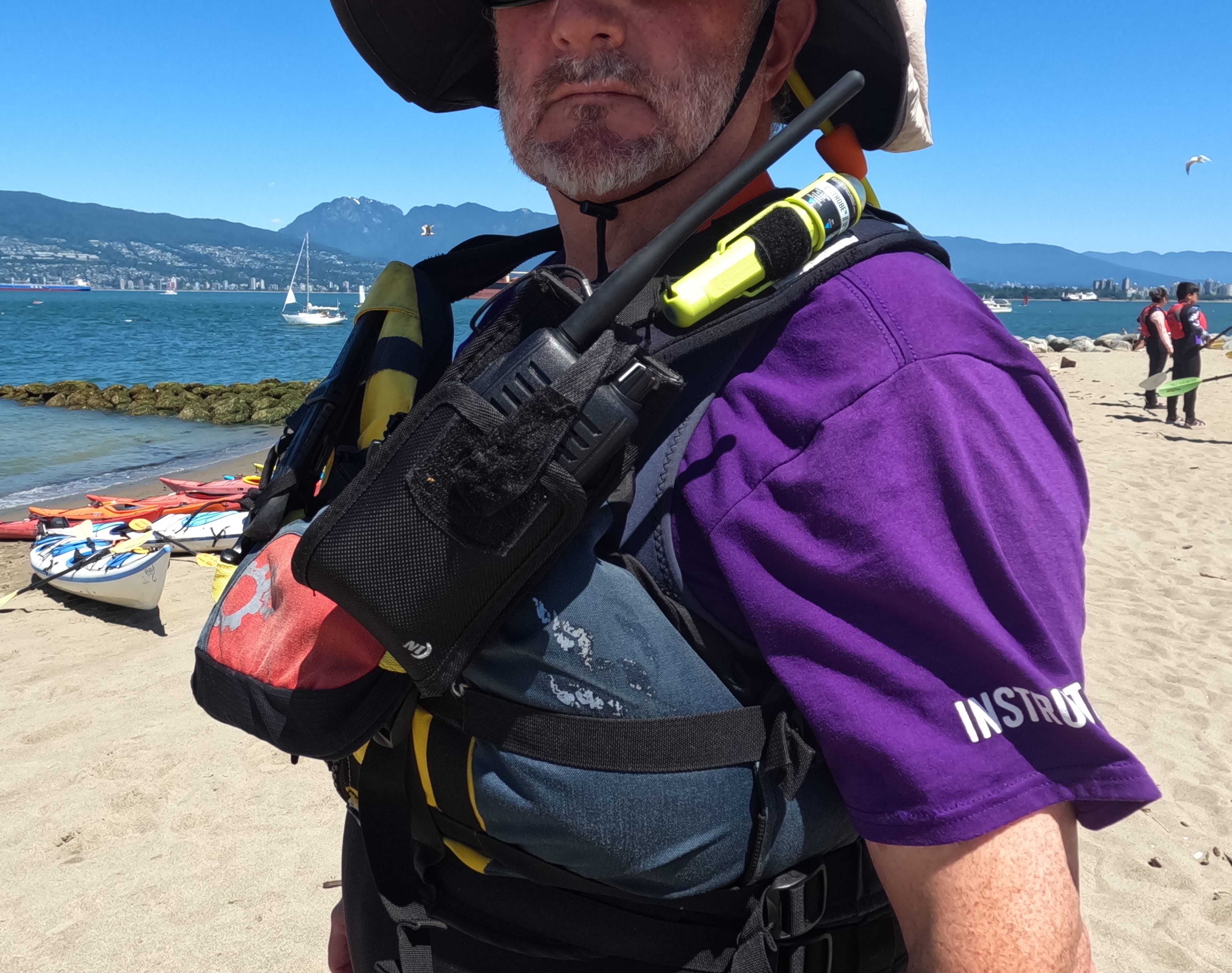
a photo of a holster for a marine VHF radio, mounted on a sea kayaking PFD

My current radio holding hack is a Nite Ize cargo holster, with the top flap cut away for antenna clearance, and a dollar-store hook-and-loop strap sewn on that can be released or secured one-handed. It stretches to fit either my DSC or non-DSC radio snugly, and the rotating back clip secures easily to the shoulder strap of my PFD. I like having the radio, especially the antenna, at least mostly above water in its holster in case I dump, especially if I’ve pushed the DISTRESS button and need the radio to be automatically calling for help while I thrash for shore or cling to my upturned boat.

But if you’re not constantly transmitting with the radio, the removable belt clip that comes with it should be fine for clipping to the webbing or somewhere on your PFD. Whatever system you use, add a lanyard and hook to prevent losing the radio if it should slip from your hands. I prefer the Scotty nylon snap hook over metal carabiners since it won’t rust or bang destructively against my radio.     

A part of many layers

If you’re familiar with the Swiss-cheese model of accident causation, you know that the more layers of equipment and/or skill-based defences you have, the more opportunities there are to break the chain that can lead to catastrophe. A VHF radio can be part of many of those defences: in the outer layers, it lets you access marine weather reports that help you make go/no-go decisions; in the middle layers, it lets you communicate with kayakers and other boaters to prevent confusion; and in the inner layers it lets you call for help if all else fails.

In more than three decades of carrying handheld VHFs for sea kayaking, I have never needed to send a full-on Mayday call. And I couldn’t be happier about that. But I’m also very happy to know that if the need should ever arise, I have both a radio and the knowledge to use it effectively. I think you should, too!

Philip Torrens is a long-time sea kayaker. He instructs on-water, onshore, and online classes for Jericho Beach Kayak, including the course to get your ROC (M). He’s the majority owner of WestCoast Paddler, an online community for kayakers. He also blogs about kayak trips and techniques at https://philiptorrens.com/

Crossposted from https://www.bcmarinetrails.org/vhf-marine-radio-a-lifeline-for-sea-kayakers/.

WestCoastPaddler meet-up

Prologue: Back in the day, all the available members of Westcoastpaddler used to have an annual meet-up on Portland Island on the last weekend of April. What with COVID and one thing and another, it had been years since this had happened. So as co-owner of WCP, I was very excited when we decided to renew the tradition this year.
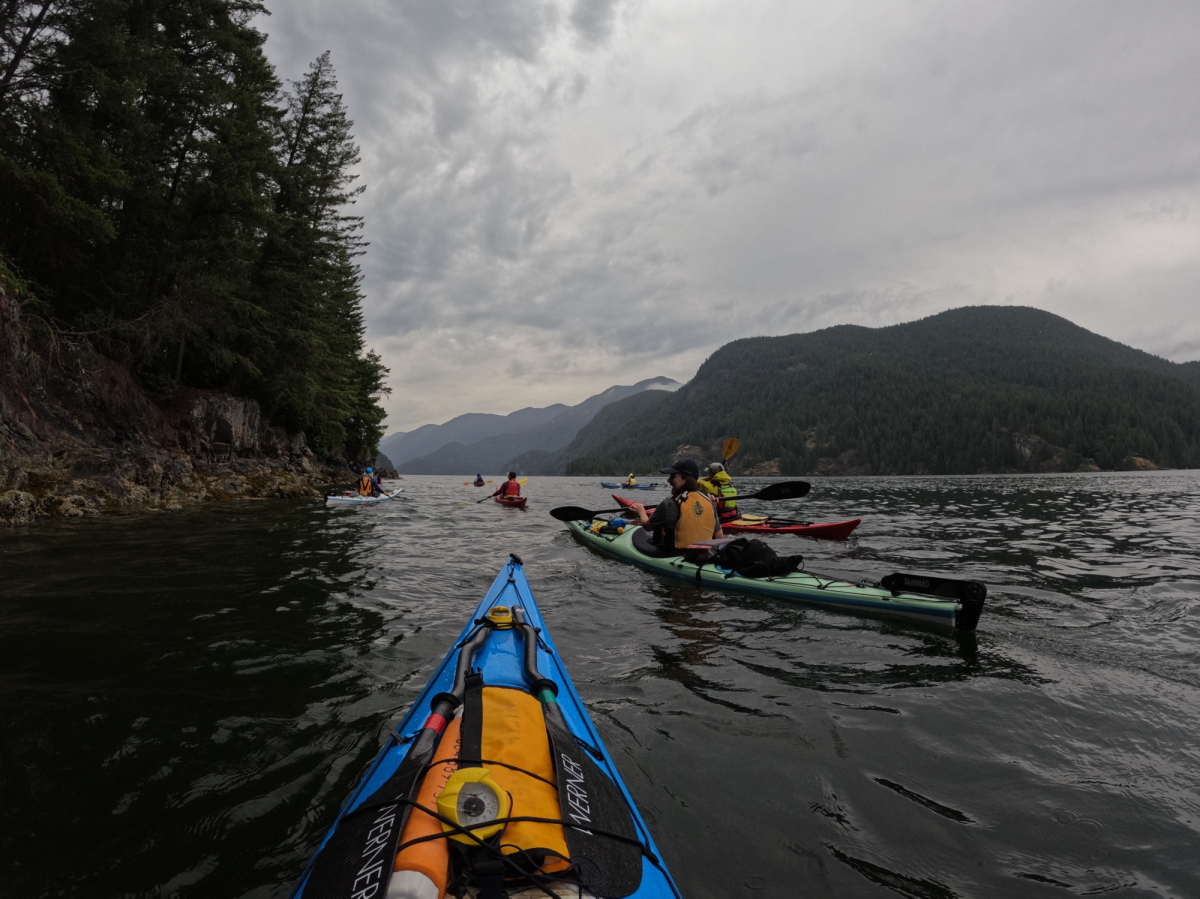
April 25, 2025

I drove into the long term parking at Tsawwassen ferry terminal shortly after 9AM. It might have seemed ridiculously early for an 11AM sailing, but I like to have time in hand to deal with curveball crises. Which proved to be a good idea: as I pulled my kayak cart wheels out, I was hit by a letdown feeling: both tires were so flaccid that they’d have rolled right off the rims under the load of my kayak and the weekend’s cargo. After a frantic few moments, I remembered I had an electric pump for my car tires in the back – and fortunately the valve fitting was also right for the kayak wheels. With the tires once again fully tumescent, I heaved the boat on the cart, and the cargo into the boat.

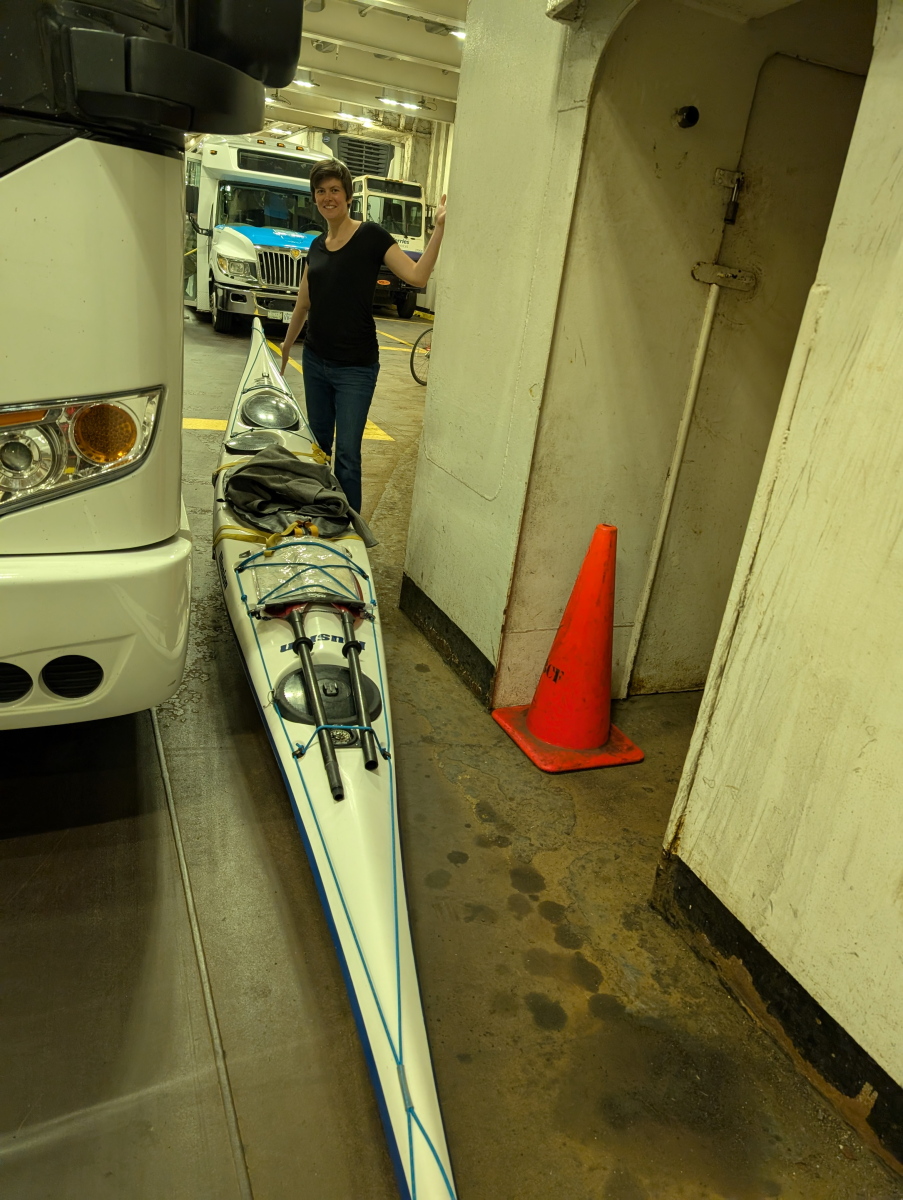
Wheeling up to the foot passenger wicket, I spotted a beautiful skeg kayak on a much more compact cart. And soon found Alana in the line up. We brunched on burgers on the ferry and compared notes. At Swartz Bay, Alana wheeled off towards the public dock to launch; I rolled over to the ferry to Fulford Harbour.

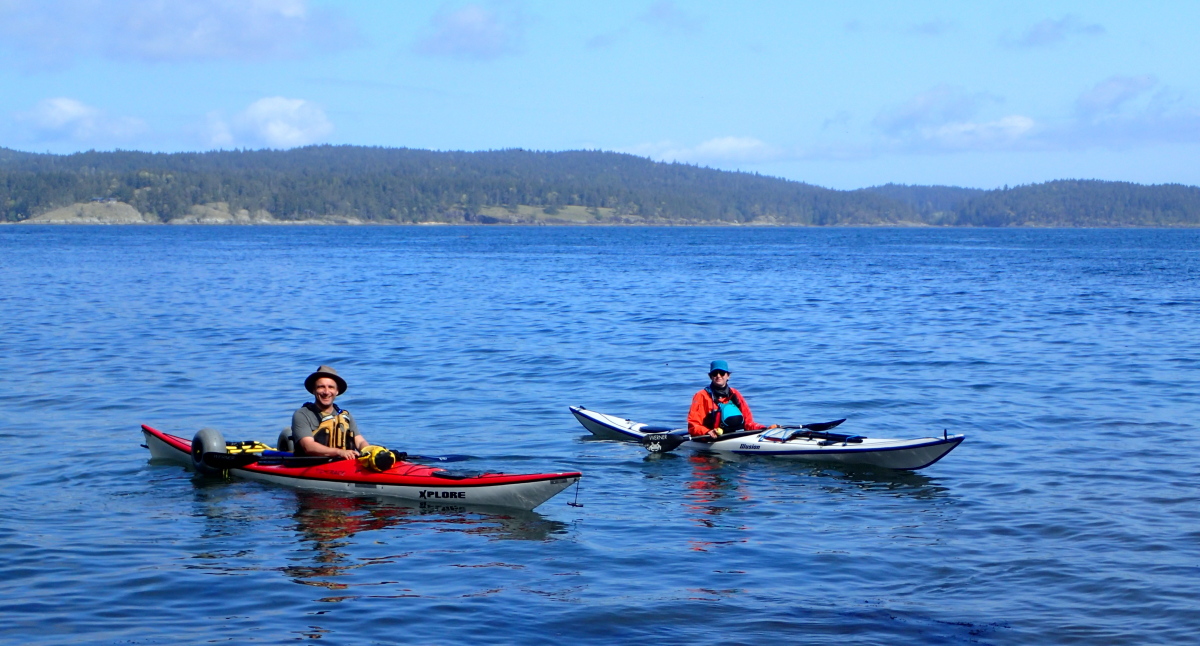
My cunning plan was to put in at Fulford Harbour, supposedly upwind from Arbutus Point based on the forecast, raise my kayak sail and glide effortlessly down to camp. Like many cunning plans, it hit several snags. Firstly as I launched, I discovered the metal bracket guiding the rudder lift/lower line had broken off, so I couldn’t raise or lower the rudder from the cockpit. But that was rather a moot point since (secondly) as soon as I put my feet on the foot pedals, the swaged copper stopper holding the right rudder cable end popped off. So I had no steering anyway for my non-deployable rudder. Fortunately, I’d upgraded the foot pegs from the “slidey” type that were OEM for a vintage boat like mine to the gas pedal ones that stay in place even with broken cables. So I could still brace properly in the boat. But it did mean that if I were sailing, it would require a lot of nimble work with my paddle to steer, because no rudder. But that issue went away as I discovered (thirdly) that the wind was SE rather than the promised NW. No sailing for me. Reduced to paddling – the horror! The horror!

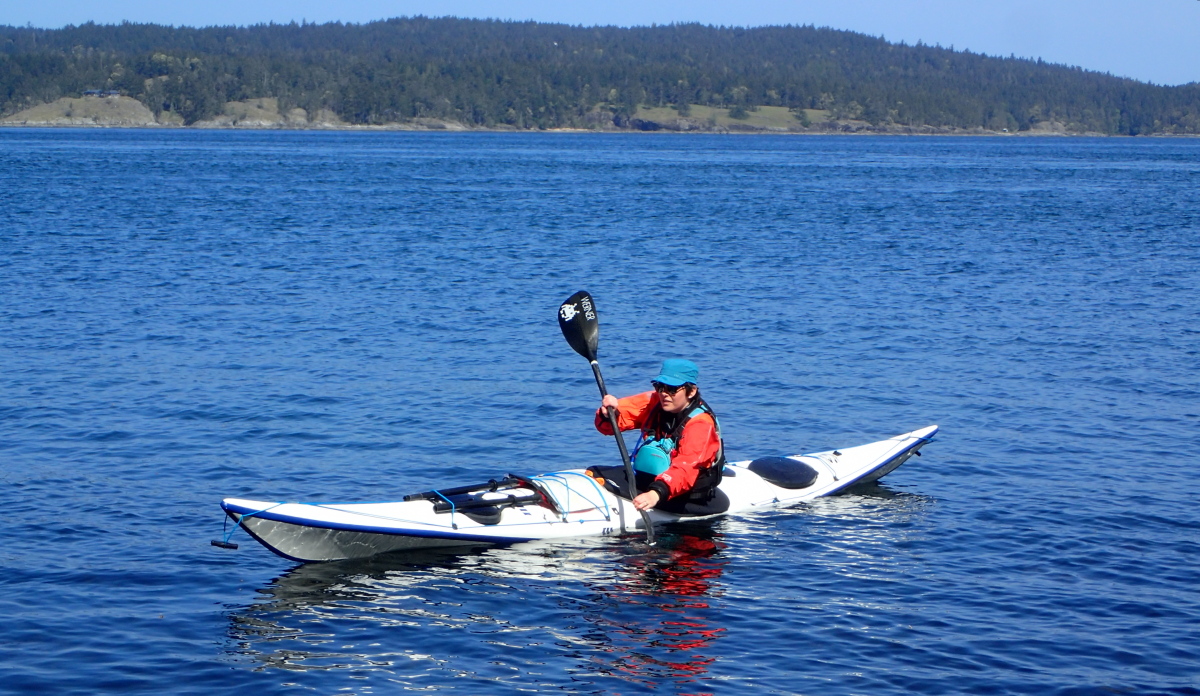
Still the sun sparkled on the bright blue sea, and I had a very pleasant crossing, threading through the shallows on the north side of Russell Island, over the white shell bottom.

Otter in the water.
Russel Island on the horizon, with Portland Island visible behind.

With no rudder in the water, the Expedition kayak had a tendency to weathercock once I was out in the main channel. But that wasn’t entirely bad, as I needed to ferry between 30 and 40 degrees to windward to counter the downwind drift. (I was detecting and correcting for drift by using the tip of Arbutus Point and the high flat peak of Moresby Island behind it as a range.)   

After a couple of happy hours, I arrived off Arbutus Point to find, as expected, Alana was already in residence. Based on previous soggy experience, I lurked offshore while the wake from a recently passed BC ferry dissipated. (Surf landings in loaded boats are rather too exciting.) 

There were a few other kayaks already on the beach, but none of their owners were here for the WCP meeting – or even knew what it was! So Alana and I supped together with our respective meals, and hit our tents fairly early as it was cool and buggy.

Night, night.

It was while I was seated on the edge of my sleeping pad, writing up my journal, that the first foreshadowing of a restless night emerged: with a muffled twang, one of the internal battens in the pad parted. A small hillock now bulged up out of the formerly featureless plain of the pad. Oh, well, not too bad, right? Wrong. As I lay abed, there occurred a slow but relentless progressive failure as each torn batten put more load on its neighbour, leading it to tear in turn. My mat transformed itself first into a sort of half-inflated life raft—with my feet at the high end and my head on the ground, naturally—and then finally into a pneumatic log. After an indeterminate period of trying to drape myself over this squashy cylinder and being regularly bucked off just as I dozed off, I gave up, deflated the mat, and slid a spare fleece top between my body and the ground. But it wasn’t like the venerable pad owed me anything: it was more than a dozen years old, and the cozy companion of many a night. 

April 26, 2025

Over my breakfast of tinned hash and fruit cocktail, I discovered a third WCPer had infiltrated Arbutus Point under cover of darkness last night, and slept commando-style beneath the stars. (Many of you will know Alex from the amazing adventures and photography he has shared over the years at Alexsidles and on Westcoast Paddler.)  

Alex on the water

Later in the morning, Alana and Alex decided to join a pair of the other paddlers (Liam and Jane, also kayak guides as it turned out) on a quest for homemade ice cream in Fulford Harbour. 

I had a bit of cutting and chafing under my left arm (later determined to be caused by the very deep cockpit and high seatback of the Expedition kayak pushing my PFD higher up my body than in my other kayaks, and rubbing the lower edge of the arm hole against my armpit. I have an alternate PFD with a shorter torso I’ll use on future trips with the Expedition.) Plus, I wanted to see if I could fix the rudder lines and cable on my boat. So I puttered happily on the beach as the others paddled off. 

First, I improvised a guide for the rudder raising and lowering line by running it through the tent pole repair sleeve from my repair kit and duct taping that to the V-cradle for the previous rudder on the back deck. With the tape looped right around and under the hull, it was pretty fugly. But functional.

How to hack a line guide.

Next, after a bit of hesitation, I dismounted the right pedal and housing from the hull, then completely disassembled it in order to rethread the cable through it. I worked as carefully as any surgeon to ensure I didn’t drop any of the nuts, bolts or screws into the concealing sand. By adjusting the loop where the cable runs around the tiller at the rudder, I freed up some slack at the foot pedal end, which I then tied into a figure 8 stopper knot to replace the missing swaged copper stopper.    

I was just congratulating myself on the success of these field repairs when the Fulford Harbour Foursome hove back into view on the horizon. Per an earlier promise, I donned my drysuit and waded into the shallows with my GoPro to video Alana working through her rolls and static braces. I congratulated her on pulling off rolls better in quality and variety while in her first trimester than I ever could while non-pregnant. “Second trimester” she casually corrected me. Which of course made me feel much more adequate. 

Alana on the water.

As Alana was changing into her shore wear, a lone kayaker appeared. This proved to be Mick, which was a welcome surprise as I’d originally expected him to be there on the Thursday and leaving on the Friday, so we thought we’d missed him. So now we were four WCPers.

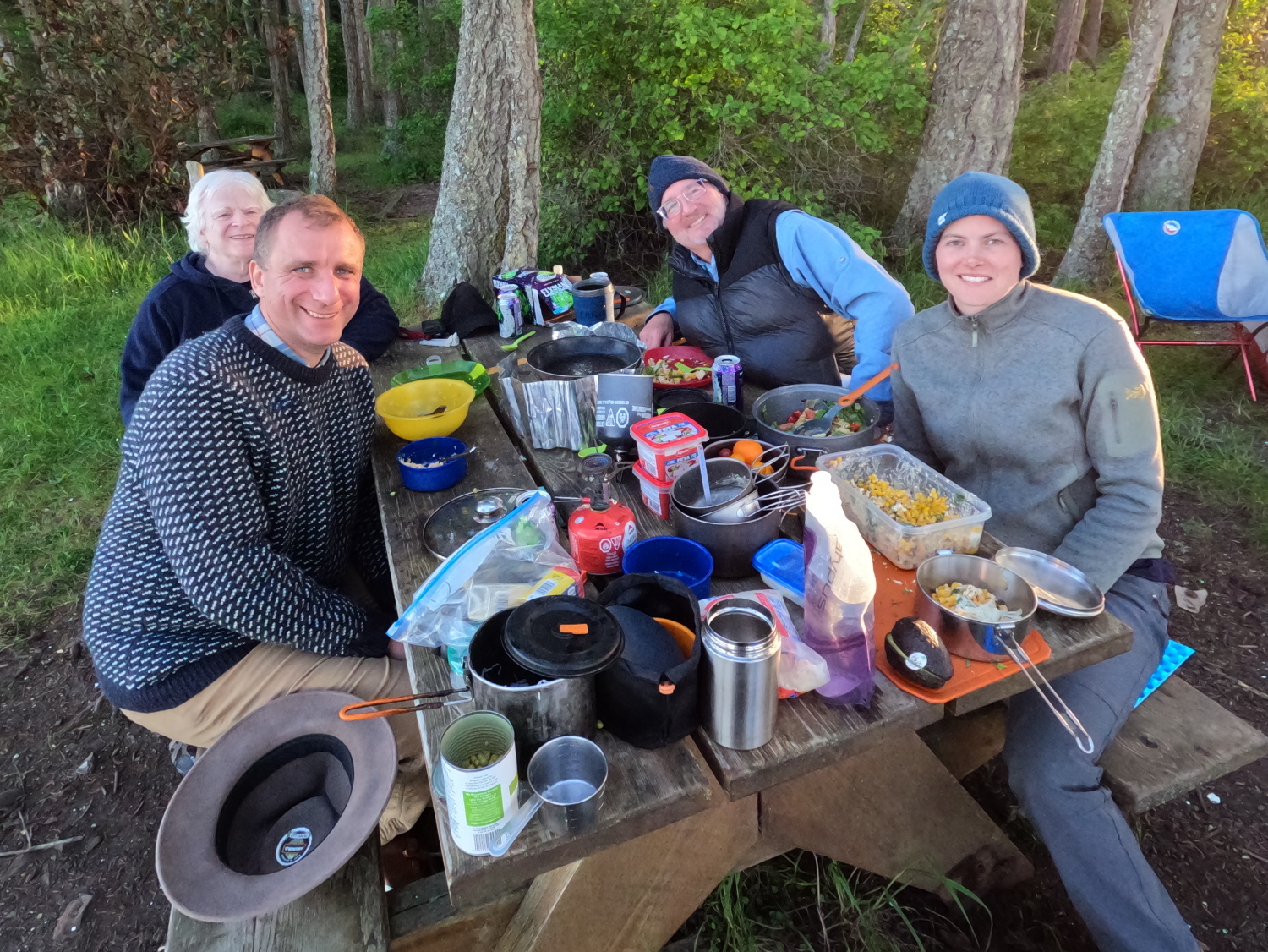
It turned out Mick had managed to leave the bag with his intended dish for the potluck at home. And that turned out to be a good thing. Because with just my veggie pasta dish, Alana’s corn salad and Alex’s zingy tofu offering, we had so much surplus that we had to accost our neighbours Liam and Jane and foist food upon them – not just for supper, but also leftovers for their lunch the next day!

Saturday night supper!

Armed with my carefully sun-dried sprayskirt as an improvised sleeping mat, I slept much more comfortably than last night.

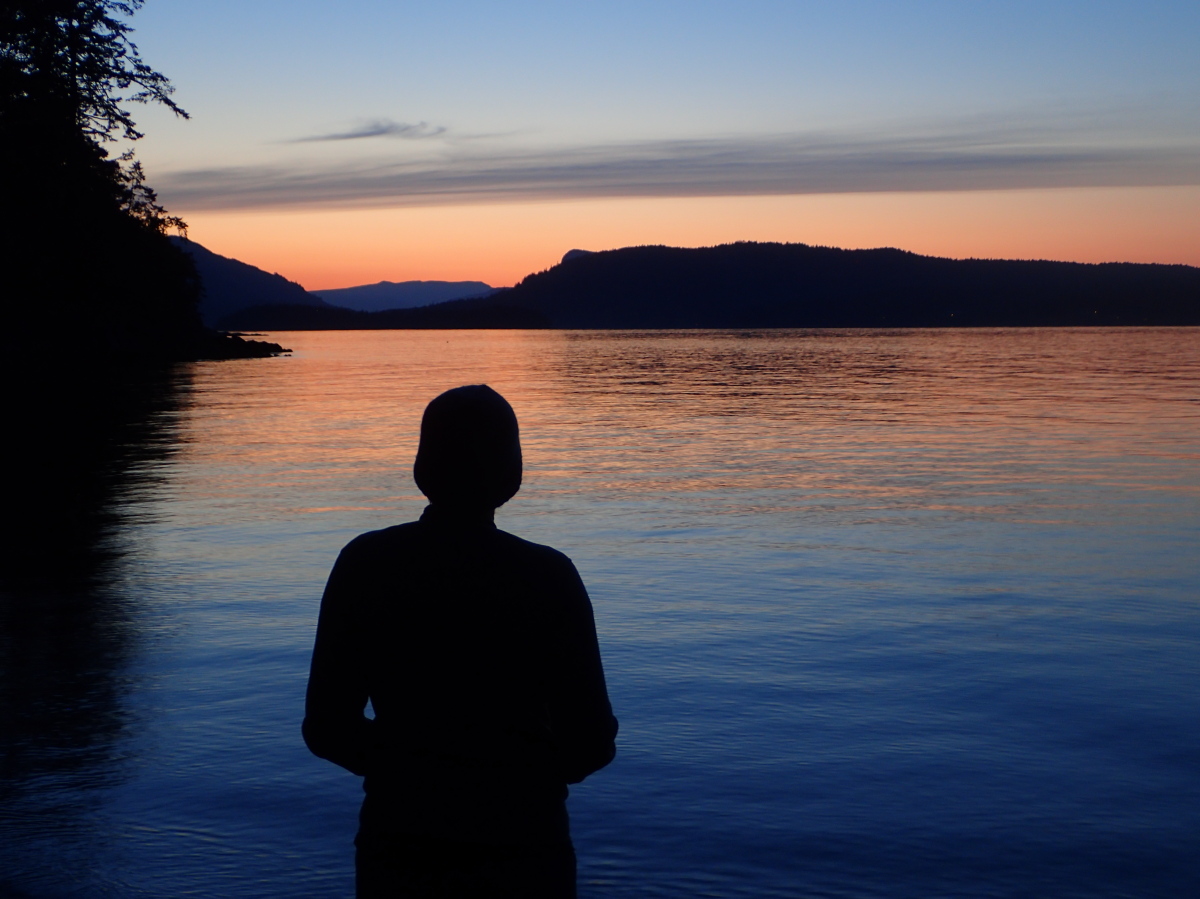
Sunset over Saltspring Island

April 27, 2025

Over breakfast and coffee, I chatted with Mick and Alex. It turns out we all three share an interest in traditional Polynesian and Micronesian methods of ocean navigation, so the conversation flowed freely.

Alex and Alana launched together about mid-morning for Swartz Bay. Mick was staying another night, so I bid him adieu as I launched shortly before noon.

Alex and Alana set off.

I had to paddle only a few hundred metres to escape the lee of Portland Island before I was able to hoist the sail. (I was so glad to have invested the time to fix the rudder and foot peg cable!) At first I was merely ghosting along, but the wind and my speed increased as I went. Once I’d opened the mouth of Fulford Harbour, I could have sailed in a straight shot down to the public wharf and ferry dock. But I was having far Too Much Fun, so instead I zigzagged downwind in a series of ever-speedier broad reaches.

Fair bids the wind for Fulford Harbour!

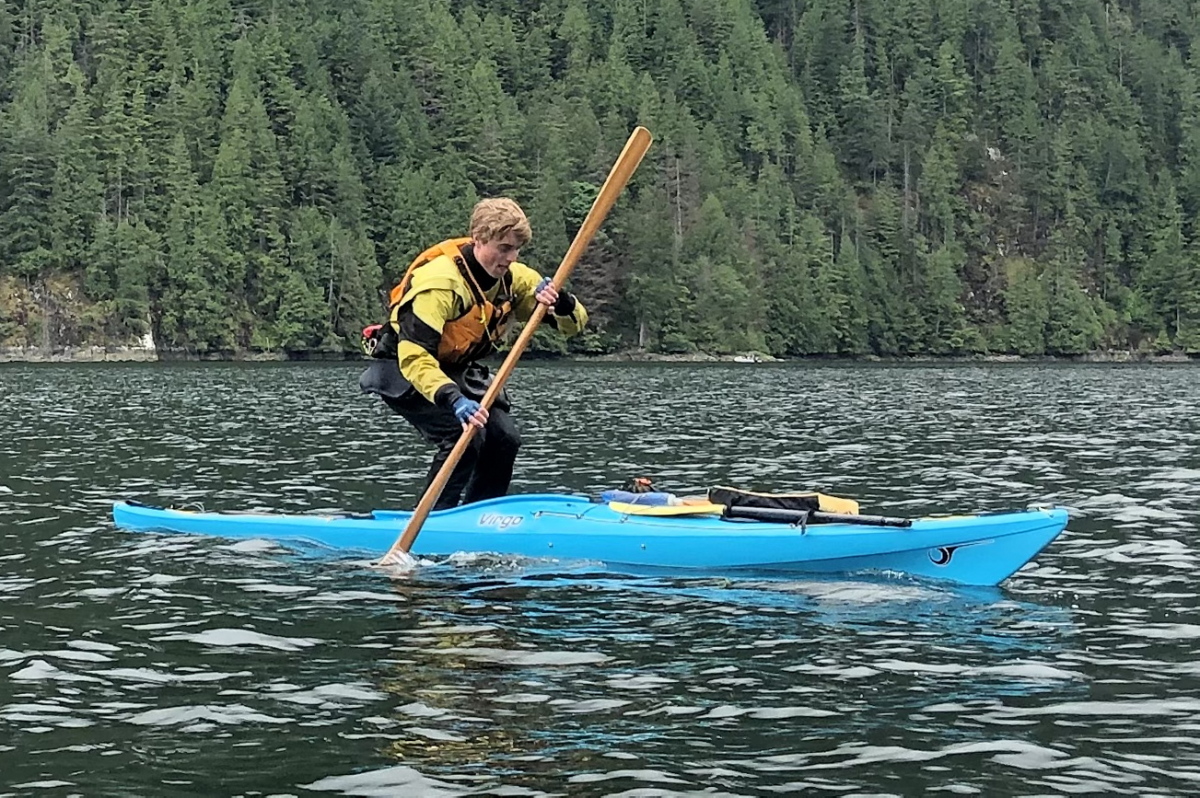
I got some good video clips, but no footage of the most exciting sailing since my hands were literally full. As the wind sped up between the contracting hills at the far end of Fulford Harbour, I had to lean to the windward side of the kayak (the paddler’s equivalent of the sailor’s hiking out). As I’ve done before in high winds, I also lay my paddle on the water on the windward side in what I call a flying brace: with the leading (forward) edge of the blade angled slightly upward, the blade is continually lifted by the forward motion of the boat as it would be during a sweep brace, so the paddle becomes a hydrofoil outrigger I can lean aggressively down on if a gust threatens to capsize me to leeward.

I stopped to furl the sail a hundred or so metres upwind of the public wharf, so I’d have had some searoom to sort things out if they’d gone sideways. But fortunately for my pride, all went smoothly.

I pulled alongside the public wharf about 1:15PM. Even with an unhurried remount of the boat onto the wheels, portaging the cargo separately up the dock ramp, then reloading the boat, I was able to stroll on the 1:50 ferry just behind the last car, as if the ferry had been my own personal transportation just waiting for me before departing.

Farewell to Fulford Harbour – for now.

Great to have relaunched the get-together tradition. Hoping more WCPers can join us next year.


Rooms With A View: The Basics Of Tarpology

Featured

If you’re sea kayak touring in British Columbia, and out for any length of time, it’s not a matter of if it will rain, but when it will rain. They don’t call it “The Wet Coast” for nothing. In such Noahscape situations, being able to rig a secure kitchen-dining shelter is essential to ward off both cold and cabin fever.   

Showing a camp tarp rigged in an A-frame configuration
The classic A-frame bungalow roof tarp configuration, with an end pole improvised from driftwood.
Read more: Rooms With A View: The Basics Of Tarpology

Materials

If you only camp very occasionally, even the basic “plastic” tarps from your local Crappy Tire or Home Depot will suffice. They will be bulky and not terribly durable — though pinholes are easily fixed with duct tape. Please don’t let their semi-disposable price point tempt you to abandon them in the field at the end of your trip. Blue is the most commonly available colour, but if you can find orange, it provides a more cheery ceiling in the rain (this is true of all tarps: yellow and orange fabrics create a gloom-dispelling faux-sunlit vibe even on cloudy days.)

Polyester (PU) coated fabric tarps are more durable and compact, and, predictably, more expensive.

The most compact of all tarps are made with silicone-coated fabrics. (I fondly remember field-testing a prototype tarp for my erstwhile outdoor retailer employer decades back, before silicone fabrics were common. I wound up sharing a backcountry campsite with a friendly father and son. Their astonishment when I conjured an 8’ x 10’ tarp out of a soda-can sized stuffsack was as if I had produced not a rabbit, but an elephant, out of a hat.)
Silicone fabrics are also highly stuffable, saving a lot of time with folding and rolling.

Shapes

Several companies make cunningly-tailored wing tarps. I’ve owned a couple and really loved the catenary-cut, sag-defeating ridgeline and the assured-drainage scalloped edges. I was less enamored of the single set-up option. Particularly at improvised sites deep in the backcountry, vegetation often rudely insists on growing exactly where you need the edges of the wing to be. So these days, I carry rectangular or square tarps. They take a bit more rigor in rigging to prevent pooling water, but are more adaptable to cramped and oddly-shaped sites. 

Lines

When it comes to rope, the rule is: it’s hard to have too much. I typically carry at least a couple of hundred feet of paracord, in hanks of about 20 feet. The more line you have, the more options you have for set-up. By splicing one hank to another with a square knot, you can anchor lines to remote branches, trunks and roots. 

Showing a tarp rigged with very long lines, anchored to rock and trees up to a hundred feet away.
Playing the long (line) game. Having plenty of cord lets you float your tarp pretty much wherever you want it, even when natural anchor points are not nearby.

Brightly coloured lines will reduce stumbles and self-strangulation as you walk under and out from your roof. You can even buy reflective cord, which shows up beautifully in headlamps, and makes an excellent navigation beacon if you’ve wandered far into the bush to answer nature’s call at night.

Rigging Your Roof

If you’re setting up the classic A-frame bungalow roof configuration, you typically start by rigging the two high points that will form the ends of the tarp’s ridge, then adding the side and corner lines. 

Some folks like to do this by rigging a literal ridgeline —  a thicker rope running between two trees and/or poles. Next, they drape the tarp over this line, and use short lengths of cord wrapped in prusik knots (see below) around the ridgeline and secured to tabs or grommets on the tarp to stretch it along the ridgeline. This creates a very strong structure, but with the downside that the ridgeline rope chafing against the tarp may eventually wear the waterproof coating and/or the fabric itself to the point that it leaks. And dead centre of your roof ain’t a great place for leaks. 

Showing the A-frame configuration of a tarp without the use of poles
Look mah! No poles! The classic A-frame roof made by suspension only.

So for chafety reasons, I usually opt to simply stretch out the two attachment points at either end of the tarp’s centreline, letting the tensioned fabric itself create the ridge. Separate-ridgeline-rope enthusiasts will sneer that this stresses the fabric of the tarp more and is a weaker structure in wind. They are not wrong. But, tocca ferro, in decades of touring, I haven’t had a tarp tear yet. This might be because I retire my tarps (or demote them to “windbreaks only” duty) once the waterproofing has worn out, and this typically occurs long before the fabric itself is brittle. 

If you’re at a site that doesn’t accommodate retangular, symmetrical roof sides, think outside the box: make the diagonally opposite tarp corners the ends of your ridge, so the sloped sides become asymmetrical triangles that can poke between barricading trees and bushes.     

Showing a tarp rigged with an interior pole.
The high centre(ish) point setup. The tip of the pole is covered with a stuffsack to reduce chafe on the tarp.

Another classic tarp configuration is the high centre point, with the sides sloping down to form a shallow (and not necessarily symmetrical) pyramid. You can raise that centre point from the inside or the outside. From the inside, it’s via a pole of some kind, store-bought or improvised from driftwood. Either way, the tip where the pole makes contact with the tarp fabric should be condomized with a stuffsack to reduce chafe.

showing a kitchen tarp rigged with a centre pole made from a driftwood log
A driftwood log, upended and with the low end buried deep in the sand, makes a secure centre pole for this cozy camp kitchen.

Raising the centre point from the outside maximizes usable interior space. If there’s a cooperatively placed branch above the tarp site, just sling a line over it, tie it off to the topside tarp tab, then hoist the far end of the line and tie it off to a tree trunk or branch. (Your D.O.T. mandated “buoyant heaving line” works a treat for this.) 

a tarp suspended pyramid-style over the vestibules of two tents.
Centre-suspended pyramid configuration. Hanging from an overhead branch, this tarp forms a rain-free “mud room” for both tents.

If there’s no handy overhead branch, run a line from tree to tree above the tarp, then attach a prusik knot to this line and hence to the topside tab. This way, you’ll be able to slide the attachment point along the high line to fine-tune the tarp’s position. 

The blue line runs above this tarp from tree to tree. It’s connected to the topside tarp anchor point with a short, separate piece of cord wrapped into a prusik knot.

At breezy kitchen sites, you’ll want to rig the tarp as a combination windbreak and roof, with one edge at ground level. This will block wind-blown rain and keep gusts from wicking heat away from you and your camp stove. Some folks just rig their tarp as a simple lean-to, but these flat surfaces are prone to inverting into a sail when hit by strong wind. So I prefer to do a sort of pyramid tilted on one side. With the tip of the pyramid pointed into the wind and anchored securely, the tarp is much more aerodynamic and wind shedding.

Showing a tarp rigged as a leanto windbreak.
The “tilted pyramid” windbreak configuration. On the outside of the black patch above my head, a line runs to the tree branch beyond, preventing the tarp from inverting when wind hits the far side.

Though I do carry a few pegs for my tarp lines, I generally prefer to tie the lines off to tree branches, driftwood logs or roots. Natural anchors are usually more secure than pegs.

To minimize wrinkles and maximize drainage, try to run the lines from the side of your tarp as close as possible to 90 degrees away from the centre ridgeline, and corner lines out at roughly 45 degrees. Where lack of anchor points or the presence of obstacles prevents running a single line at the optimum angle, attach two lines to a single tab or grommet, run them out to whatever anchors are available, and tension them differentially to rid the tarp of ruckles.

As anyone who’s ever schlepped even a 5-litre waterbag knows, it doesn’t take a vast volume of water to be seriously heavy. So you want to ensure your tarp setup won’t trap large rainpools, lest there be rending of fabric and gnashing of teeth. Preventing pooling isn’t always a matter of going higher with your tarp lines or steeper with your tarp slopes. Sometimes it’s as simple as creating drainage valleys at the lower edges of your tarp. Do this by suspending a light weight, such as a water bottle, stuff sack with pebbles, or small piece of driftwood from one of the grommets or tabs.   

Knots

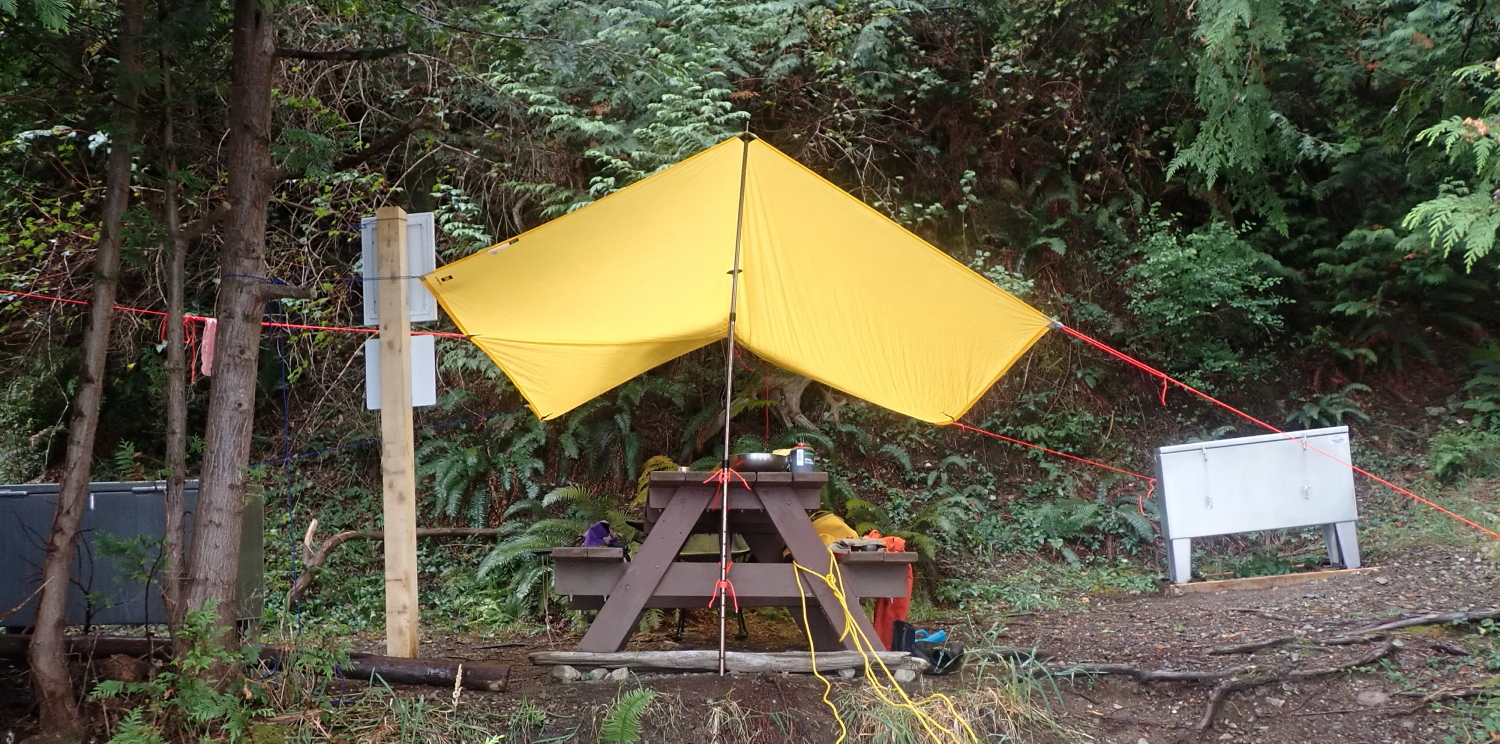
I have a pretty basic repertoire of knots that I mix-n-match as needed for rigging. The trucker’s hitch lets you apply a lot of tension to a line easily, so I tend to use it for the ends of the ridge attachment points, or for a tree-to-tree line that I’m going use a prusik hitch to suspend the topside attachment point from to form a high centre point pyramid. For the side or corner lines a tautline hitch usually provides enough tension. A simple square knot is great for splicing lines together to extend your anchor options. In the photo below, I used a pair of Japanese square lashings to secure the tarp pole vertically against the end of the picnic table. You can also use a square lashing to attach the ends of driftwood poles together to form an A-frame for one end of your tarp. 

Poles

If you can find one of suitable size on site, driftwood poles are an excellent option: they’re free, fully biodegradable, and take up no room in your boat. That said, I often carry at least one tarp pole for convenience and assurance I’ll have the right pole for my needs. I find the fully-telescoping type is easy to stow against the keel line of my kayak, but its minimum collapsed length is a few feet. If you have tighter hatches, you might need poles that fold tent pole style to fit through them.  

Tarps For Tents

Even if your tent’s fly is reliably waterproof, there are several reasons you might want an over tarp for it, especially on extended tours in persistent rain: 

Firstly, it’s wonderful to have a dry porch roof/mudroom where you can stand up to doff and don wetwear without getting the tent interior soggy. 

Secondly, in seriously heavy rain–the sort that hammers down in dollops rather than drops–bedtime in an unshielded tent can be like trying to sleep inside a drum at a heavy-metal concert. Intercepting the rain a foot or two above the fly dials down the din from crazy-making to practically cozy. 

Thirdly, like me, you may well be fond of breathing right through the night. Each of your hundreds of exhalations contains water vapour. The cooler and wetter your tent fly is on the outside, the more of that breath vapour will condense against its inside. Wet begets wet. In a really prolonged rain in cooler weather, so much breath moisture can condense against a fly’s interior that it looks–and feels–as though the fly is leaking. By keeping the outside of the fly dryer, an over tarp will vastly reduce this effect.  

Finally, by rigging the over tarp first and taking it down last, you can set up and pack up your tent out of the rain, and keep the interior canopy dry. Or at least dryish.        

Midwinter Paddling: to the Pasley Islands in Howe Sound, BC

Featured

January 21, 2024

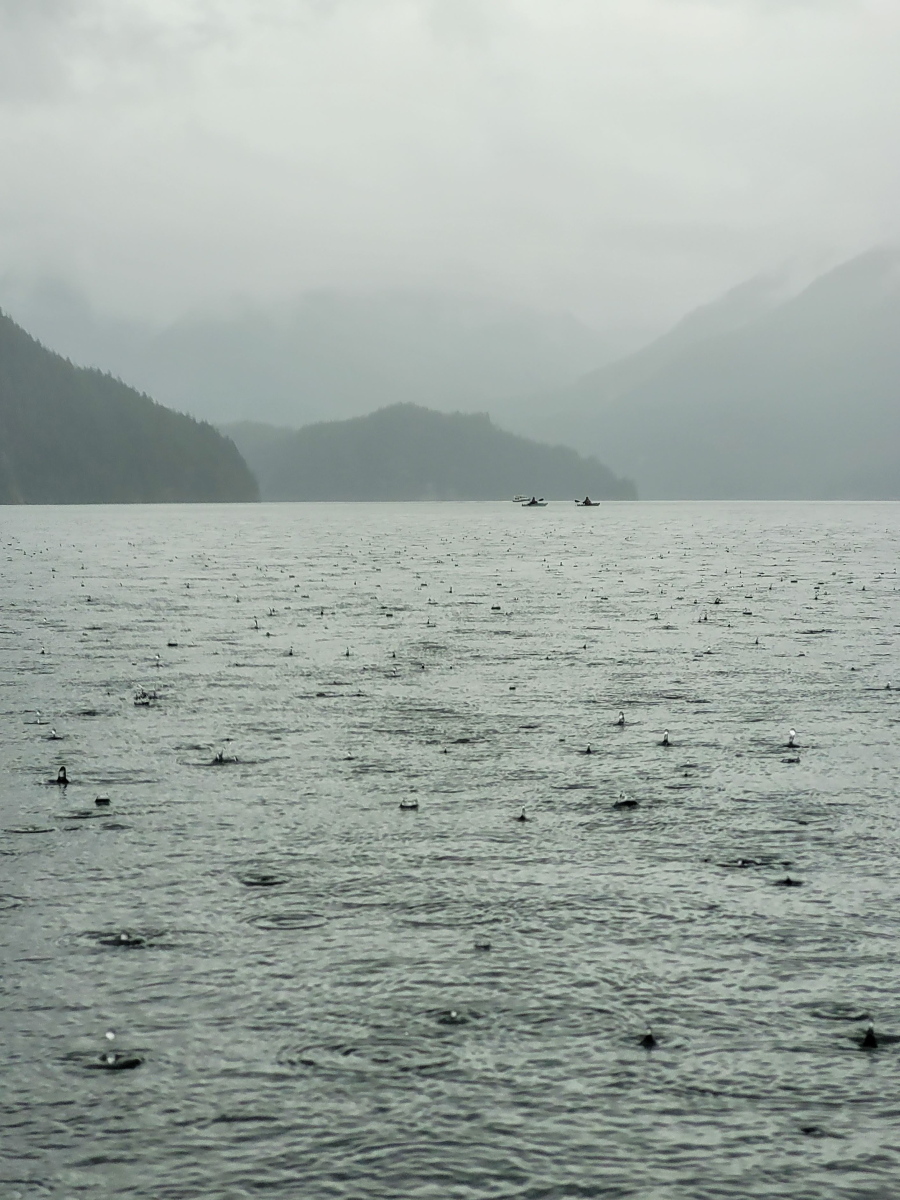
The relentless icy rain this Sunday morning was pretty uninspiring. But we thirteen Jericho Beach Kayak guides had committed to a group daytrip weeks before. So we had a certain professional pride (plus a gender-neutral machismo) that dissuaded any of us from chickening out in front of our peers.

We waded through a small ice-water lake in front of the Jericho Beach Kayak hut to schlep the boats out to the roof racks waiting on our vehicles (the prudent—or at least the so-equipped—of us had heeded EJ’s suggestion to bring boots for this portage.)

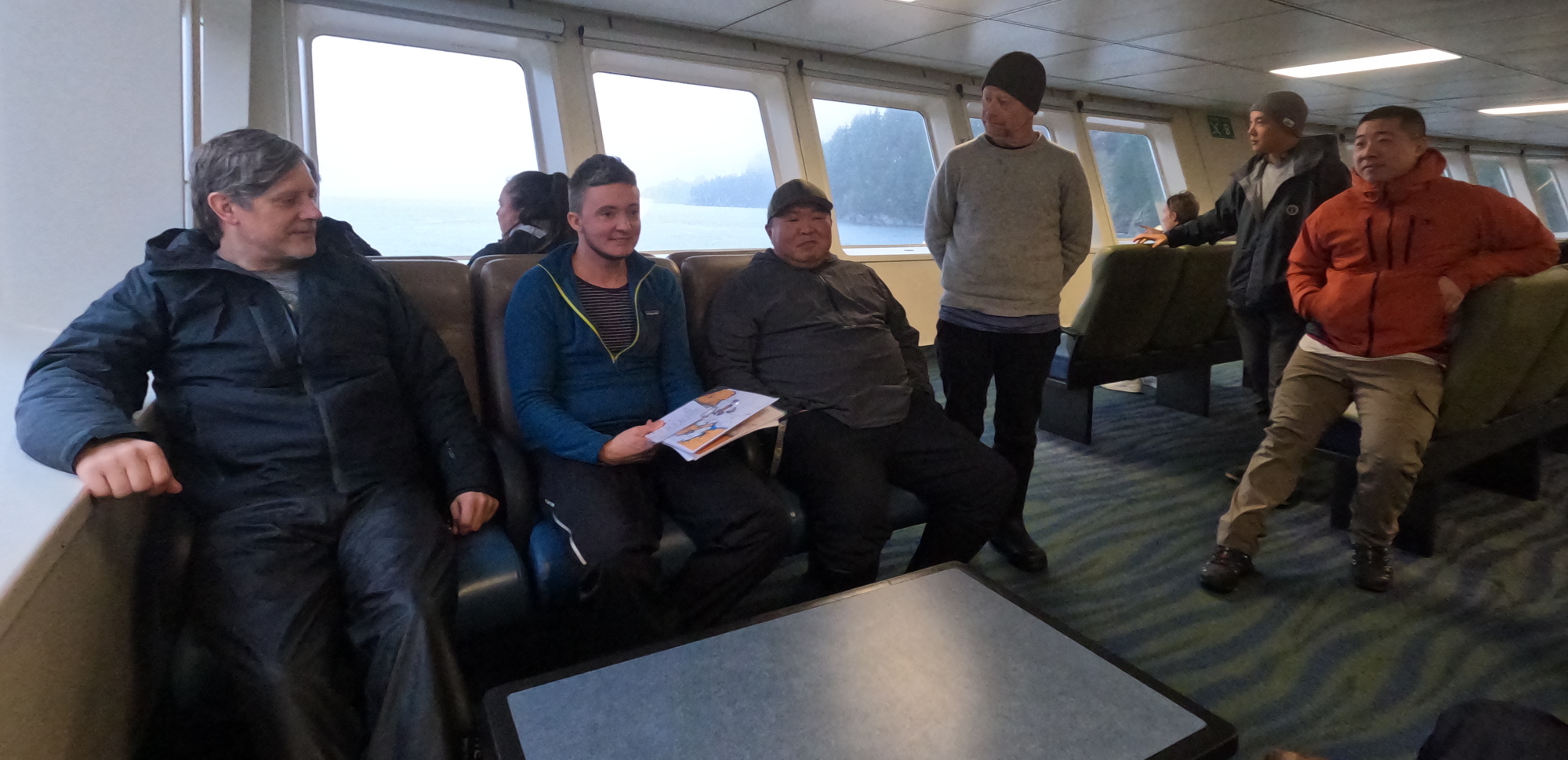
Our little car convoy made fine time to the Horsebay Ferry Terminal, and caught the 10AM something boat across to Nex̱wlélex̱wm/Bowen Island. Enroute, we had a quick huddle in the passenger lounge to confirm launching, the paddle plan and radio channels.

final pre-paddle briefing on the ferry

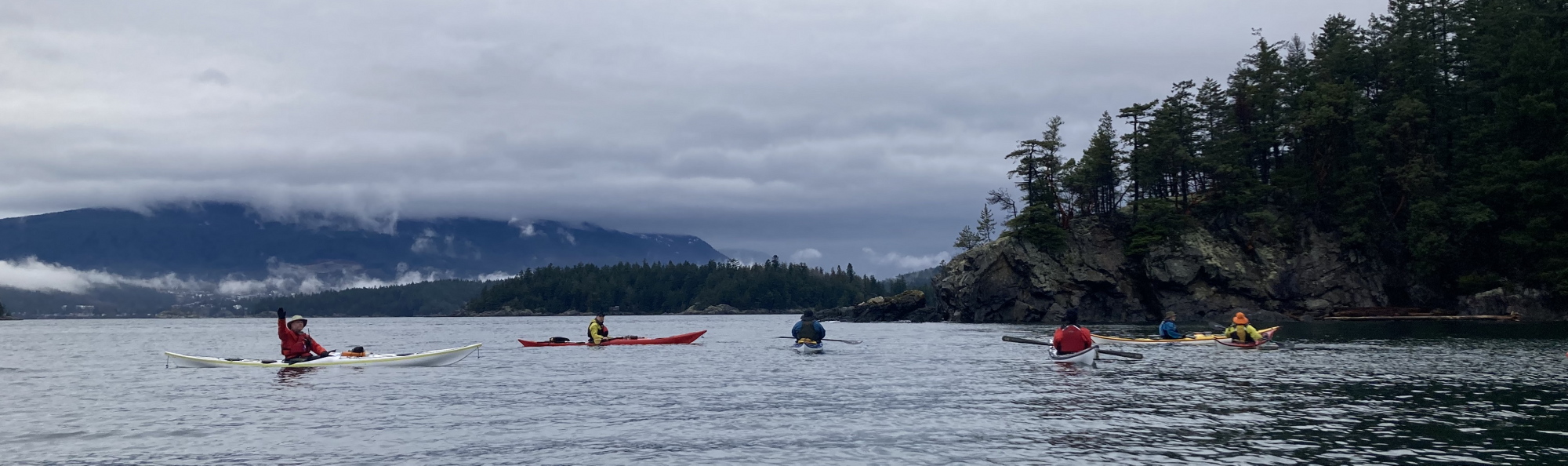
As if to reward us for our perseverance, the rain stopped just as we launched from Tunstall Bay at noon. On the cliffy south side of the bay, a frozen waterfall testified to the unseasonably cold weather of the previous week.

Ice, ice, baby! A frozen waterfall on the south side of Tunstall Bay
Enroute to Worlcombe Island

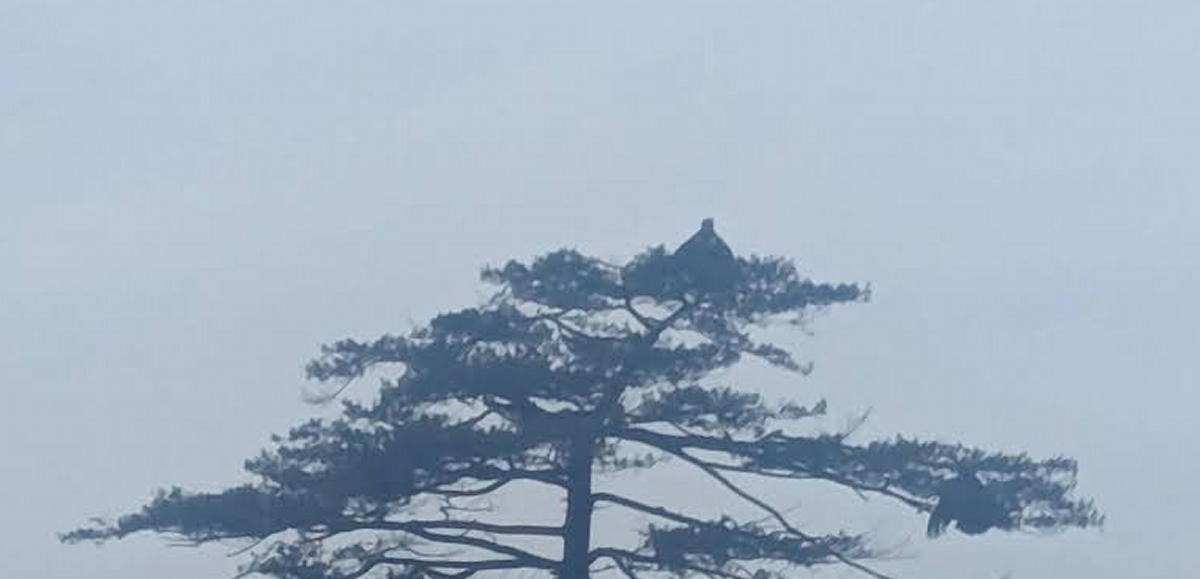
As we approached Worlcombe Island, we could see vast flocks of large birds gyring above the treetops. They proved not to be vultures lurking for under-prepared kayakers, but eagles young and old. (They’re clearly visible at this point in my buddy Mike’s video of our outing.)

Along the north side of Worlcombe Island

We alit a little after 1PM in a small bay at the southwest tip of Pasley Island. In summer, I wouldn’t bother firing up a stove for lunch, but in winter, it’s nice to stoke the inner fires with pre-warmed fuel. So my trusty WindBurner stove came into play. It was not only mucho fast but also provided much amusement for my tripmates, as the vast clouds of steam made it look like I was either improvising a sauna or preparing to do a magician’s disappearing act.

It being the offseason, the homes on the upland above our picnic spot were not occupied. This was fortunate, since it meant that those of us who lined up facing the southern rockwall to take the necessary pre-launch precautions to ensure our drysuits would remain dry for the next leg of the voyage were not accosted by irate cottagers. 

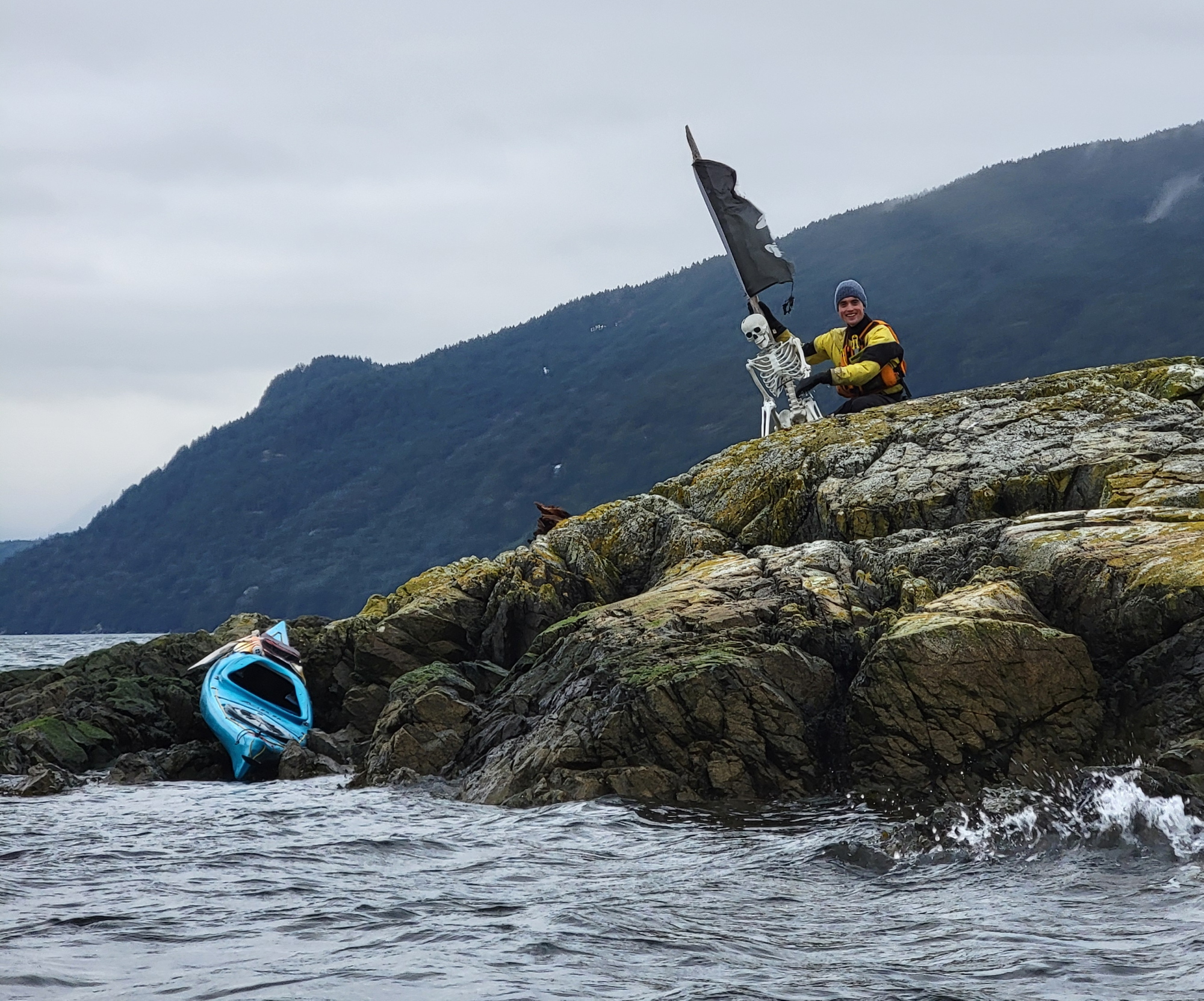
On an offshore rock near the northwest tip of Pasley, we spotted a bleached white skeleton. This was not a kayaker who’d been marooned by an insufficiently secured boat, but a brilliant bit of sculpture installed by an unknown artist for the delight of passing boaters. It even included an appropriately wind-tattered pirate flag.

Somewhere between our boney friend’s reef and Mickey Island, the rain began to fall intermittently. But it had held off for our lunch stop and was pretty tolerable while we were buttoned up in our boats and pumping out body heat with every stroke.

As we bobbed in the lee of Mickey Island, confirming our course home and who was leading the next leg of the trip (me, as it happened), swooping and diving seagulls just off the point on Pasley Island south of us showed something was afoot (or perhaps, afin). And as we got nearer, swirls and splashes from beneath the sea, like reversed raindrops, confirmed that fish were being herded up from below. Sure enough, enormous thick brown necks suddenly broke the surface, accompanied by huffs and snorts. (As an aside: I’ve been within paddle-poking distance of Orca more than once over the years, but I continue to be more wary of sealions than killer whales. Still, I comforted myself with the idea that if they decided they were tired of seafood and wanted a little red meat, the odds were only one in thirteen I’d be dinner!) The sealions are best visible at this mark in Mike’s video.

Switching leaders once more at the western tip of Worlcombe, we handrailed along its south shore, encountering more sealions on route. They proved pretty camera-shy, appearing only in the distance anytime I had my Go-Pro in hand.

along the south shore of Worlcombe Island

We landed back in Tunstall Bay a bit after 4PM, with a rain falling so steadily I opted not to change out of my drysuit, but to drive to the ferry terminal still wearing it.

The last of us rolled onto the five-something ferry just moments before it sailed, as if it were our own personal, private transportation. Upstairs in the passenger lounge, we ambushed one of our number, whose birthday it happened to be, with donuts and singing.

After offloading the boats back at Jericho Beach Kayak, we supped at the Wolf And Hound. It’s amazing how many of our adventures end there. It’s almost become our off-season office!

The fabulous thirteen!
a chart of Bowen Island and the Pasley Islands in Howe Sound, British Columbia, showing the route of our kayak daytrip
the route of our daytrip

Thanks to all my colleagues for the pleasure of their company, and to Mika, Chris, Natalie, Tomo, Warren, and EJ for sharing pictures for this post.

Guiding Light: 2023 Jericho Beach Kayak staff trip to Halkomelem: səl̓ilw̓ət (Indian Arm)

Featured

One of the things I love about working as an instructor-guide with a raft of mostly younger colleagues is the chance to spark off their energy and enthusiasm. But at work, the longest paddles we typically do together are day trips. So getting away for three days and two nights up Halkomelem: səl̓ilw̓ət with many of them gave me a chance to feel like I could pay things back a little by demonstrating some campcraft, backcountry cooking and compass navigation to co-workers who might not have done a lot of kayak touring.

Read more: Guiding Light: 2023 Jericho Beach Kayak staff trip to Halkomelem: səl̓ilw̓ət (Indian Arm)

June 9, 2023

Having swung by Jericho Beach Kayak to pick up boats, we arrived at Deep Cove mid morning. I, like several others, was waffling back and forth about whether to bring my wetsuit or my drysuit on this trip. At the present, it was cool and cloudy, with showers predicted, but it was scheduled to get warmer and dryer later in the weekend. In the end, I opted for the drysuit, which proved to be the right choice. At least mostly.

Launching at Deep Cove
Heading out of the Cove. Note the marine sighting compass tucked under my decklines.
Tethering up the boats at the Twin Islands dock

As we lunched on the Twin Islands, the rain began to patter down. Shortly after we left the Islands, it upgraded to full showers, with a following wind. I’d stowed a folding sail on the back deck of my boat (I was paddling a kayak borrowed from JBK, and suspected my boss would not appreciate me drilling holes in it to mount a permanent sail, so the clip-on Windpaddle Sail it was.) My cunning plan had been to effortlessly cruise past, or at least alongside, my colleagues. But with the cloud, the wind was not the strong atabatic it would have been on a sunny day, so my sailing was significantly slower than I’d hoped. In the end, I did a series of leapfrogs – sailing until I was a few hundred meters behind the pack, then sprinting with the paddle to catch up, then taking a sailing break again, and so on. The end result was me landing pretty much with the pod at Granite Falls in the late afternoon.

Running through the wind and rain. Croker Island is faintly visible in the distance.

On this rainy Friday night, there were only a few other campers, which gave us a nice selection of sites. Some of our group doubled up tents on one pad, since we suspected the Inn would be much fuller tomorrow (we knew at least three more of our own group would be joining us.)

Landing at Granite Falls, Indian Arm, British Columbia
multi-person portage at Granite Falls

EJ, our fearless leader, had rigged the kitchen-dining tarp by the time I had set up my tent and changed into shore wear. Very necessary as the rain was falling heavily now. Audrey was my meal mate for making the group supper this first night, and was very patient with chopping vegetables (I was making this dish, but with the Chorizo fried separately to be added downstream by the non-vegetarians in our group.) I also managed to subcontract grating the Parmigiano Reggiano to Mika, which left me free to concentrate on toasting the pine nuts, frying the veggies in proper order and boiling a huge pot of pasta. It looked like a lot, but eight hungry kayakers made short work of it. Good thing I’d also brought a strawberry-rhubarb pie to heat in the Outback Oven. And hot custard to pour over it.

June 10, 2023

It continued to pour heavily through the night, so I was glad of the overtarp on my tent. The precip lightened off by the morning, but we were still glad of the kitchen tarp as we enjoyed oatmeal with a range of toppings, courtesy of Chris and Mika.

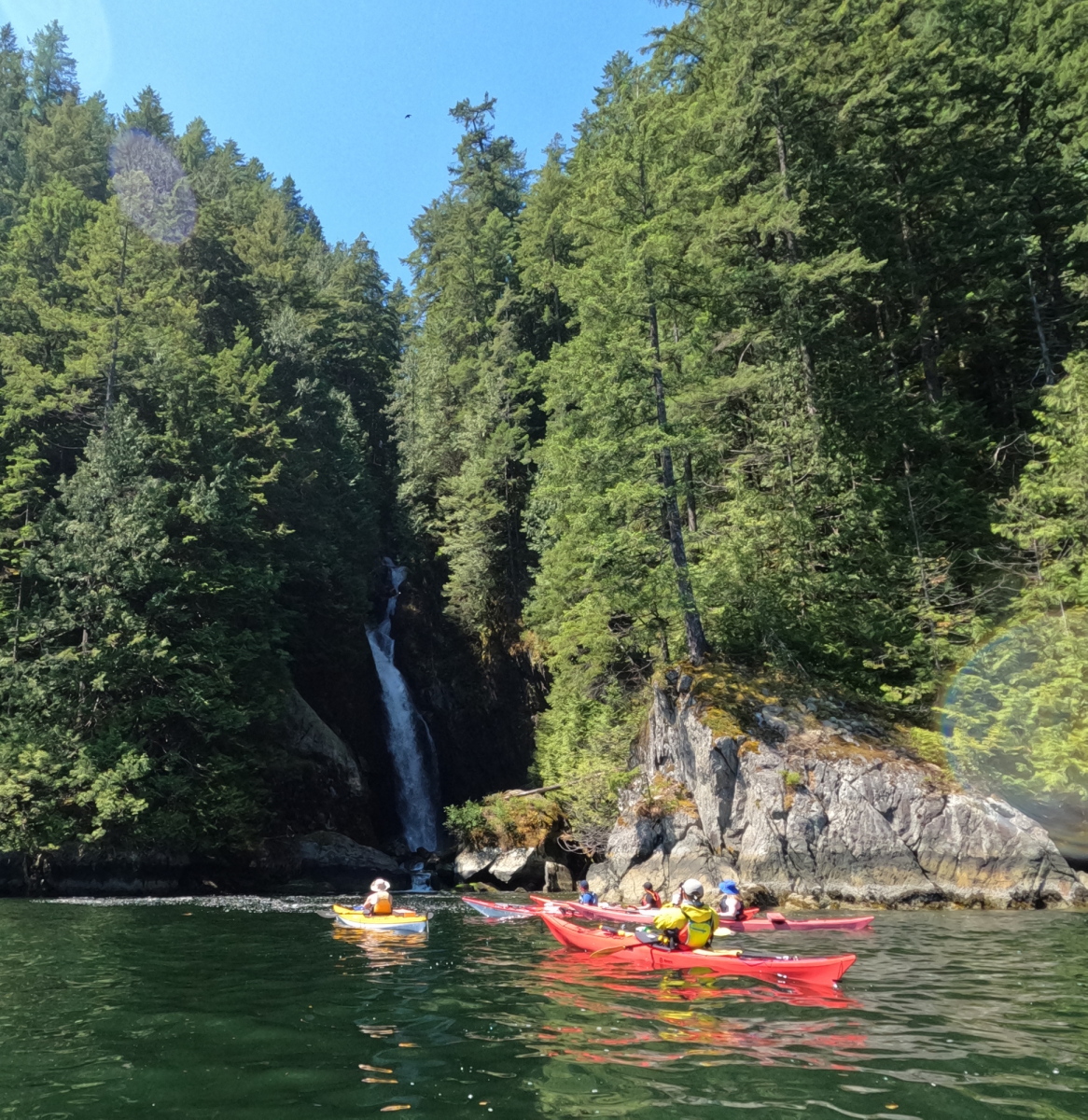
Paddling past Granite Falls

Then it was to the boats and off to the mouth of the Indian River. We’d planned to arrive at near high tide in order to get as far up the river as possible. With EJ demoing, the group got to practice paddling in currents. Though I used to run whitewater back in the day, being in an unfamiliar boat with a rather loose skirt, I opted to eddy out just below the sandbar the rest of the group made it to, and go birdwatching while they walked further upstream. During all this, we got the call on my VHF from the trio that were joining us today – Natalie, Maggie and Mark. I was pretty impressed that the handheld radios worked with us so far up the river.

Entering Indian River

After the exploration, we ran effortlessly downstream. The falling tide had made the river significantly more boney than it had been on our way in, but we got to a sandbar in the estuary without anything more serious than some sacrificed gelcoat. There Lyra and EJ laid out a beautiful buffet lunch for us. I got a chance to demonstrate a marine sighting compass and the use of a modified Douglas protractor to the group. After a bit of a learning curve with the sighting compass, the group did plot an LOP off the west side of Croker Island that put us where we already knew we were (how awkward if it had been otherwise!)

lunch at the Indian River buffet

On the way home, we both played and learned, experimenting with a variety of old and new strokes. Back at Granite Falls, as we’d expected, there’d been a massive population explosion, but everyone was being considerate of one another, and no-one was operating loud musical devices. (A sensible precaution, as it has been known for boom boxes at backcountry campsites to fall in the water, even from well up on shore. Funny that.) Natalie and Alex fed us to repletion on amazing ramen.

Paddlers in the hood

Mark is a stand-up guy!

June 11, 2023

Sunday lived up to its name, dawning clear and dry. I helped Marc and Maggie configure the campstoves to set up a pop-up IHOP, with excellent pancakes and a wide selection of toppings, including whipped cream! To tamp down breakfast, Alex led us all in some improvised yoga paddle warm-ups.

a magnetic tool with grains of local ferrous rock stuck to it.
This little magnetic stove tool is made to plunge the jet cleaner needle up and down. Turns out it’s also great for identifying ferrous rocks!
yoga posers
Sunday morning service

Natalie chills out on a water bed

Even with my lightest layers on under the drysuit, it would have been a boil-in-bag experience save for the fact I was wearing a Mustang Hudson suit, with a neck seal that could be loosened for a bit of ventilation.

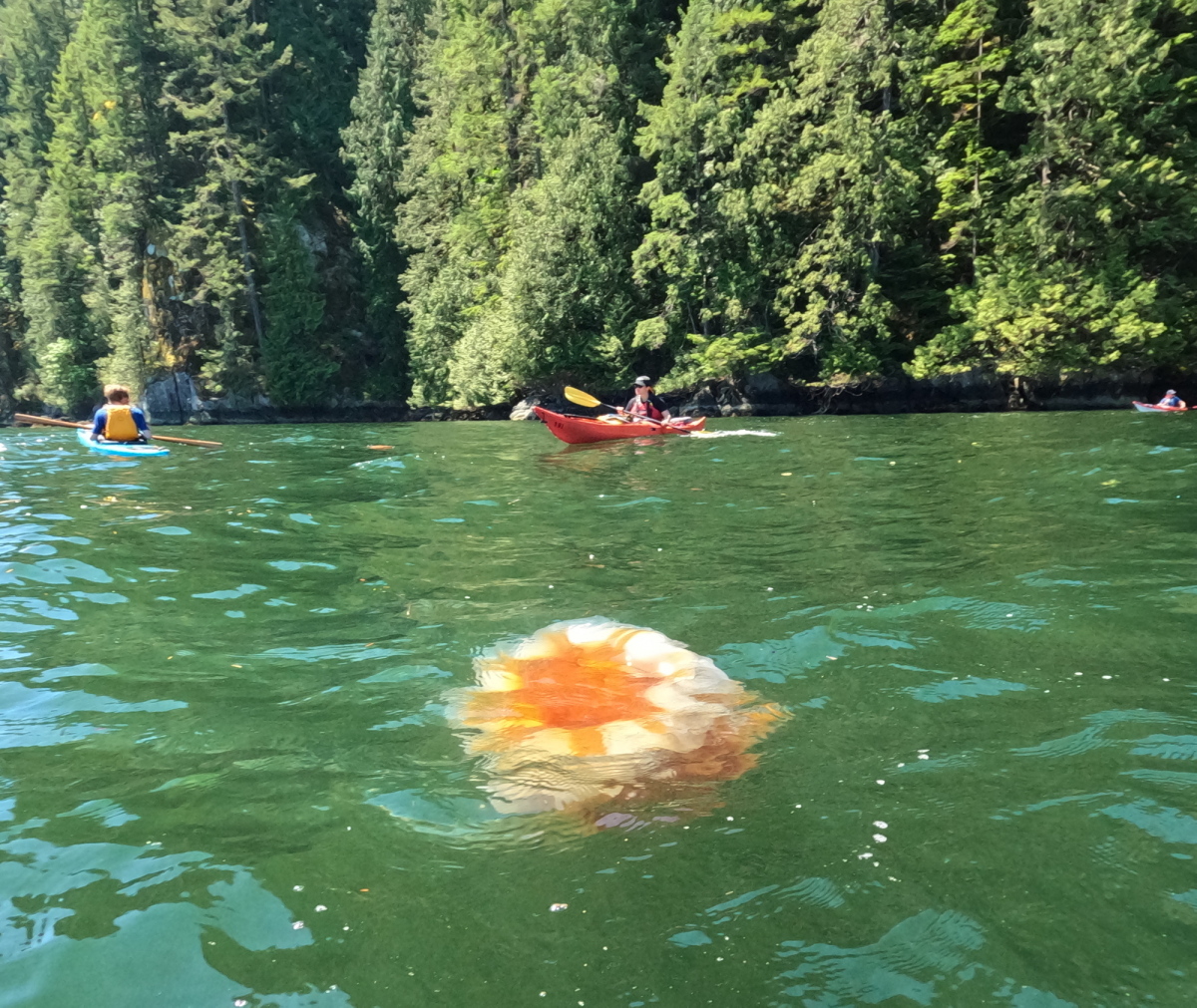
We frolicked down the east side of Croker Island, with Marc and EJ giving us an on-water clinic on the use of cross-bow draws and hanging draws to slip along right next to the rock walls. Just off Silver Falls, the water was thick with Lion’s Mane jellyfish, including one monster that must have been a couple of feet across.

big ass jellyfish

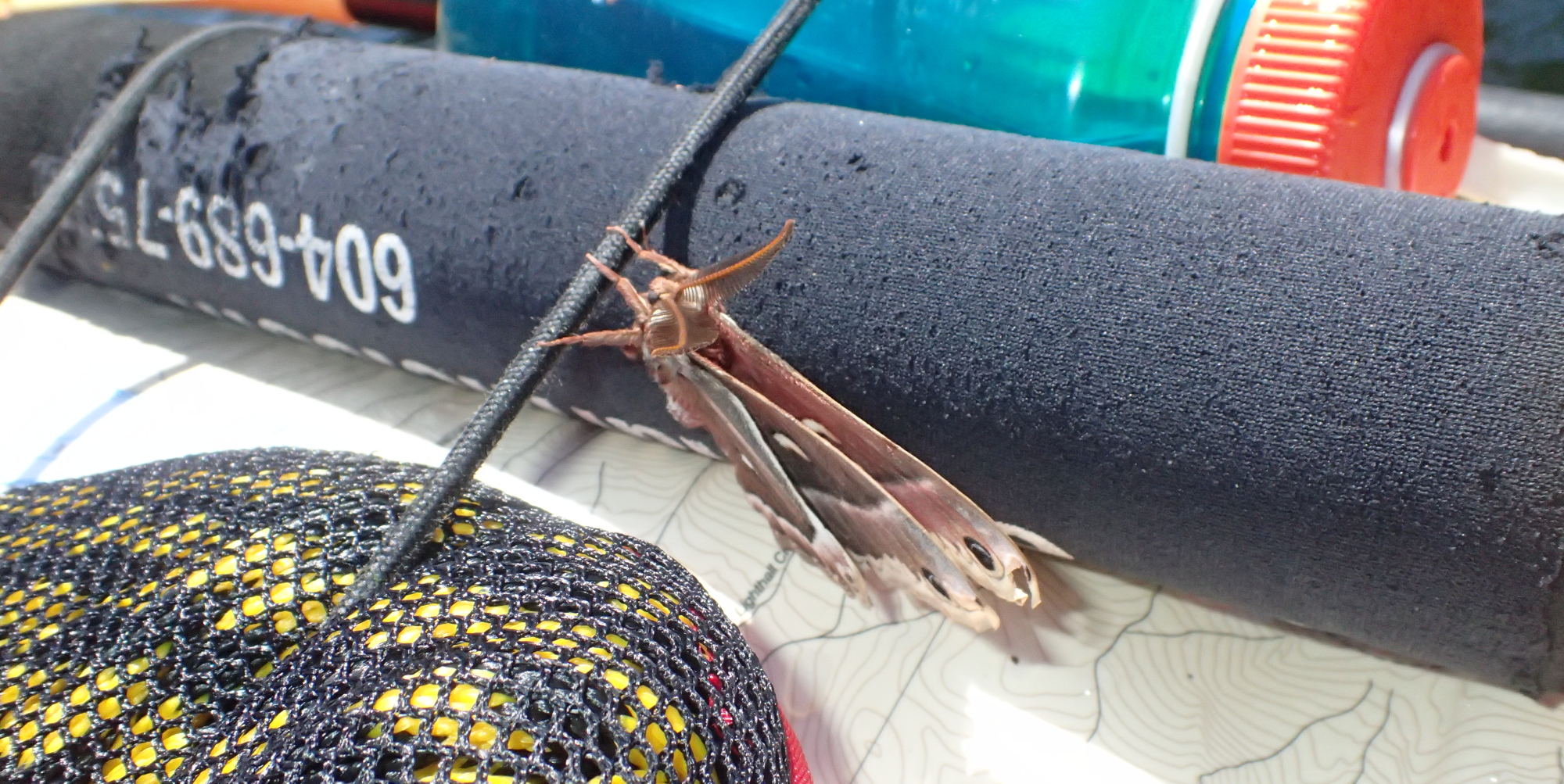
As we made our way south, the kind-hearted Mika fished a winged warrior out of the water, where it had somehow crash-landed and stuck. With its wings dry, it was able to take off again from our lunch stop.

With the sun out, the inflow wind rose steadily as we clawed our way towards Thwaythes Landing for lunch. (Where was that wind a couple of days ago when I needed it to race north to Granite Falls?) Elaine and Rita laid out a zesty tortilla wrap buffet for lunch. Since I’d been lagging significantly behind the group just prior to lunch, I opted to launch earlier than them after lunch to get a head start and not hold the fleet back. (By prior arrangement, we were in touch on Channel 69 on the VHF.) Though I was nominally the navigator for the fleet, they assured me they were capable of “keeping the land on the right” until they reached Deep Cove. And so it proved.

Thwaythes Landing

By hugging the shore and finding back eddies from the wind, I made pretty good time back to Deep Cove, maintaining my 30 minute lead. The sea just in front of Deep Cove beach looked like a pond of mutant water lilies, with paddlecraft and inflatable rafts of every colour and size wafting about under varying degrees of directional control.

I tried to put my advance landing to use by running to Honey Donuts, hoping to greet the main invasion force on the beach with a box of a dozen gooey treats. But the weekend line-up was insanely long, so I instead grabbed a quick shower and fetched my car back from the long term parking.

It was evening by the time we got back to the Jericho Sailing Association, offloaded boats, and headed home in that happily weary way that ensures a sound sleep and sweet dreams.

Thanks to all my colleagues for sharing their knowledge, the pleasure of their company, and their photos!

April Showers bring… April showers

Featured

April 7, 2023

We’d laid plans for this trip with an Option A (Howe Sound/Átl’ka7tsem) and an Option B (Indian Arm/Nuth Khaw Yum Provincial Park). The predicted winds made Howe Sound sound rather too exciting, especially given that if we were crossing from Porteau Cove to the Islets View site, we’d have the wind and waves on the beam coming and going.

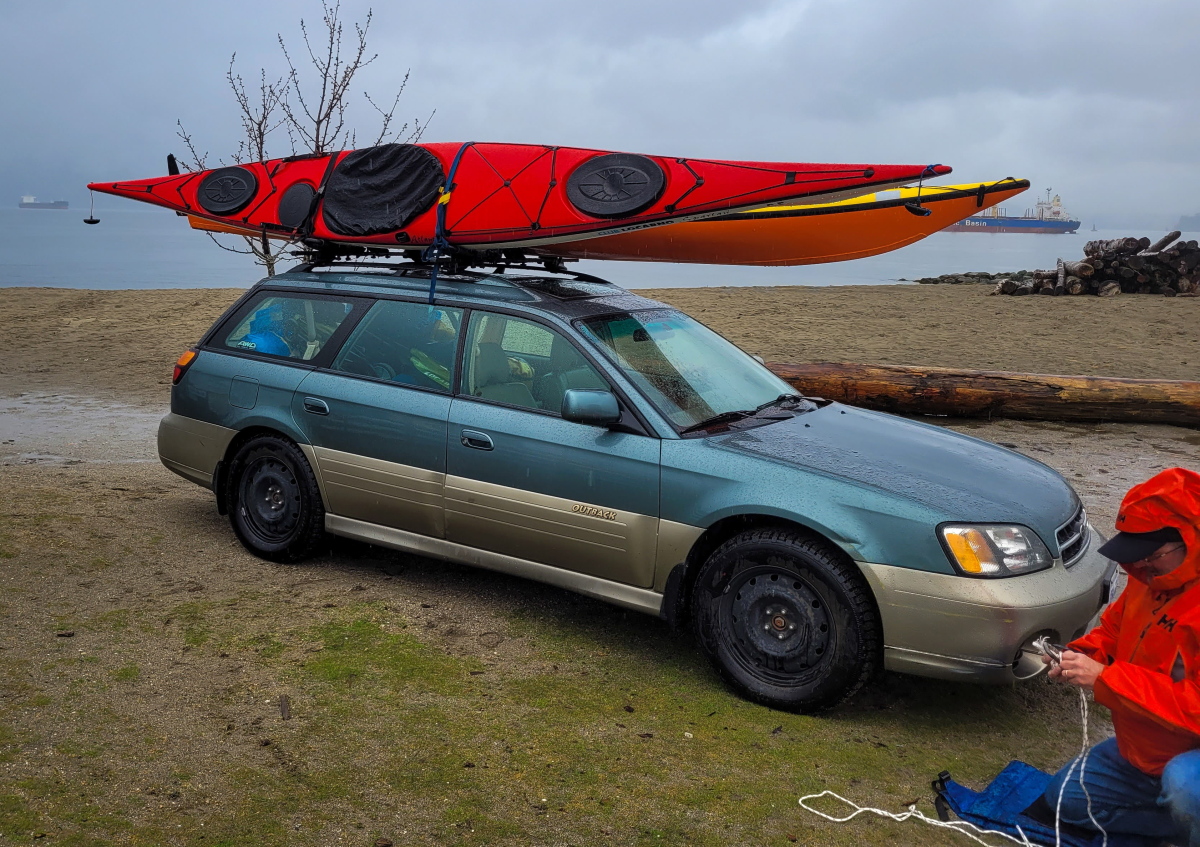
Rack n’ Roll: securing boats to the trusty Subaru
Read more: April Showers bring… April showers

So Indian Arm it was. Rhian and I swung by the Jericho Sailing Association compound to grab our boats, then met our accomplices, Paul and Nessa, at the Deep Cove put-in. A light drizzle washed us as we loaded and launched. 

Paul and Nessa snap a selfie at the Deep Cove put-in as Rhian and I demonstrate precision kayak maneuvers in the background.

Things cleared a bit as we made our way down the Arm, becoming what the Irish would call “soft”. Scraps of blue sky even appeared, lulling us into a false sense of security.

We paused to frolic briefly in the currents below Silver Falls, then pressed on.

Premature Exhilaration: Paul and I celebrate the blue sky. North Twin Island is visible on the horizon behind my outstretched left arm.
Sea kayak siren self-portrait: Rhian’s selfie


The rain held off as we landed at Bishop Creek (Berg’s Landing) in the late afternoon, letting us all rig both our tents and the overtarps for them. It began to foreshadow the coming deluge as we rigged the kitchen-dining tarp.

Nessa and I approach Bishop Creek/Berg’s Landing on the left. Croker Island is visible just beyond us.
Overtarps are de rigueur in heavy rain to reduce interior condensation in tents. So de rigger set’em up!
Paul and Nessa’s backcountry pied-à-terre. Happily, the grey overtarp I lent them accessorized well with their tent, else I’m sure they would have refused it.

Fortunately, the group consisted of seasoned outdoor folk, who understand that when it comes to weather, things are what they are. Plus, we had brought a lot of good cheer (mostly of the fermented-red-liquid-in-bags kind.) And, as this group’s now-traditional dessert, we heated a pie in the Outback Oven until it was as warm as though fresh-baked, and drizzled it with hot custard. 

April 8, 2023

Throughout the night, the temperature continued to fall, as did the rain. In fact, it cranked up to a volume that made last evening’s showers look like a desultory drizzle. Even landing on the tarp above the tent canopy, it drummed loud enough to preclude sleep. So I stuck in my ear plugs – not usually a recommended procedure in bear country, but honestly, unless Brother Bruin were clashing cymbals to herald his approach, I’d never have heard him over the rain anyway.

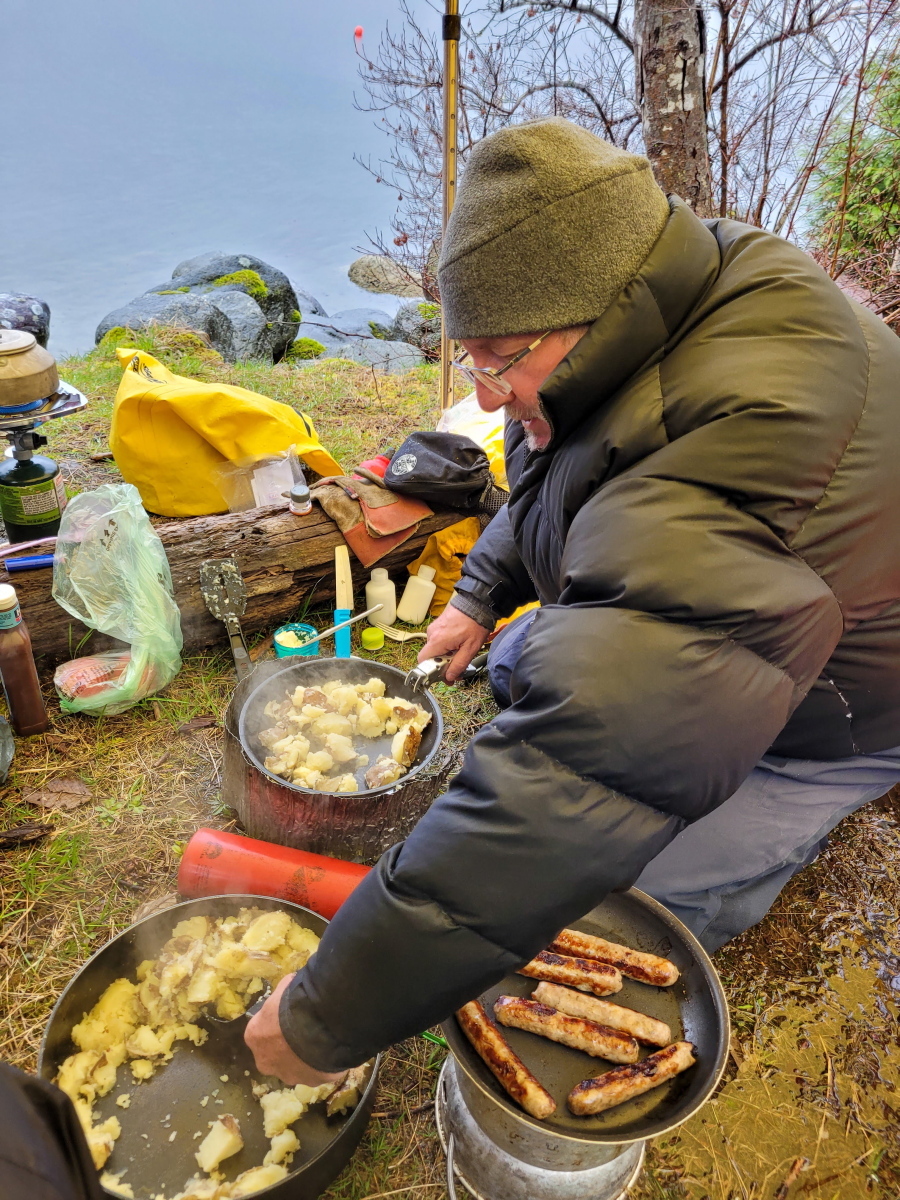
I was on breakfast duty and had massively underestimated the time needed to cook a “full English” for everyone in the group. It could only have gone slower if I’d started by planting the potatoes and fattening the pigs. Fortunately, no-one was in any hurry to leave the sheltering tarp, so the meal evolved into a leisurely “full English brunch”, washed down with endless cups of tea and coffee.

Camp kitchen, complete with cold and colder running water (under your feet)!

The ground under the kitchen tarp had gone from fairly damp last night to full swamp this morning. Fortunately everyone had waterproof pants for kneeling to cook or fill plates, and full-frame, above-the-flood chairs for actually eating.

By this point, all of us were wearing every layer we had when outside our tents, and counting our blessings that we’ll all brought winter-weight sleeping bags, pads and clothing. Entering and exiting the tents involved elaborate doffing or donning rituals that would have looked familiar to a hard-hat commercial diver. Vapour hung in the air with our every breath.

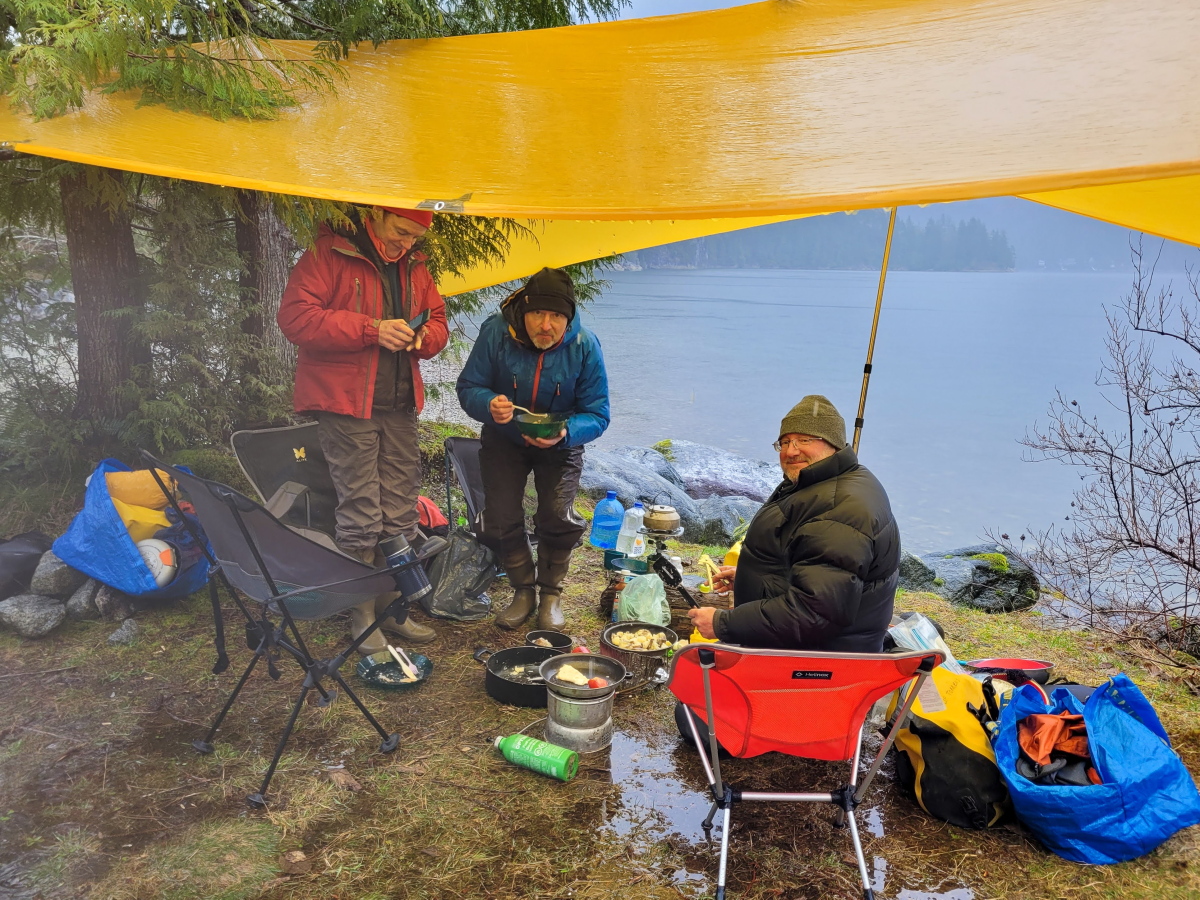
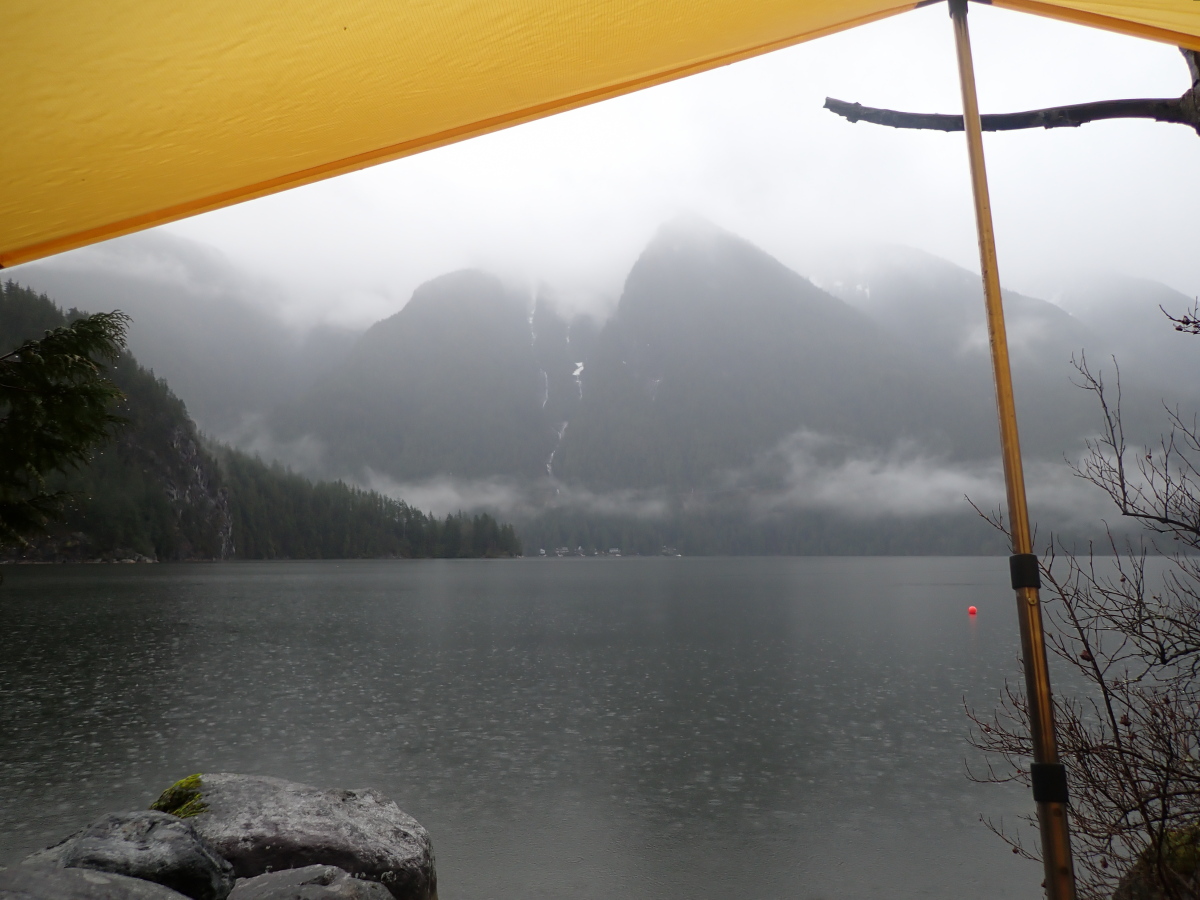
In the afternoon, Paul and Nessa, ever the bold and energetic ones, launched for a daytrip to Granite Falls. Rhian went on a wet weather photo safari, finding the beauty in the rain. I did likewise in my own way, hanging out under the tarp and admiring the way the swirling low clouds concealed and then revealed the various peaks and crannies in the fjord walls opposite our camp. And I pondered an additional point I would emphasize to the students in my Online Trip Planning Class: in the Marine Weather class, we typically talk about the importance of being dressed appropriately for whatever on-water (and possibly in-water) conditions prevail. But frankly, if everyone in our group had not been equipped with not just drysuits and appropriate layers, but winter-weight shore wear and sleeping equipment, we’ve have at best been trying to call a water taxi for the trip home and at worst needed to be medi-vaced for hypothermia.

Supper was tamped down with our also now-traditional hot Auntie’s Puddings and custard. (Are you sensing a theme here?)

April 9, 2023

Wanting to be back home at a reasonable hour for what promised to be several days of drying tarps, tents and selves, we’d agreed the night before to aim for a 9:30AM launch. Typically this means we’d actually launch nearer 10ish. But we were all apparently very motivated, and were sliding the boats off the cobbly, shelly beach at the appointed hour. Even with all four on each boat for the portage from the loading station to the water, we all walked very gingerly – one slip on the slimy, lumpy and shifty rocks would have been an excellent way to twist an ankle or break a leg.

Undamped spirits or contagious rictus? We Report; You Decide.
Rhian and Nessa model this winter’s must-have kayak cruise wear. From the high (and watertight) necklines to the little-black-cockpit skirts, they’re sure to make a splash wherever they go!

My three companions, all younger than me, set a smart pace back to base. At first, I kept up well, and was even in the lead for a bit. But gradually, I fell behind. If there had been a Captain Oates Award For Best Straggler, I’d have been a shoe-in. Fortunately, the situation was not quite dire enough for the others to suggest I go outside for some time. Besides, we already were outside.

About an hour out of Deep Cove, we got hammered by a headwind squall and blinding rain. In the low vis, I mistook two other paddlers who were bee-lining for their shoreline cottages as Paul and Nessa, and wound up paddling for sometime at a tangent to the rest of the group. But once the weather cleared, we re-united.

On the final leg to Deep Cove, the wind shifted, and I kept hoping I would get a least a sail assist to catch up with my friends. But the wind just toyed with me – repeatedly inviting me to rig the sail, glide through the water for a few seconds, then dying off. My companions were remarkably patient with all this faffing about. And even with it, we landed at Deep Cove shortly after noon.

The rain continued to fall so hard that Rhian and I simply stayed in our drysuits for the drive back to Jericho and dropping off our boats. Even with the wipers on full blast, the windshield often looked as though it were iced over. The heavens poured one last contemptuous dump on us as we offloaded the kayaks. And naturally, as I drove Rhian home from Jericho, the showers ceased and the sun began to peek coyly out from behind the clouds. That sun of a bi …!

Big thanks to Rhian, Paul and Nessa for sharing their companionship and photos!

Sea Kayak Navigation: Plotting Your Position With A Compass

Featured

In an earlier post, we discussed how to use a chart and compass to find a compass bearing we could follow to a desired destination. But all those techniques for heading somewhere new require us to know where we are now. As any kayaker who’s ever done a longer crossing or paddled along a featureless shoreline can confirm, it’s easy to lose track of your precise location. How do we find it again? 

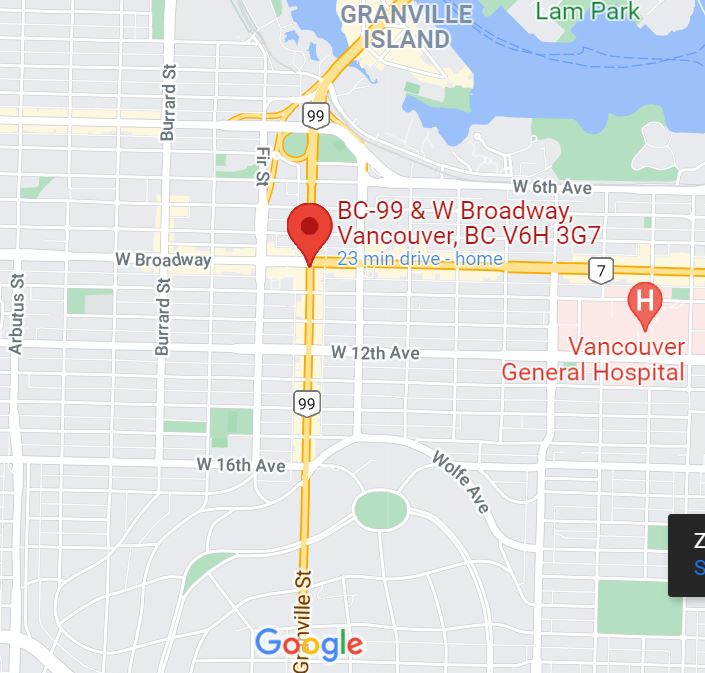
First, a quick detour into a concept called a Line Of Position (LOP). You’ve almost certainly used LOPs before, even if you didn’t call them LOPs. If you were wandering around a city (for example, Vancouver, British Columbia) with a paper street map, you might have known you were somewhere on Granville Street, but not sure where along Granville. So you walked down to the next corner and checked the signs for the cross street. Finding it was Broadway, you now knew your exact location: the intersection of Granville and Broadway. Each of those streets served as one LOP for you. Where the two LOPs intersected was your location.

A section of roadmap showing the intersection of Broadway and Granville in Vancouver, British Columbia. Demonstrating the concept of Lines Of Position.
Granville Street is one Line Of Position. Broadway is a second Line Of Position. Where they intersect is your location. See, you’re already a navigator!

To determine our location when sea kayaking, we do exactly the same thing: we find the intersection of two or more LOPs. The only difference is that we use lines other than streets as our LOPs.

Even for novice kayak navigators, there’s one Line Of Position that’s so obvious you’ve probably used it without even thinking about it: the shoreline. (Yes, most shorelines are curvy and crinkly rather than straight. But there’s no requirement that every Line Of Position be a straight line. In my hometown of Vancouver for example, Kingsway Road has lots of jinks and bends, but I can still use it to clearly define a position such as “the intersection of Kingsway and Broadway.”)

Bendy LOPs? No problem: where they intersect is still your position.

So, if we only ever intend to navigate along shorelines, why would we ever need a second LOP?

Imagine you and I and several friends are kayaking close alongside the southwest shore of North Pender Island, admiring the undersea flora on the rock wall and petting the passing Orca. Distracted by all this merriment, we’ve lost track of how much time we’ve spent paddling vs drifting. Plus, the tricky currents on this coast have sped us up or slowed us down unpredictably. So now all we’re sure of is that we’re somewhere between Boat Nook and Smuggler’s Nook. We need a second LOP to show us exactly where between those points.

A section of marine chart, showing the lines of magnetic North drawn in with red, to allow plotting Lines Of Position without adding or subtracting for compass variation.
A section from CHS Chart #3441. Look for Canoe Rock (below the purple compass rose) and Pelorus Pt (on the right/East side of Moresby Island). The red lines I’ve drawn in point to magnetic North, 16° East of truth North. (Why 16° East? The purple compass rose shows true North, magnetic North as of 2005, and a predicted change in the magnetic variation of 8’ Westward annually. So in in the 18 years since 2005, the variation is predicted to have reduced by 2° 24’ (18 years x 8’ = 144’ or 2° 24’). The variation in 2005 was 18 1/2° or 18° 30’. Subtracting 2° 24’ from that gives us 16° 6’ East. This matches pretty closely with the 15° 46’ East predicted for this area by the online declination calculator. We can round either figure to 16° East for practical purposes.)

To lay out a second LOP, we need to take a compass sighting (AKA a bearing) from any clearly identifiable location shown on the chart and visible from where we are in the real world. A lighthouse, the tip of a cape, one side of a known island, or a distinctive mountain peak would all be excellent options. 

Looking out to sea from Pender Island, we find a highly distinctive landmark to take a bearing from: the red-and-white marker on Canoe Rock. Even better, it’s at roughly a right angle to the shoreline. (It’s a good habit to pick your landmarks so that your LOPs meet at as near to right angles as possible; this creates a much clearer intersection point than sharp acute angles or almost parallel obtuse angles.)

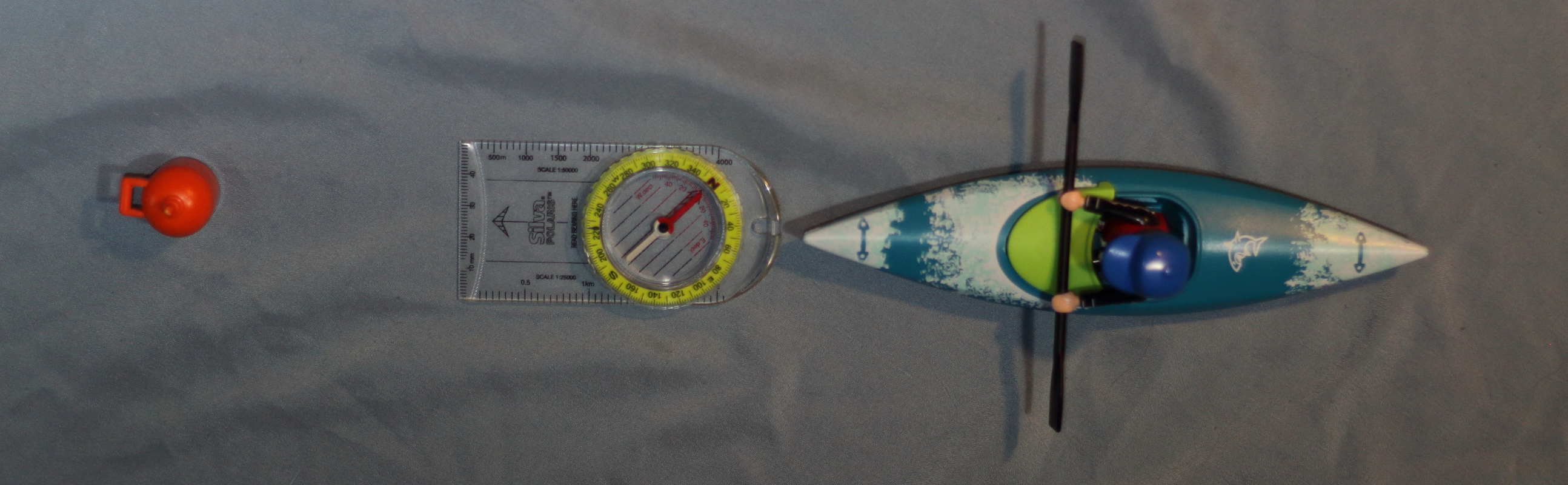
Taking a bearing from a real-world object (in this case, the orange thingie representing the marker on Canoe Rock) using a hiker’s/orienteering compass. Step 1. Holding the compass as level as possible, aim the Direction Of Travel arrow towards the landmark. Pro tip: this is much easier and more accurate if your body is facing the landmark. Which means your boat should also be pointing in at least the general direction of the landmark. Notice that at this time, the compass bezel dial is in a random direction relative to the magnetic compass needle, with the N (for North) on the bezel not aligned with the red needle tip. 
Taking a bearing from a real-world object using a hiker’s/orienteering compass, Step 2. While keeping the Direction Of Travel arrow aimed at the landmark, twist the bezel dial until the meridian lines in the bottom have put “Fred in the shed” — that is, the red box on the bottom of the bezel is enclosing the red half of the magnetic needle, and the N on the bezel is directly in front of the red needle tip. Read off the degrees at the Read Bearing Here indicator. In this case, the bearing to Canoe Rock is 224°. (BTY, if this whole process feels exactly the same as taking a bearing to a visible landmark you want to paddle to following a compass course, that’s because…it is!)

Great. We have our bearing off Canoe Rock. So now what? So now, we’re going to transfer that bearing into an LOP on our chart.

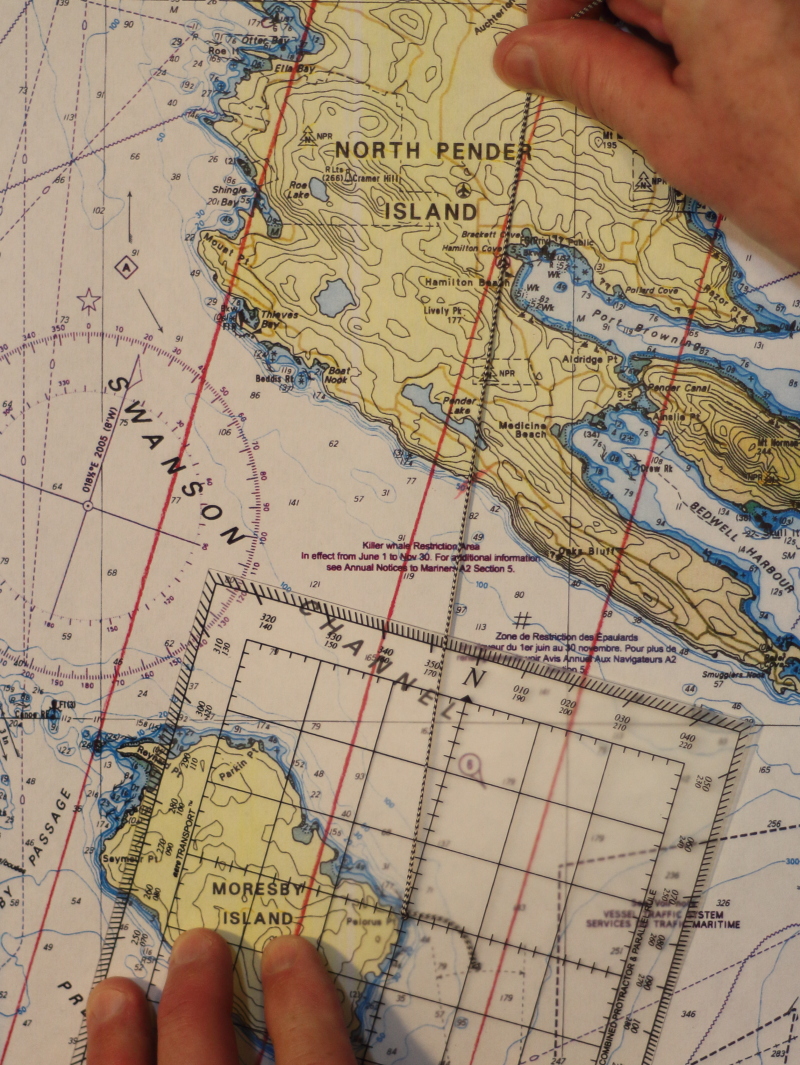
A section of marine chart with a hiker's compass, bezel parallel to the lines of magnetic North. Showing how to draw a Line Of Position on a chart.
Using a hiker’s compass to transfer a bearing onto a chart as an LOP. We keep the bezel dialed to 224°, from when we “shot” our bearing to Canoe Rock. Keeping the meridian lines on the bottom of the compass bezel as parallel as possible to the red magnetic North lines on the chart, we put one edge of the compass baseplate on the Canoe Rock landmark on the chart. That baseplate edge is now a Line Of Position. Where that LOP intersects the shoreline is our location. In this case, the baseplate doesn’t quite reach to Pender Island, so we extend the LOP by eye and pencil it in. (Notice that we don’t care about where the compass needle is pointing now: we’re just using the compass bezel and baseplate as a protractor.)

Woot! We are unlost! We are right where the shoreline (the first LOP) and the bearing from Canoe Rock (the second LOP) meet. High fives everyone! 

BUT…

We took that compass bearing with a hand-held land compass from the cockpit of a kayak rocking in the waves (landing to take the bearing wasn’t an option on the cliffy shores). And we extended that LOP by eye from where we ran out of compass baseplate. So there have been lots of opportunities for errors to creep in. How can we cross-check our apparent position? By determining a third LOP.

Happily, our pod of paddlers includes the excellently-equipped Greta Geerweenie, so we can not only shoot an entirely separate landmark, we can do so using a more accurate instrument. Because Greta’s kayak boasts a deck compass, aligned with the keel line of her kayak. So to take a bearing, she simply aims the bow of her boat toward her chosen landmark (Pelorus Point on the east side of Moresby Island), and reads the bearing in degrees at the lubber line.

A model kayaker with a real, full-sized marine compass pointing towards a marker. Showing how to take a bearing on a landmark with a deck-mounted kayak compass.
Taking a bearing with a deck-mounted marine compass. With the kayak pointing towards the real-world landmark (the orange thingie now representing Pelorus Point), we read the bearing directly from the black “lubber line.” In this case, it’s 172°. (No bezel twisting required. Because instead of the needle on a hiking/orienteering compass, a marine compass has a floating, degree-marked dial that rotates to line up with local magnetic North.)

But Greta’s opportunities to flaunt her superior gear don’t end with the deck compass. Now it’s time to transfer the bearing she shot onto the chart as that third LOP. Rather than roughing it with the hiker’s compass, she whips out her modified Davis Protractor, complete with String™ that extends much further than the baseplate on a hiker’s compass.

A chart with string-added Davis Protractor. Showing how to use the string as a Line Of Position to determine your location based on a compass bearing to a known landmark.
Using a string-equipped Davis Protractor to transfer a bearing onto a chart as an LOP. Position the protractor’s centre point over the landmark we took the bearing on (Pelorus Point). Pivot the protractor until its North-South grid lines are parallel to the red magnetic North lines on the chart. Pull the string taut across the degree reading we got with the compass (172°) on the outside edge of the protractor. Where the string intersects the shoreline is our location. Reassuringly, it’s pretty much the same place as the LOP from the first landmark showed us. (And remember how we said we don’t care about where the compass needle is pointing for this step? The Davis Protractor doesn’t even have a compass needle to distract us!)

We won’t always be paddling with a Greta Geerweenie. But we still can (and should) cross-check our plotted position wherever possible by shooting at least two landmarks as bearings and bringing them down onto our chart as LOPs, even if we’re only using a humble hiker’s compass for everything. It’s also true that in the real world, our multiple LOPs won’t usually intersect with the suspiciously perfect agreement they have in this story: typically they’ll form a triangle. You’ll know you’re somewhere inside that triangle, and as long as it’s small enough, it will be good enough for navigation purposes.

A PLOT TWIST!

Clever readers (which is all of you, of course) will have realized something: once we’ve intersected two or more LOPs based on compass bearings, we don’t need the shoreline LOP anymore to know where we are. That’s exactly how bigger, deeper boats, who need to stay further from the shore than kayaks, do it. And exactly how you can do it as you graduate from simple shoreline paddling to longer crossings. There are even other compass-free LOPs you can use when away from the shore. But we’ll save those for another post.

And that “another post” is now up here.

Different Angles On Sea Kayak Compass Navigation

If you’ve done any map/chart and compass navigation at all, you’ve wrestled with the inconvenient truth: with some very limited local exceptions, in most parts of the world, the needle on your compass does not point to the true North pole (the Northern tip of the axis around which the Earth revolves, also known as the geographic North pole); instead, that needle usually points to the magnetic North pole. Sort of. Because what that needle is actually doing is aligning itself with the local magnetic field of the Earth. And those local fields are heavily influenced by currents and counter-currents in the sea of molten iron that swirls far below the Earth’s outer crust.

kayak deck compass with sail reflection
Continue reading

Shoulder season on the Sound: Hotham Sound

Featured

September 30, 2021

During the drive to Earl’s Cove, heavy rain showers coated the winding road with sheets of water a centimeter deep at times. It was uninspiring, but by the time we arrived at the ferry terminal, it had cleared.

As we approached Saltery Bay on our second ferry ride of the day, we could see Freil Falls (AKA Harmony Falls) in the distance off the starboard side. Shortly afterward, the ferry crew announced whales cavorting off the port side. I snapped a couple of photos of the “you can’t quite make it out, but this black blur is a whale” variety.

The Falls in the distance
A humpback whale spyhops in the distance

By the time we’d landed it was late afternoon. Packing the boats for the first time on any trip always involves a couple of hours of faffing about, especially when you have to go park the car several hundred meters from the put-in after offloading. So we opted to car camp at Mermaid Cove that night, and make a single hop, all by daylight, to our intended destination at Elephant Point the next day.

Continue reading

The Trip That Wasn’t (Part 2)

August 20, 2001

Though I had set my watch alarm for 6:30AM, when my bladder alarm went off at 3:30AM, the wind was howling fiercely through the trees and the barometer had continued to fall. I switched off the clock alarm and slept in until 8AM – which was fine: as it turns out the wind continues to blow against me and whitehorses gallop north through the passage as far as the eye can see.

Continue reading