
One of the great pleasures of sea kayaking is increasing your understanding of the forces at work around you. Aside from being intrinsically satisfying, having at least a working knowledge of what’s going on can help you to better turn those processes to your own purposes. A prime example of this is the concept of lift. Lift is at play in at least two ways for most sea kayakers, and in additional forms for those lucky enough to have a sail on their boats.
Mildly disconcertingly for anyone who’s ever flown in an airplane, there isn’t unanimous agreement among aeronautical engineers as to whether Newton’s, Bernoulli’s or Coandă’s theories best explain how the lift beneath a plane’s wings is generated. More reassuringly, there is (mostly) agreement about the empirical behaviour of wings and fluid flow. And almost any child who’s ridden in the back seat of a car on a highway has conducted their own practical investigations into the matter. Arm stuck out an open window, they’ve discovered that if they hold their flattened hand just so — front of the hand tilted a few degrees out of parallel with the ground — an unseen force pushes their hand steadily upwards (lift). Trial-and-error soon teaches them that angling the front of their hand too high results in their whole arm being blown forcefully backwards (stall). This angle of attack, as pilots call it, is definitely one of those situations where less is often more.
When kayakers arc a paddle blade across or under the water’s surface in a sculling brace or during a sweep roll, we’re also flying a wing. As with an airplane wing, the sweet spot for the angle of attack is with the front blade edge roughly 15 degrees up from the direction the paddle is moving. Too much below that, and we’re missing out on available lift. Too much above it, and the flow of water beneath the blade unravels from a smooth, supportive stream into a sucking, turbulent void that leaves you with a sinking feeling.
Similar guidelines apply when the paddle is on end, pretty much vertical in the water during a sculling draw. Lock the blade too parallel to the boat’s keel line and it generates little to no pull. Get greedy by angling the leading edge out to 45 degrees and all you’ll accomplish is to churn holes in the water. With practice, you don’t even need to be looking at the blade to know if the angle is right. When it’s angled too shallow, you’ll feel the paddle slashing back and forth through the water without gripping it; when it’s angled too far, you’ll feel the boat getting yanked back and forth rather than sideways. In the Goldilock’s zone, you’ll feel a smooth, steady resistance and the boat slipping steadily sideways.
Picturing sculling draws has reminded us that wings can be vertical as well as horizontal. The most common horizontal wing on a typical sea kayak is the rudder. Now that we’re thinking about lift and stall, we intuitively grasp that angling the rudder just slightly out of parallel with the boat’s keel line will maintain smooth, laminar flows of water over both sides of the rudder, which will generate maximum lift (that is, turning force). Conversely, cranking the rudder too hard over will crush those flows into vortices, stalling the rudder and converting it into a brake rather than a steering mechanism.
Skeg boat purists may protest that they would never defile their kayak with a fixed mechanical rudder. But when running downwind and/or surfing, they undoubtedly would use their paddle as a stern rudder, and the same principles apply: For a pry stern rudder, angle the paddle blade about 15 degrees out from parallel to the boat’s keel line and the bow will turn to the side the paddle is on; for a draw stern rudder, angle the paddle blade about 15 degrees in from the keel line and the bow will turn away from the side the paddle is on.
Many a touring kayaker has improvised a sail with a tarp or tent fly flown from spare paddles. Those jury-rigged units function pretty much as spinnakers, just designed to grab a big ol’ bucket of air and pull you more-or-less straight downwind. There’s no real lift or flow happening with these set-ups; it’s what sailboaters refer to as “barndoor sailing”.
In contrast, most purpose-built sails with fixed masts, whether homebrew or commercial products, can generate lift like a vertical wing if trimmed properly. On my own sails, I like to add tell-tales, little stuck-on strips of ribbon. They give me an accurate picture of the airflow over both faces of the sail. When I’m sailing off or across the wind, any tell-tales that are flailing like used-car lot tube men indicate turbulent air flow and wasted wind. By pulling in or letting out the line attached to the boom, I try to get all tell-tales on both sides of the sail streaming horizontally just off the surface of the sail. When that happens, I have a smooth laminar airflow over both sides. On the windward side, this results in a steady push; on the downwind side, the flow creates a lower pressure zone and a constant pull. So a well trimmed sail both sucks and blows (in good ways).
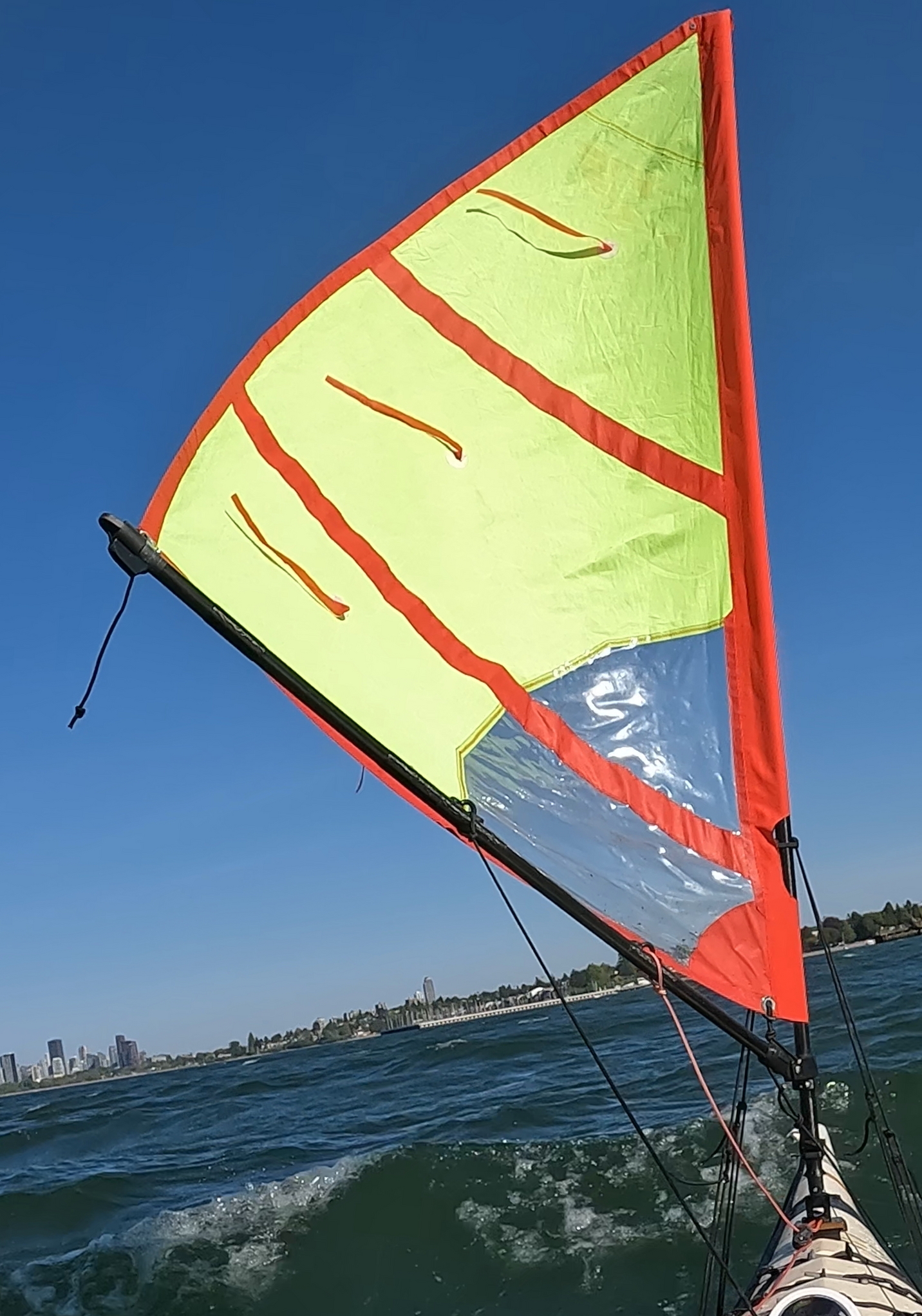
the three red tell-tale ribbons streaming smoothly indicate a well-trimmed sail with maximum lift.
My last example of lift in sea kayaking is rather a special case: when I’m sailing aggressively off or across the wind, where a sudden surge in the windspeed might capsize me, I’ll often lean preemptively upwind, stick my paddle out at a right angle to the boat on that side, and lay the blade just skimming the water’s surface. I angle the leading edge slightly up, so that the boat’s forward motion feeds a constant lift under it. This turns my paddle into a hydrofoil outrigger that I can bear down on hard if I need to counteract a potential capsize.
Whatever forms of lift are at play in your personal paddling, may the flow be with you!

