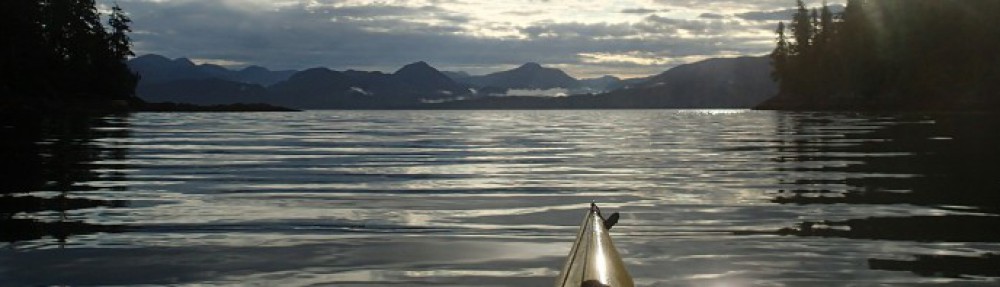
Prologue: Once again the stars (or students) aligned for me to assist my colleague Mike McHolm on a Paddle Canada Level 2 sea kayaking course. Prior to this three day/two night camping trip, we’d done an intense weekend of pretraining with our students at Jericho Beach, heavy on both theory and practice.
Friday, May 16, 2025
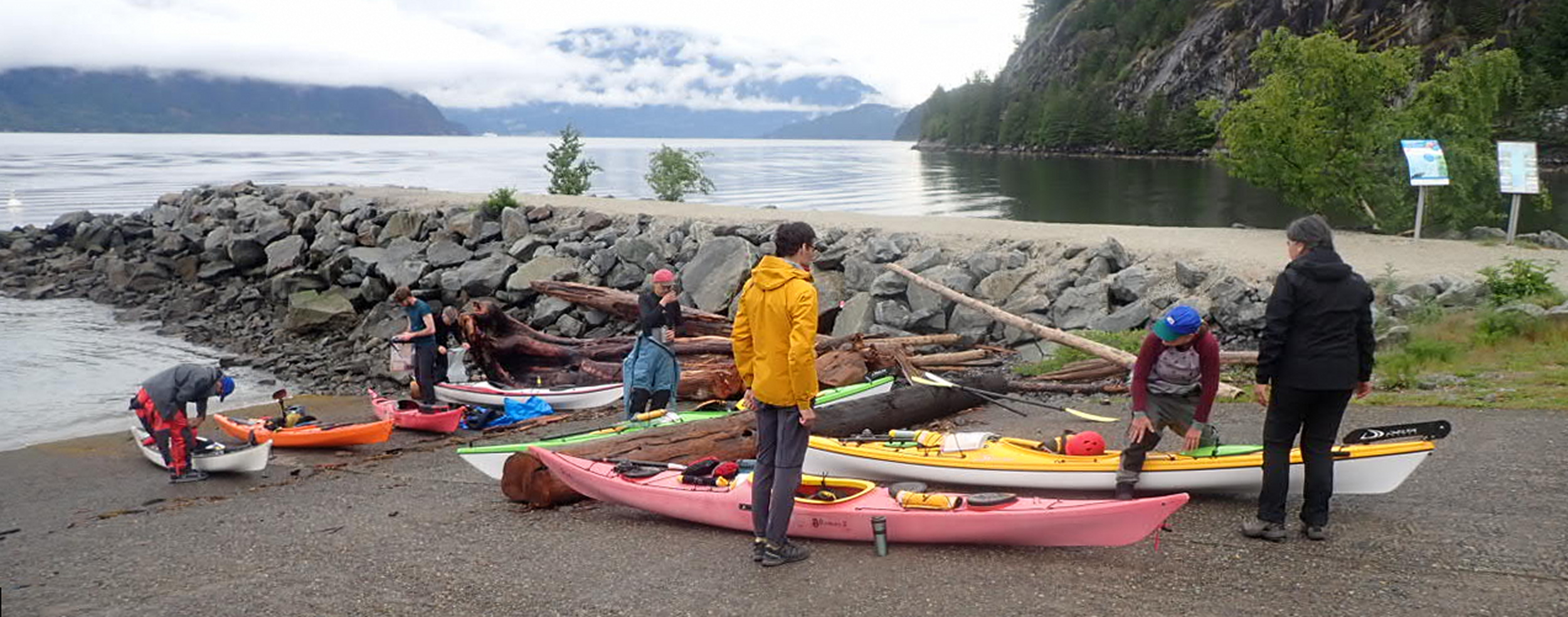
Mike and I rocked up to Xwawchayay (Porteau Cove) to find all the students already arrived and keen to launch. Before that however, we had a bit of learning and planning to do, and gathered round the nearest picnic table as an al fresco classroom.

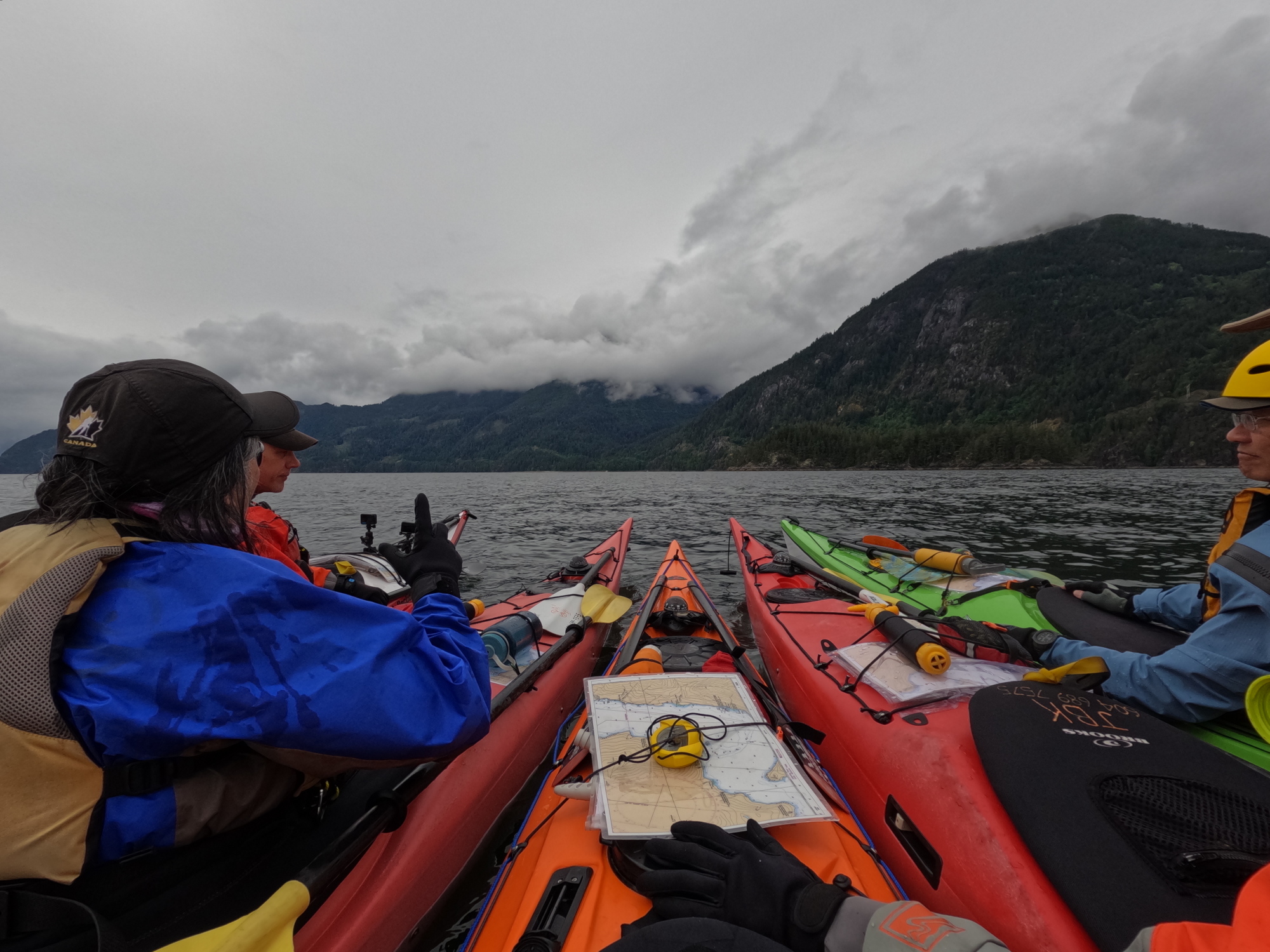
On the crossing, we practiced compass navigation, time-distance-speed calculations and the use of ranges. We made landfall just south of the Defence Islands, then turned north to handrail along the shore to Ts’itpsm (Zorro Bay).
Enroute, we spotted a bear clambering up the cliffs from his seaside shellfish buffet. They were too far away for point-and-shoot cameras, but close enough that our Mark 1 eyeballs could marvel at their massively muscled shoulders. And the steep, rocky slope they were scaling proved their claws were easily the equal of human shinobi shuko and crampons.
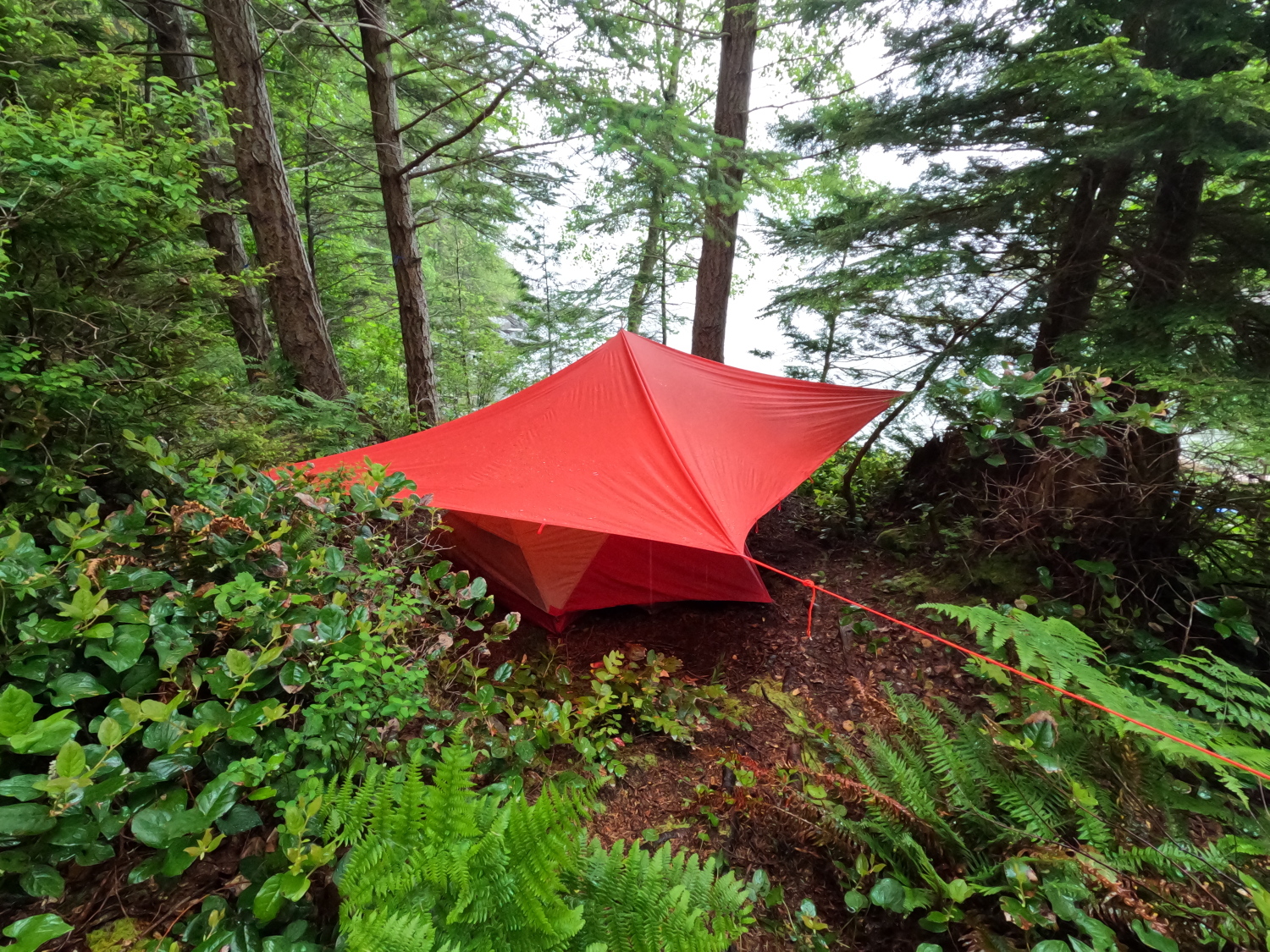
As we landed, showers were drifting in, so one of the first orders of business was to set up a dry central meeting area. I’ll plead guilty to being proud, verging on vain, of my tarpology skills, so I began rigging a roof over the most accessible picnic table. As we’d loaded our boats at Porteau Cove that morning, Mike had politely expressed that the tarp poles I was packing would probably be unnecessary, since he knew of a conveniently located tree at the site. As it turned out, the arborologist who regularly checks the site had decreed the removal of that particular tree since Mike’s last visit. So my precious poles were not a waste of space. I lashed one to a handy root ball to hold it firmly upright, and used it to suspend one end of the tarp ridgeline.
Once we had camp established, with everyone’s tents up, we reconvened at the water’s edge for a rolling clinic. This began on dry land, with Mike leading the students through the “load and drive” motions their legs and torsos should be following. Then it was on—and into—the water, with Mike kneeling next to each kayak in turn to serve as training wheels on the student’s first attempts.


As Mike was teaching, I waded out in what was supposed to be my drysuit to grab some video. An icy sensation flooding down my thighs reminded me I’d forgotten to close the relief zip after pumping my personal bilges on shore. With good reason, Mike laughed as I explained my error. But his turn would come (This is foreshadowing, or perhaps premoistening.)
It’s not a requirement for Level 2 to actually perform a roll, but you do have to have a good grasp of the theory. Impressively, Tony and Gwyn not only pulled off some paddle rolls, but Gwyn also succeeded in hand rolling his boat a time or two. A real testament to their learning and Mike’s teaching.
Once ashore for the day, I hung my drysuit liner suit in my tent’s gear loft, above the candle lantern I always carry in the shoulder seasons, so it could dry. Or at least graduate from saturated to merely clammy.
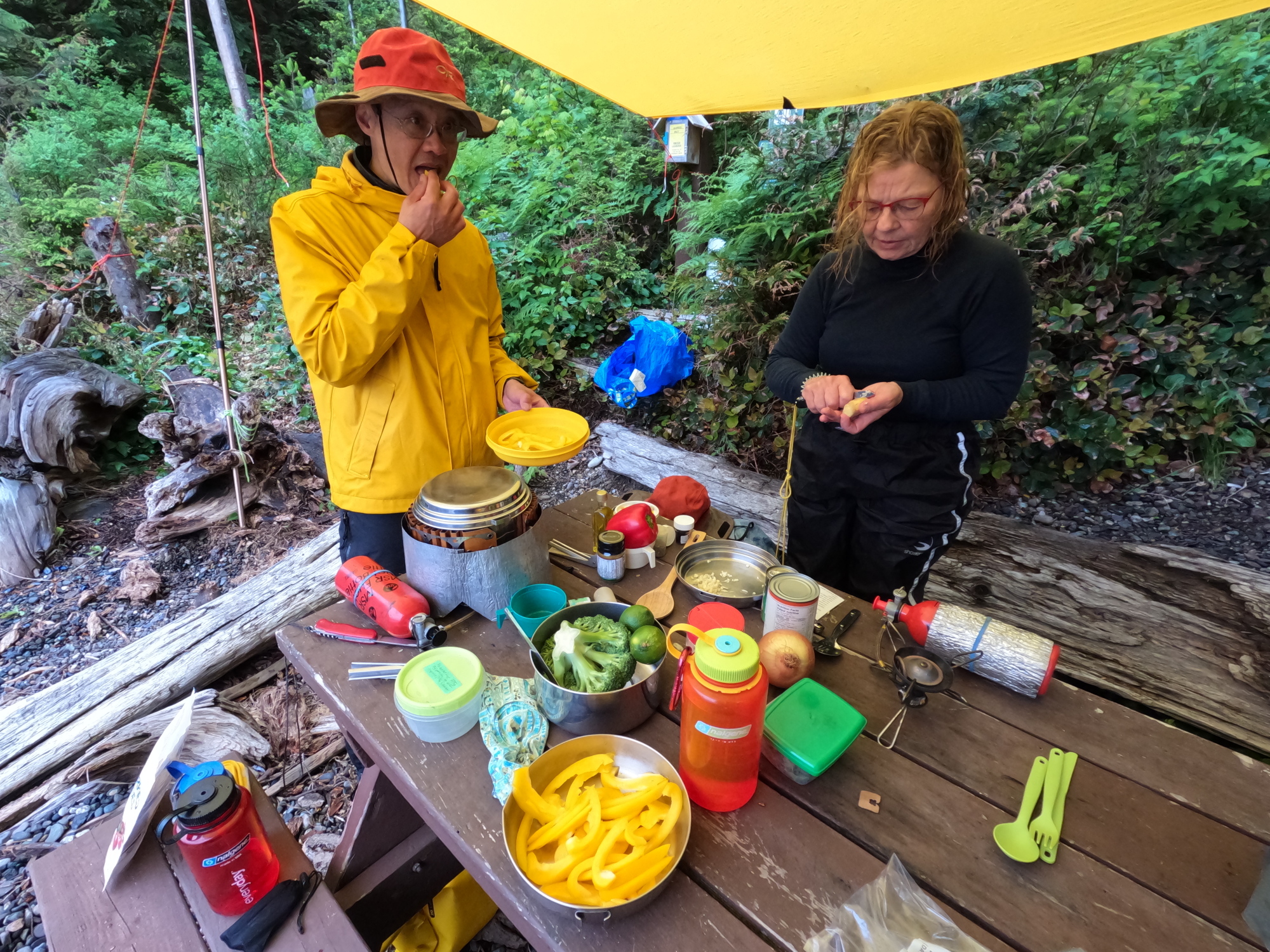
Ray and Dorothy had kindly offered to feed both Mike and I suppers on the nights we were out. And so we were treated to a delicious Thai curry, with lots of fresh veggies.
Saturday, May 17, 2025
After practicing various strokes and techniques in the sheltered waters of Zorro Bay, we set off for our day trip to Islet View campsite. Enroute, we hugged the seaside cliffs as close as possible to use our manouvering strokes.
Since the weather was cool with occasional showers, once we’d landed for lunch at Islet View, I fired up my MSR Windburner to provide hot water for soup and tea. Over years of shoulder season touring, I’ve found alternating bites of any lunch with swigs of hot soup makes even cold sandwiches feel like a hot meal. Appropriately enough, the lunchtime learning topics included managing hypo and hyperthermia.

During our lunch-and-learn, Mike dropped hints that the class might be hit with surprise scenarios on the way back to camp. This so affected one of the students that they felt a sudden urgent need to use the outhouse!
Relaunching was a slow and careful process, as the tide had dropped enough to unsheath rocks with plenty of ankle-twisting and hull-cracking potential.
Enroute to the Defence Islands, we worked on scoop re-entries. A bit after we’d made our turn north, one of our students—Tony—”unexpectedly” capsized, surfaced with a “shoulder injury” and became “hypothermic”. After some initial confusion, the other students responded to this scenario, getting him back in his boat, rafting up another kayaker with him to keep him upright, and beginning a tow.

It was at this point that an interesting wildcard came into play. Ray was towing and the steadily increasing southeasterly inflow was shoving him and his towee to the left, towards the small rocky cape just south of Zorro Bay. Quite correctly, he was doing aggressive sweep strokes on the left, attempting to turn his boat and the towee’s to the right. To his bafflement, no change of direction was happening. The problem, which of course was much easier to detect from the outside, was that his towline was draped over the left back of his boat, and was preventing it from pivoting to the left, as needed to make a right turn. Compounding the difficulty, Ray was paddling his personal Delta kayak, a boat with a rudder, so the line was not free to slide across the stern over to the starboard side. So I paddled alongside, hooked the towline with my paddle and flicked it over to the other side. Detecting and overcoming glitches like this is precisely why we practice scenarios!
By this time, as Mike happily noted, we had full-on Level 2 conditions – strong winds and regular spilling whitecaps. So he gleefully declared the towing scenario concluded and directed all students into the water to practice their solo re-entries in just the kind of conditions in which they might be capsized for real. As the students had experienced on our pre-trip prep weekend, doing re-entries of any kind in sporty waves is a whole different kettle of kayaks than in the millpond calm or light chop of Beginner or Level 1 seas.
By the time each student eventually succeeded in reboarding, they were pretty tired and cold. So at Mike’s direction, I ran a shuttle escort service, accompanying ones and twos into the shelter of Zorro Bay—which was by now south of us—and returning for the next refugees as Mike drifted further north with those students still in the water. On my last turn around, I had a briefly concerning moment. Mike had been calling me on the radio, but due to water damage on his VHF, the transmissions were as faint and garbled as if he were signalling from Mars. And when I turned to run north, he and his students were nowhere to be seen. Until, that is, I had the sense to scan more westwards, towards the shoreline, where they were all steadily and safely clawing their way south.
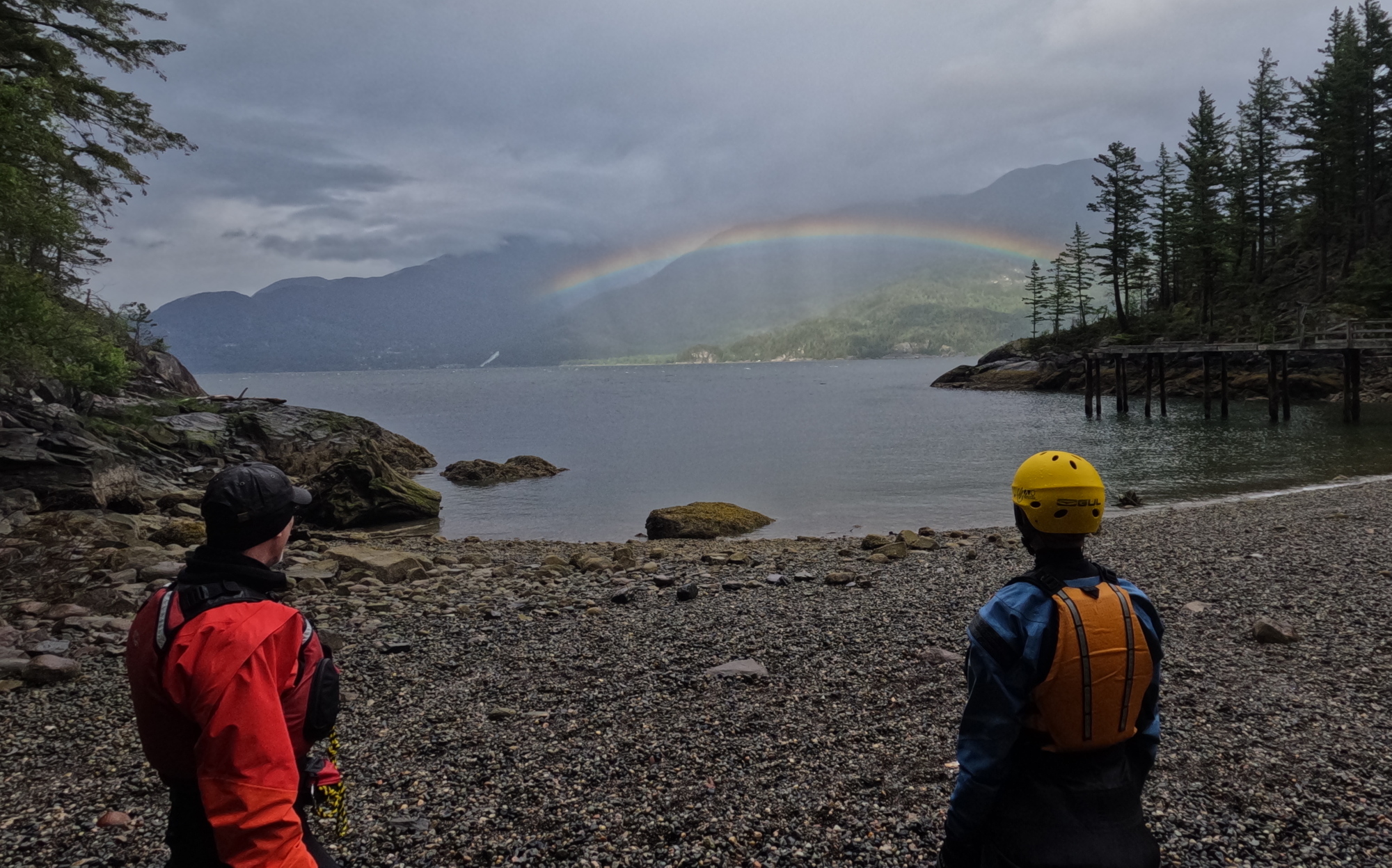
Just as the last of us landed, a spectacular rainbow lit up on the eastern shore of the sound. I’m not religious, but I’m pretty sure I remember reading that the rainbow is supposed to represent some deity’s promise that they are done with drowning people. So a good sign, then.
Sunday, May 18, 2025
We started the morning practicing hanging draws, followed by bow rescues. During one of his inversions, Mike discovered he’d made the same “leave the barn door open” oversight with his drysuit relief zipper as I had a couple of days before. So karmic balance was restored to the universe. It will be my turn again next time, I’m sure.

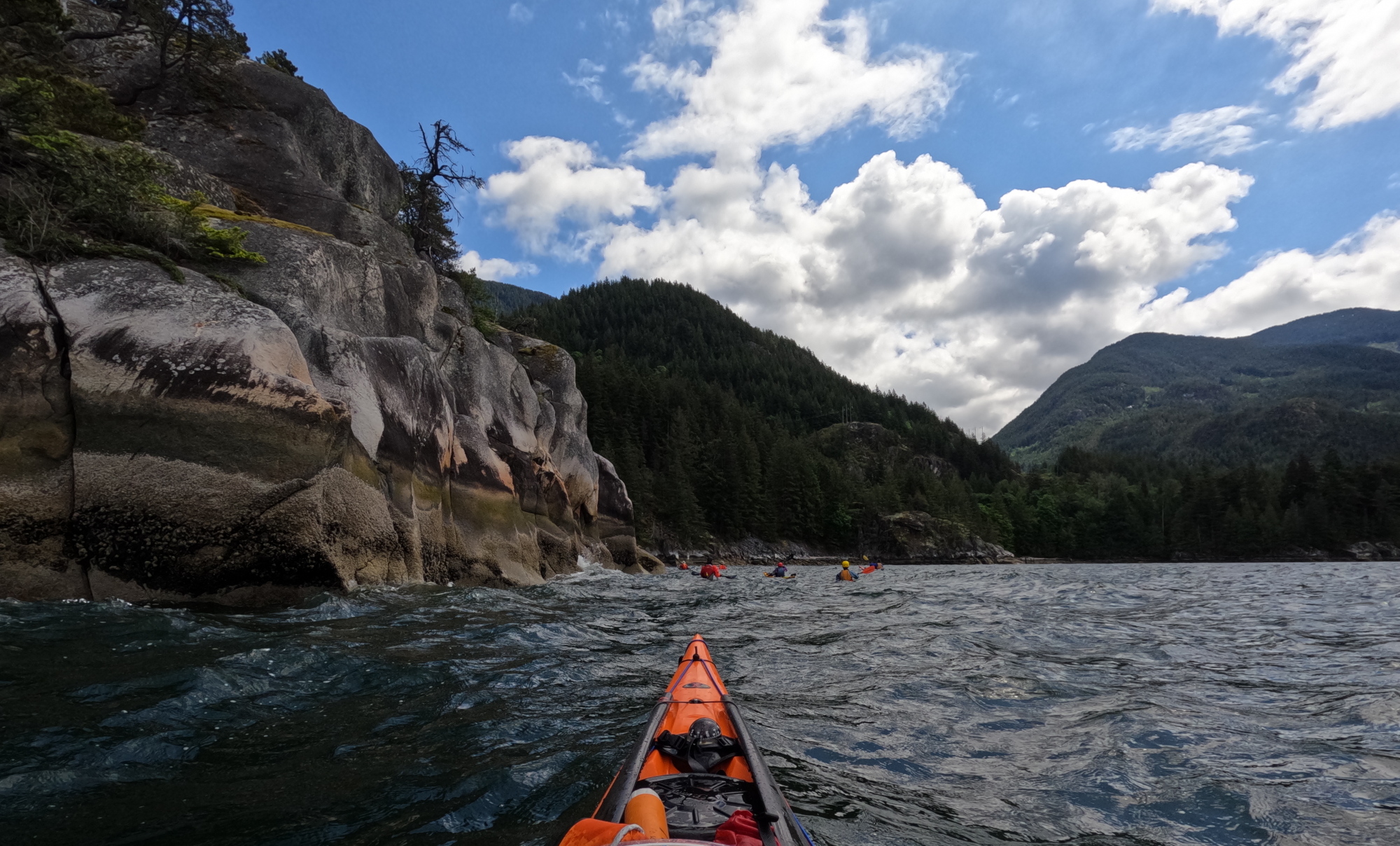
Our route, carefully planned prior to launch, took us east across Howe Sound to make landfall just north of Furry Creek, where we’d turn south to dogleg back to Porteau Cove. As the marine forecast had predicted, the southerly inflow was picking up nicely by the time we launched, so we had fine Level 2 conditions, or “Mike’s Delight” as I’m starting to call them: 1 to 2 foot seas with a high proportion of spilling whitecaps, all straight on our starboard sides, so we occasionally had to convert our forward strokes to slight sweep braces, or be ready to slap down a low brace.
I have a semi-unconscious response, developed during years of solo touring, to paddling in lively seas: I burst out into sea shanties. Fortunately for the rest of the group, the wind snatched away most of what we’ll call, for want of a better word, my singing. So they were not subjected to my offkey and misremembered version of “Jack was every inch a sailor.”
As we handrailed south down the shoreline to Porteau Cove, we deliberately hugged the cliffs, enjoying the rollercoaster ride as the clapotis pinged off the walls to create sharp peaks and valleys in the water.
Just before landing at Porteau, Mike initiated the final exercise of the course: the “all in” where the entire class capsizes simultaneously, then helps one another reboard.
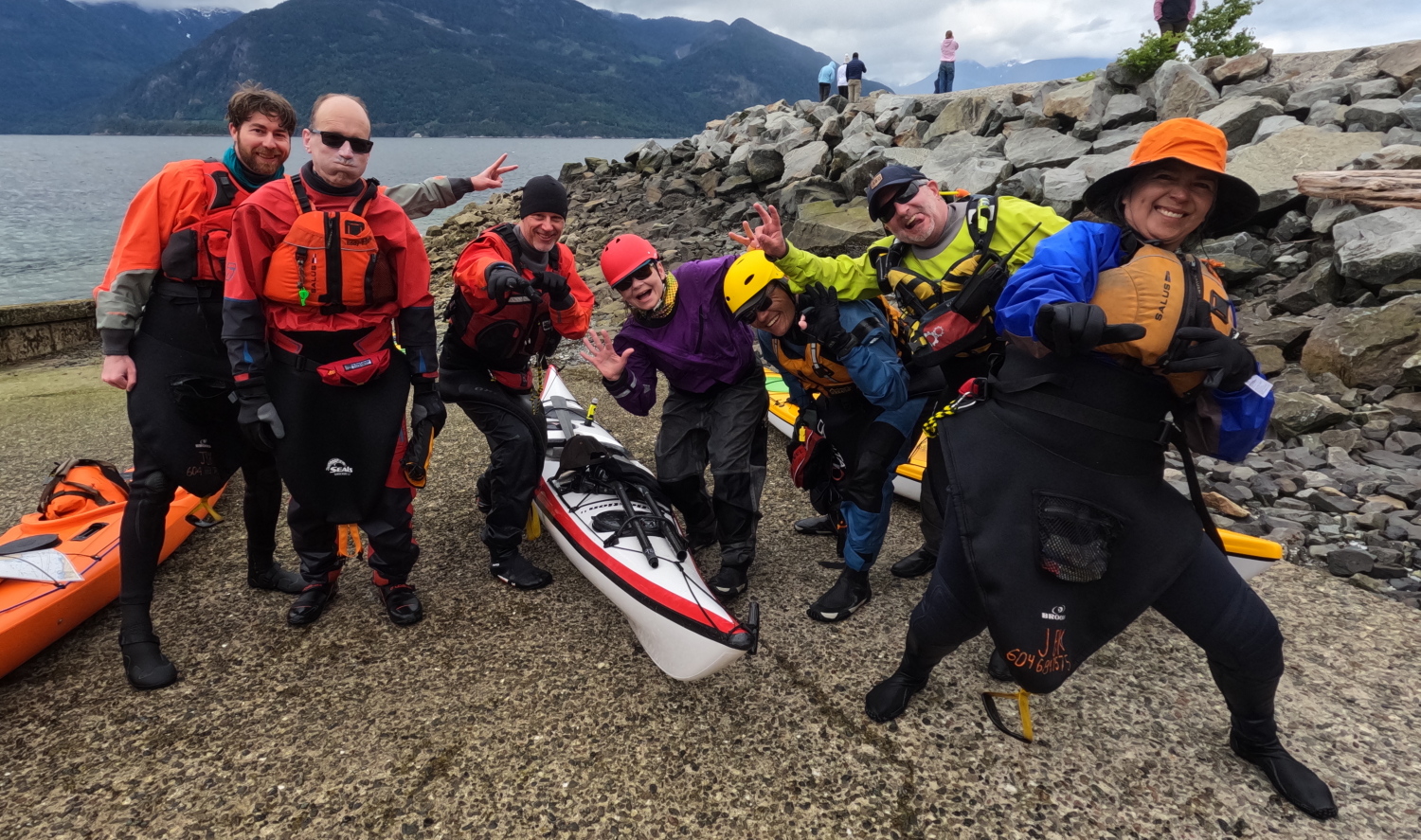
Not long after that, we were safely ashore. After debriefing with each student individually, Mike and I set off to return the kayaks and gear to Jericho Beach Kayak. It was a very long day by the time we were finished and home, but as always, we were energized by the students’ enthusiastic response to the course and its challenges.
Mike has made another of his excellent videos, with footage of many of the events described in this post.

 Kayakwriter's Blog