On the Level again: assisting on a second Level 2 Sea Kayaking course

Featured

Prologue: Once again the stars (or students) aligned for me to assist my colleague Mike McHolm on a Paddle Canada Level 2 sea kayaking course. Prior to this three day/two night camping trip, we’d done an intense weekend of pretraining with our students at Jericho Beach, heavy on both theory and practice.  

Friday, May 16, 2025

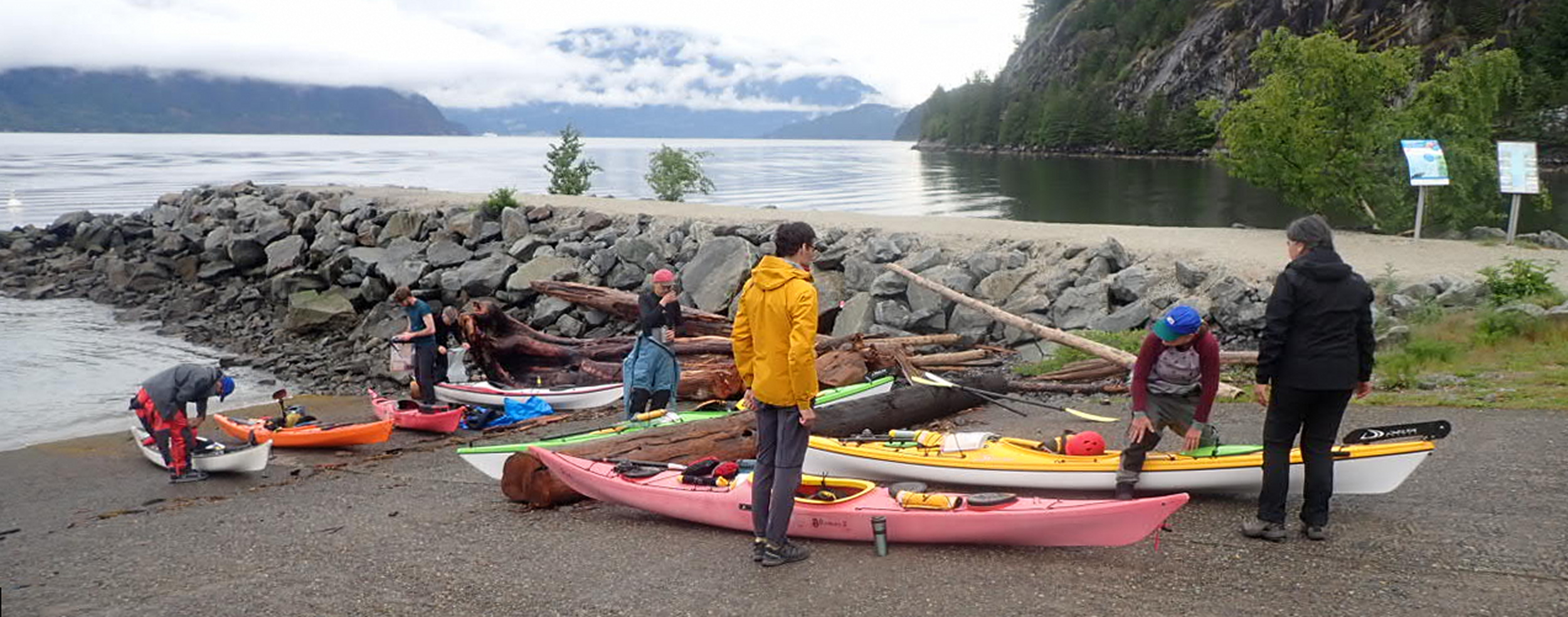
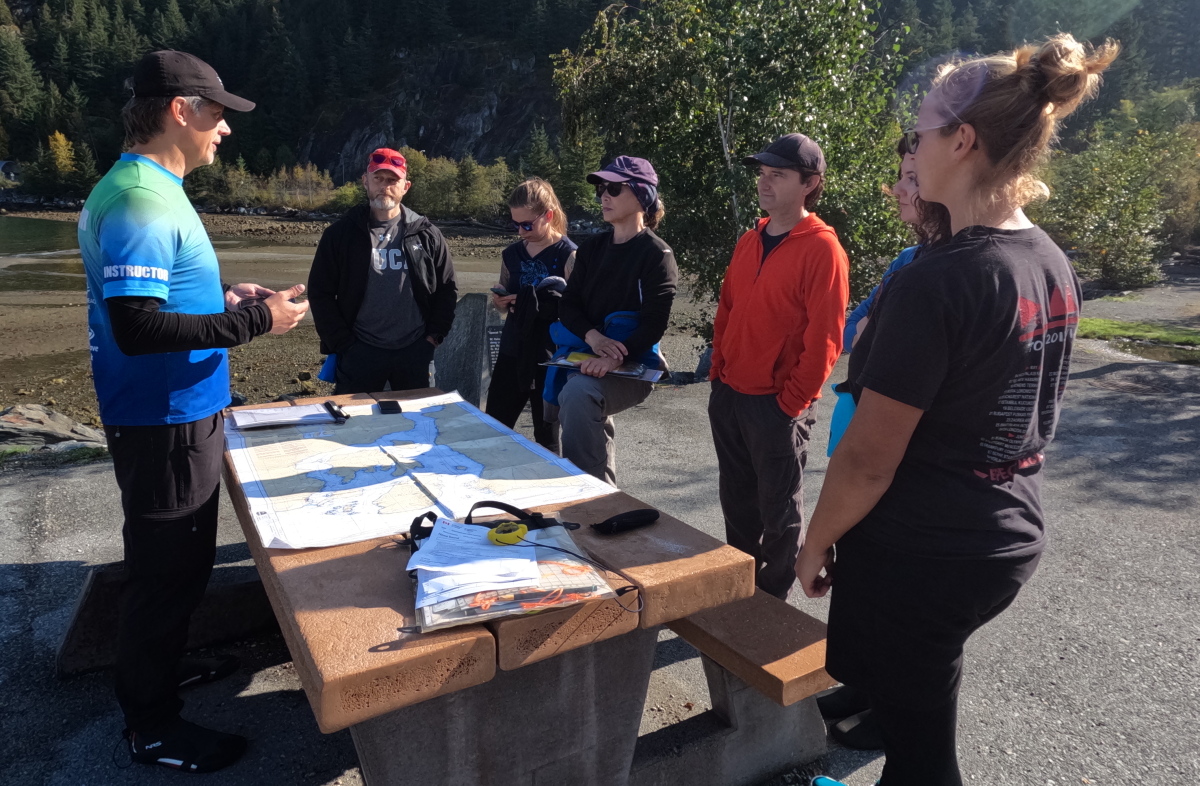
Mike and I rocked up to Xwawchayay (Porteau Cove) to find all the students already arrived and keen to launch. Before that however, we had a bit of learning and planning to do, and gathered round the nearest picnic table as an al fresco classroom. 

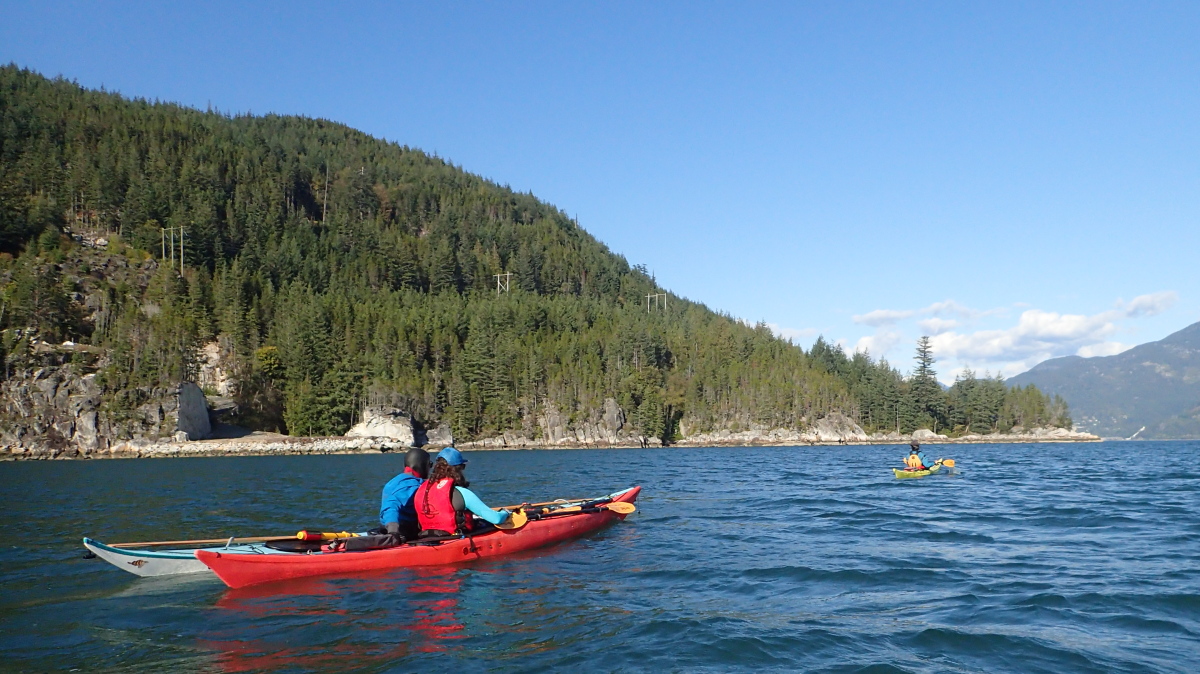
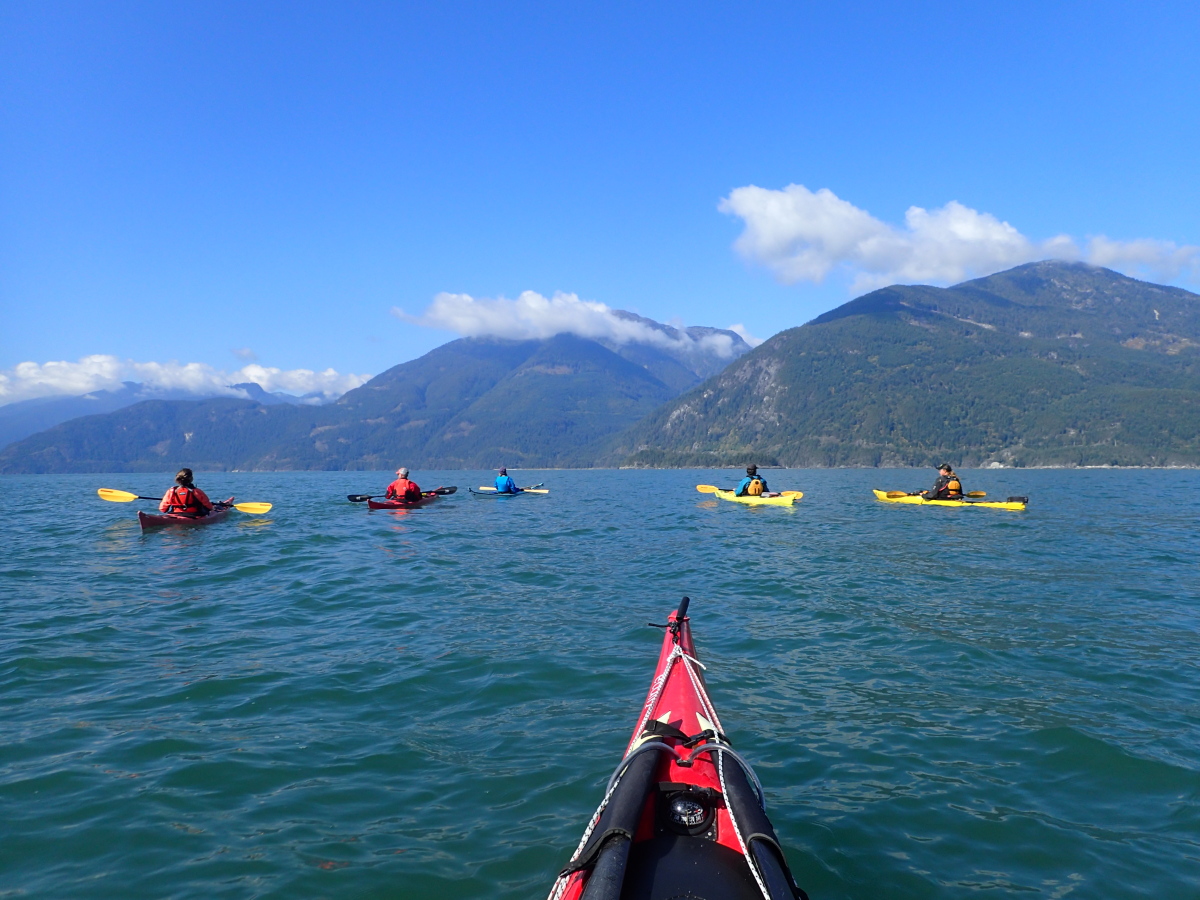
On the crossing, we practiced compass navigation, time-distance-speed calculations and the use of ranges. We made landfall just south of the Defence Islands, then turned north to handrail along the shore to Ts’itpsm (Zorro Bay).
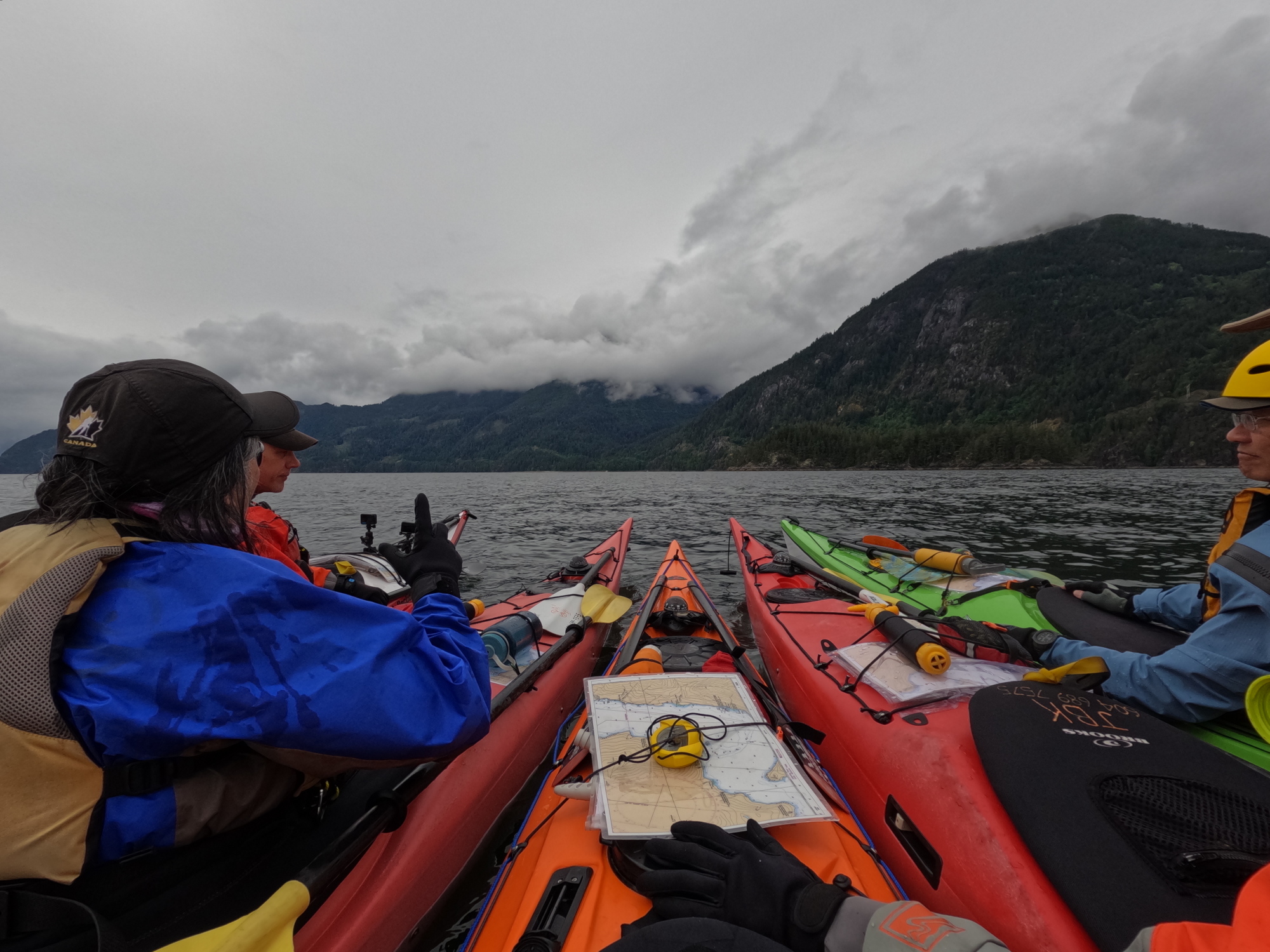
Mid-channel course check-in

Enroute, we spotted a bear clambering up the cliffs from his seaside shellfish buffet. They were too far away for point-and-shoot cameras, but close enough that our Mark 1 eyeballs could marvel at their massively muscled shoulders. And the steep, rocky slope they were scaling proved their claws were easily the equal of human shinobi shuko and crampons.

As we landed, showers were drifting in, so one of the first orders of business was to set up a dry central meeting area. I’ll plead guilty to being proud, verging on vain, of my tarpology skills, so I began rigging a roof over the most accessible picnic table. As we’d loaded our boats at Porteau Cove that morning, Mike had politely expressed that the tarp poles I was packing would probably be unnecessary, since he knew of a conveniently located tree at the site. As it turned out, the arborologist who regularly checks the site had decreed the removal of that particular tree since Mike’s last visit. So my precious poles were not a waste of space. I lashed one to a handy root ball to hold it firmly upright, and used it to suspend one end of the tarp ridgeline. 
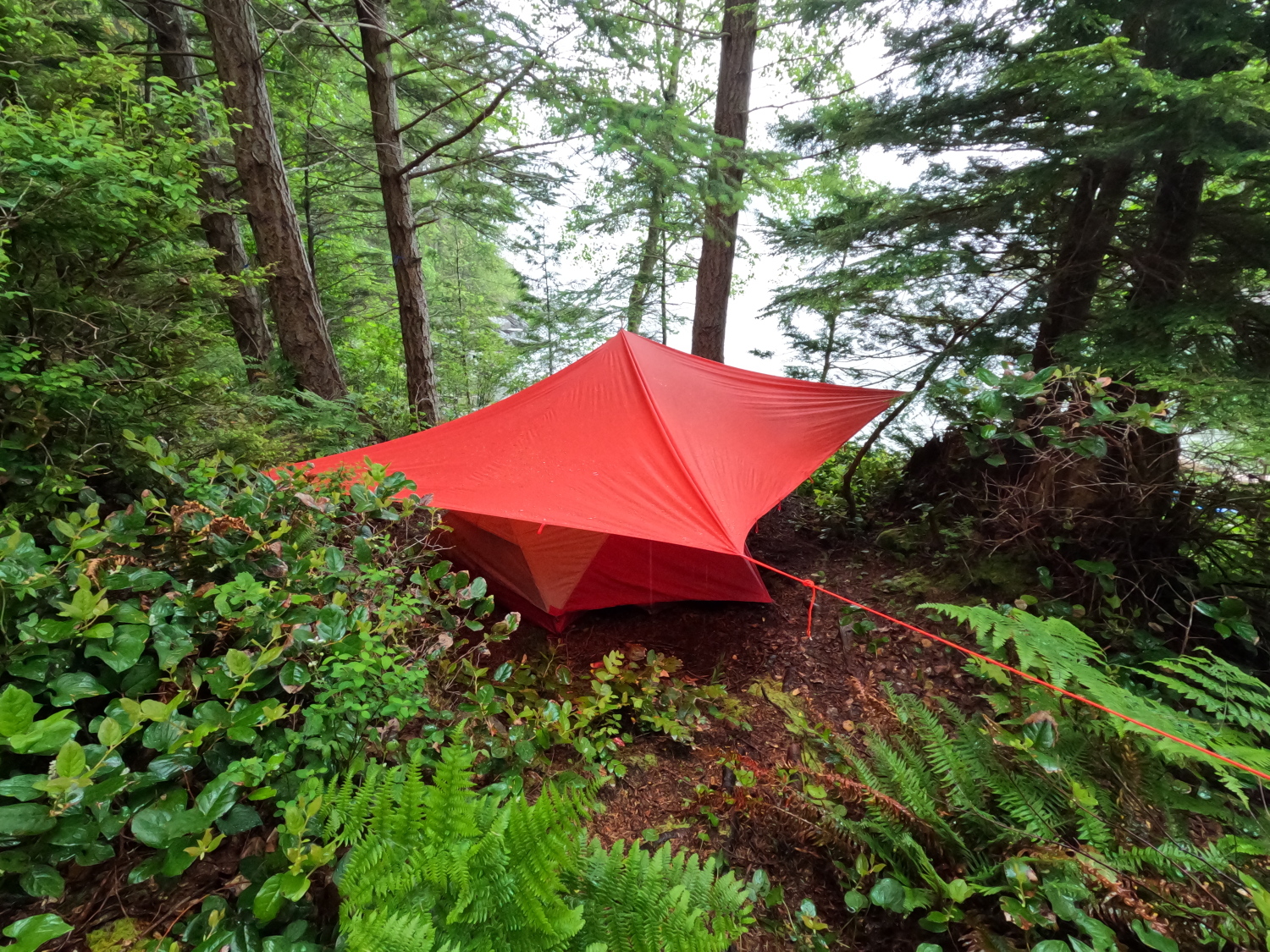
Home, sweet home.

Once we had camp established, with everyone’s tents up, we reconvened at the water’s edge for a rolling clinic. This began on dry land, with Mike leading the students through the “load and drive” motions their legs and torsos should be following. Then it was on—and into—the water, with Mike kneeling next to each kayak in turn to serve as training wheels on the student’s first attempts.    

This is not martial arts training with a Greenland paddle (though Mike is arguably a Sensei): this is dryland rehearsal of the leg loads and drives that make for a successful kayak roll.
Setting up for the sweep, with Mike as “training wheels”.

As Mike was teaching, I waded out in what was supposed to be my drysuit to grab some video. An icy sensation flooding down my thighs reminded me I’d forgotten to close the relief zip after pumping my personal bilges on shore. With good reason, Mike laughed as I explained my error. But his turn would come (This is foreshadowing, or perhaps premoistening.)

It’s not a requirement for Level 2 to actually perform a roll, but you do have to have a good grasp of the theory. Impressively, Tony and Gwyn not only pulled off some paddle rolls, but Gwyn also succeeded in hand rolling his boat a time or two. A real testament to their learning and Mike’s teaching.

Once ashore for the day, I hung my drysuit liner suit in my tent’s gear loft, above the candle lantern I always carry in the shoulder seasons, so it could dry. Or at least graduate from saturated to merely clammy.

Ray and Dorothy had kindly offered to feed both Mike and I suppers on the nights we were out. And so we were treated to a delicious Thai curry, with lots of fresh veggies.
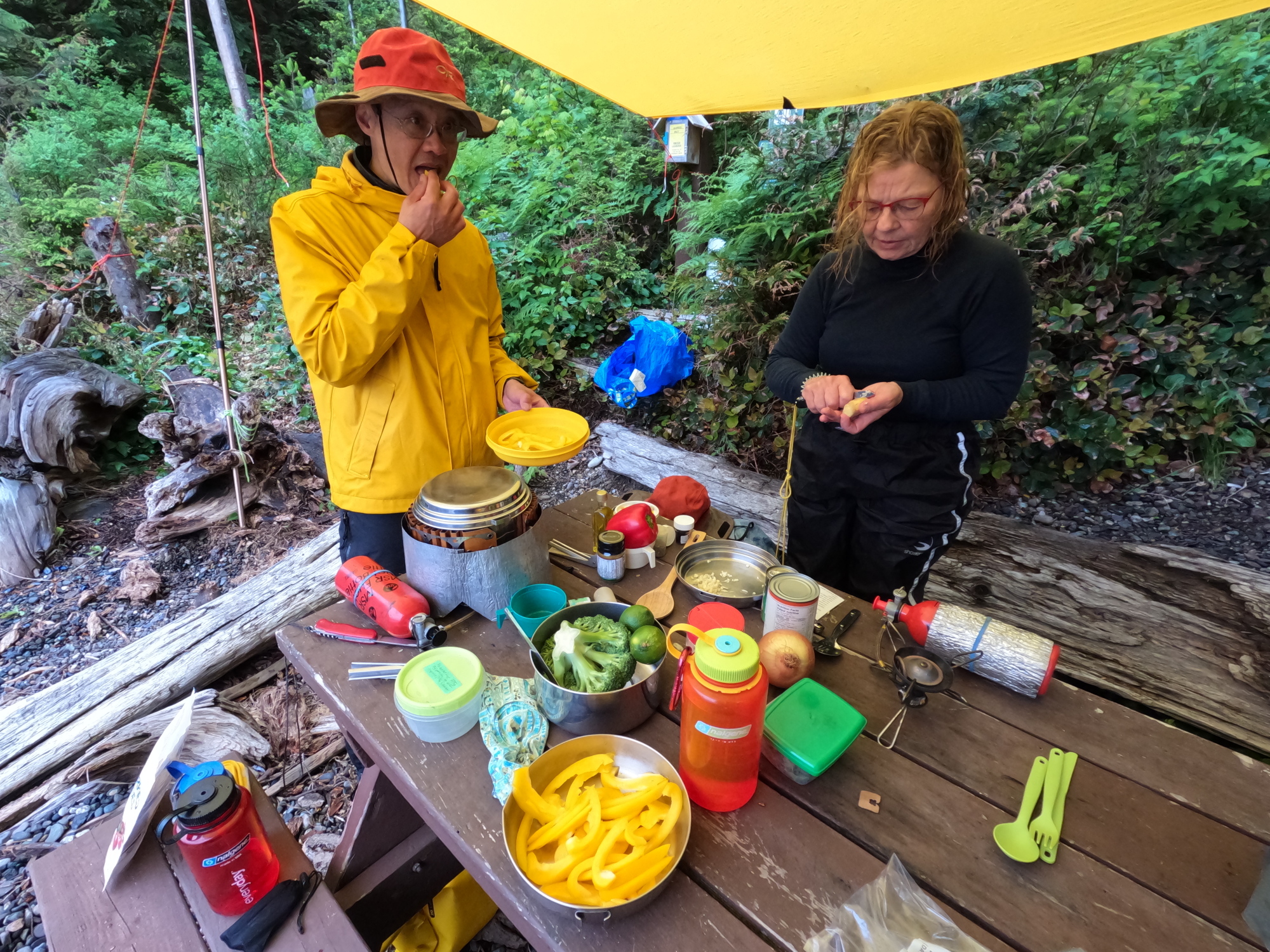
No scurvy on this sea voyage: fresh veggies ahoy!

Saturday, May 17, 2025

After practicing various strokes and techniques in the sheltered waters of Zorro Bay, we set off for our day trip to Islet View campsite. Enroute, we hugged the seaside cliffs as close as possible to use our manouvering strokes. 

Since the weather was cool with occasional showers, once we’d landed for lunch at Islet View, I fired up my MSR Windburner to provide hot water for soup and tea. Over years of shoulder season touring, I’ve found alternating bites of any lunch with swigs of hot soup makes even cold sandwiches feel like a hot meal. Appropriately enough, the lunchtime learning topics included managing hypo and hyperthermia.

During our lunch-and-learn, Mike dropped hints that the class might be hit with surprise scenarios on the way back to camp. This so affected one of the students that they felt a sudden urgent need to use the outhouse!   

Relaunching was a slow and careful process, as the tide had dropped enough to unsheath rocks with plenty of ankle-twisting and hull-cracking potential. 

Enroute to the Defence Islands, we worked on scoop re-entries. A bit after we’d made our turn north, one of our students—Tony—”unexpectedly” capsized, surfaced with a “shoulder injury” and became “hypothermic”. After some initial confusion, the other students responded to this scenario, getting him back in his boat, rafting up another kayaker with him to keep him upright, and beginning a tow.

“Saving” Tony

It was at this point that an interesting wildcard came into play. Ray was towing and the steadily increasing southeasterly inflow was shoving him and his towee to the left, towards the small rocky cape just south of Zorro Bay. Quite correctly, he was doing aggressive sweep strokes on the left, attempting to turn his boat and the towee’s to the right. To his bafflement, no change of direction was happening. The problem, which of course was much easier to detect from the outside, was that his towline was draped over the left back of his boat, and was preventing it from pivoting to the left, as needed to make a right turn. Compounding the difficulty, Ray was paddling his personal Delta kayak, a boat with a rudder, so the line was not free to slide across the stern over to the starboard side. So I paddled alongside, hooked the towline with my paddle and flicked it over to the other side. Detecting and overcoming glitches like this is precisely why we practice scenarios!  

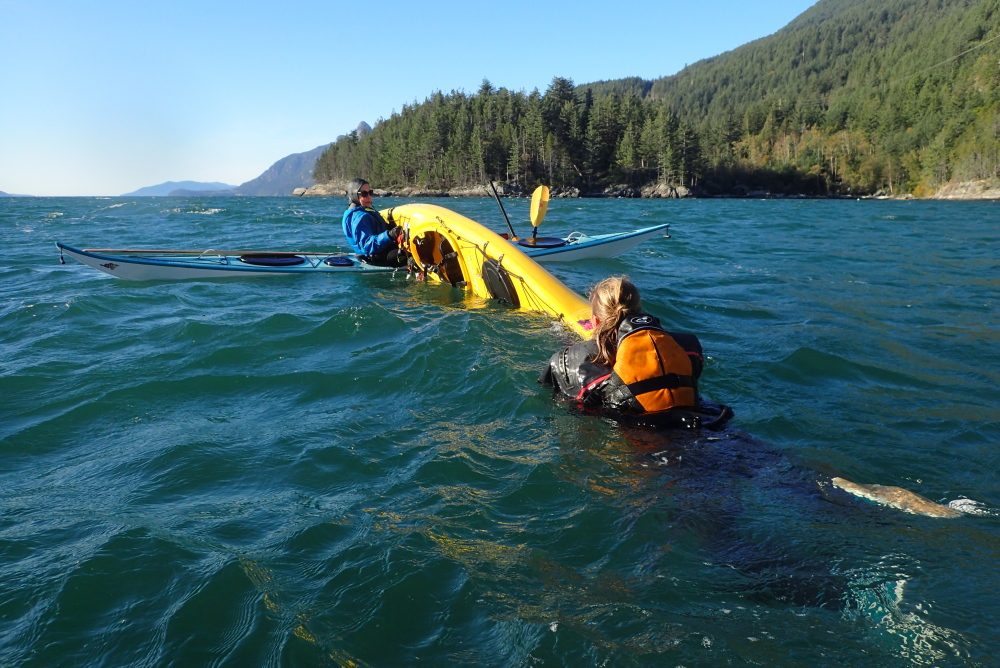
By this time, as Mike happily noted, we had full-on Level 2 conditions – strong winds and regular spilling whitecaps. So he gleefully declared the towing scenario concluded and directed all students into the water to practice their solo re-entries in just the kind of conditions in which they might be capsized for real. As the students had experienced on our pre-trip prep weekend, doing re-entries of any kind in sporty waves is a whole different kettle of kayaks than in the millpond calm or light chop of Beginner or Level 1 seas. 

By the time each student eventually succeeded in reboarding, they were pretty tired and cold. So at Mike’s direction, I ran a shuttle escort service, accompanying ones and twos into the shelter of Zorro Bay—which was by now south of us—and returning for the next refugees as Mike drifted further north with those students still in the water. On my last turn around, I had a briefly concerning moment. Mike had been calling me on the radio, but due to water damage on his VHF, the transmissions were as faint and garbled as if he were signalling from Mars. And when I turned to run north, he and his students were nowhere to be seen. Until, that is, I had the sense to scan more westwards, towards the shoreline, where they were all steadily and safely clawing their way south.    

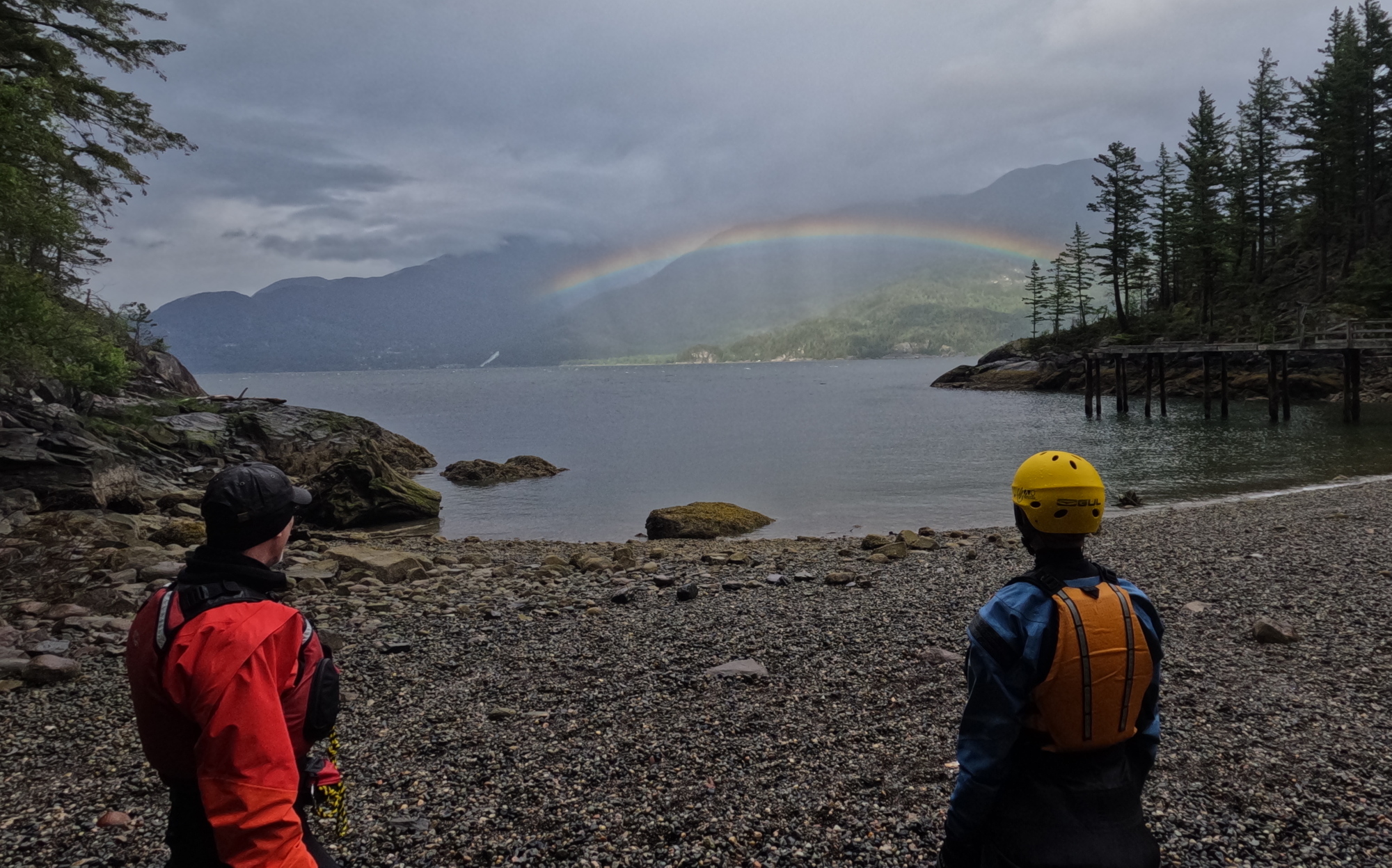
Just as the last of us landed, a spectacular rainbow lit up on the eastern shore of the sound. I’m not religious, but I’m pretty sure I remember reading that the rainbow is supposed to represent some deity’s promise that they are done with drowning people. So a good sign, then.
Sunday, May 18, 2025

We started the morning practicing hanging draws, followed by bow rescues. During one of his inversions, Mike discovered he’d made the same “leave the barn door open” oversight with his drysuit relief zipper as I had a couple of days before. So karmic balance was restored to the universe. It will be my turn again next time, I’m sure. 

Bow to your partner! A great way to prevent wet exits.

Our route, carefully planned prior to launch, took us east across Howe Sound to make landfall just north of Furry Creek, where we’d turn south to dogleg back to Porteau Cove. As the marine forecast had predicted, the southerly inflow was picking up nicely by the time we launched, so we had fine Level 2 conditions, or “Mike’s Delight” as I’m starting to call them: 1 to 2 foot seas with a high proportion of spilling whitecaps, all straight on our starboard sides, so we occasionally had to convert our forward strokes to slight sweep braces, or be ready to slap down a low brace.

I have a semi-unconscious response, developed during years of solo touring, to paddling in lively seas: I burst out into sea shanties. Fortunately for the rest of the group, the wind snatched away most of what we’ll call, for want of a better word, my singing. So they were not subjected to my offkey and misremembered version of “Jack was every inch a sailor.”   

As we handrailed south down the shoreline to Porteau Cove, we deliberately hugged the cliffs, enjoying the rollercoaster ride as the clapotis pinged off the walls to create sharp peaks and valleys in the water. 
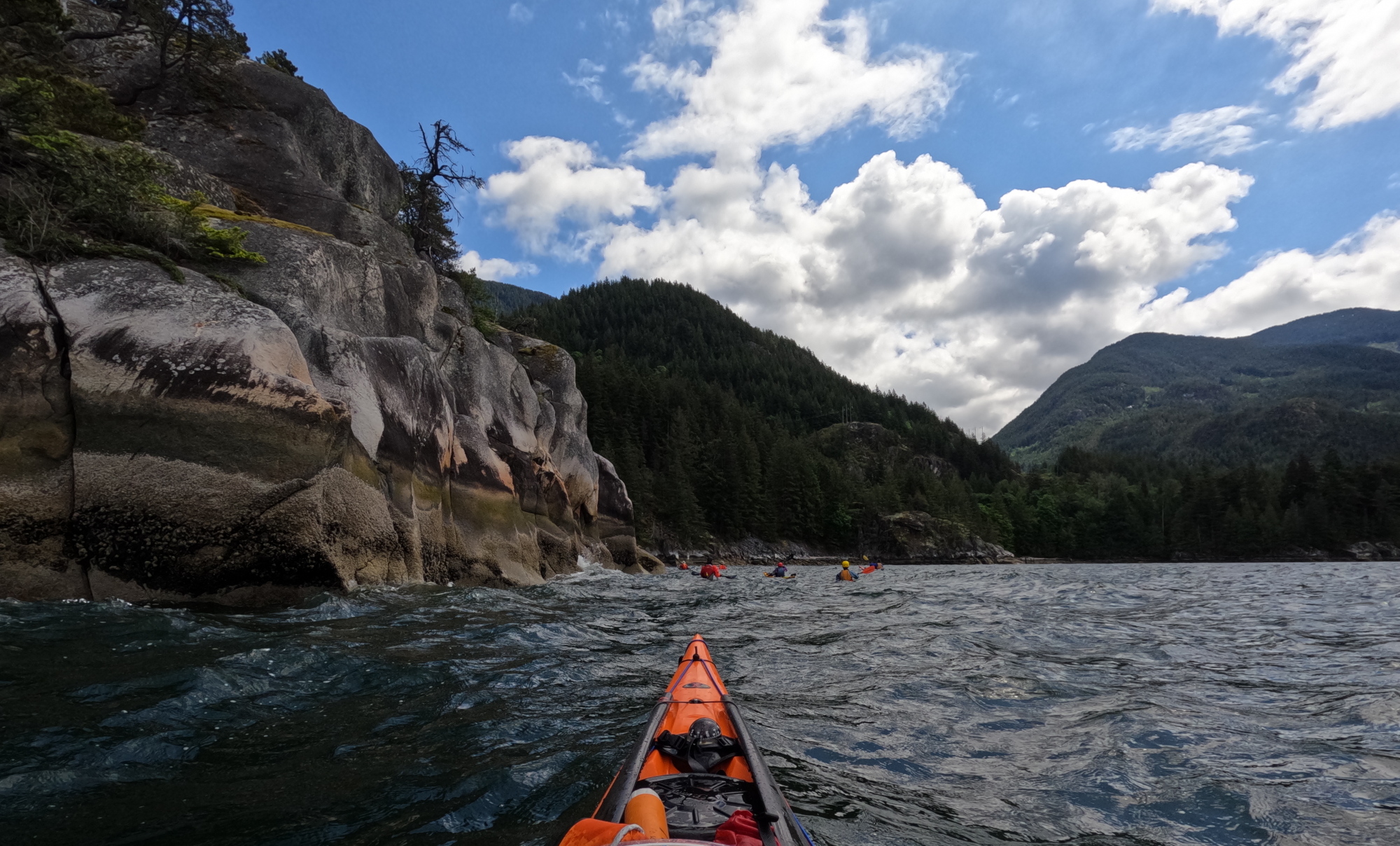
Rocks and roll: Lumpy seas alongside the cliffs.

Just before landing at Porteau, Mike initiated the final exercise of the course: the “all in” where the entire class capsizes simultaneously, then helps one another reboard.
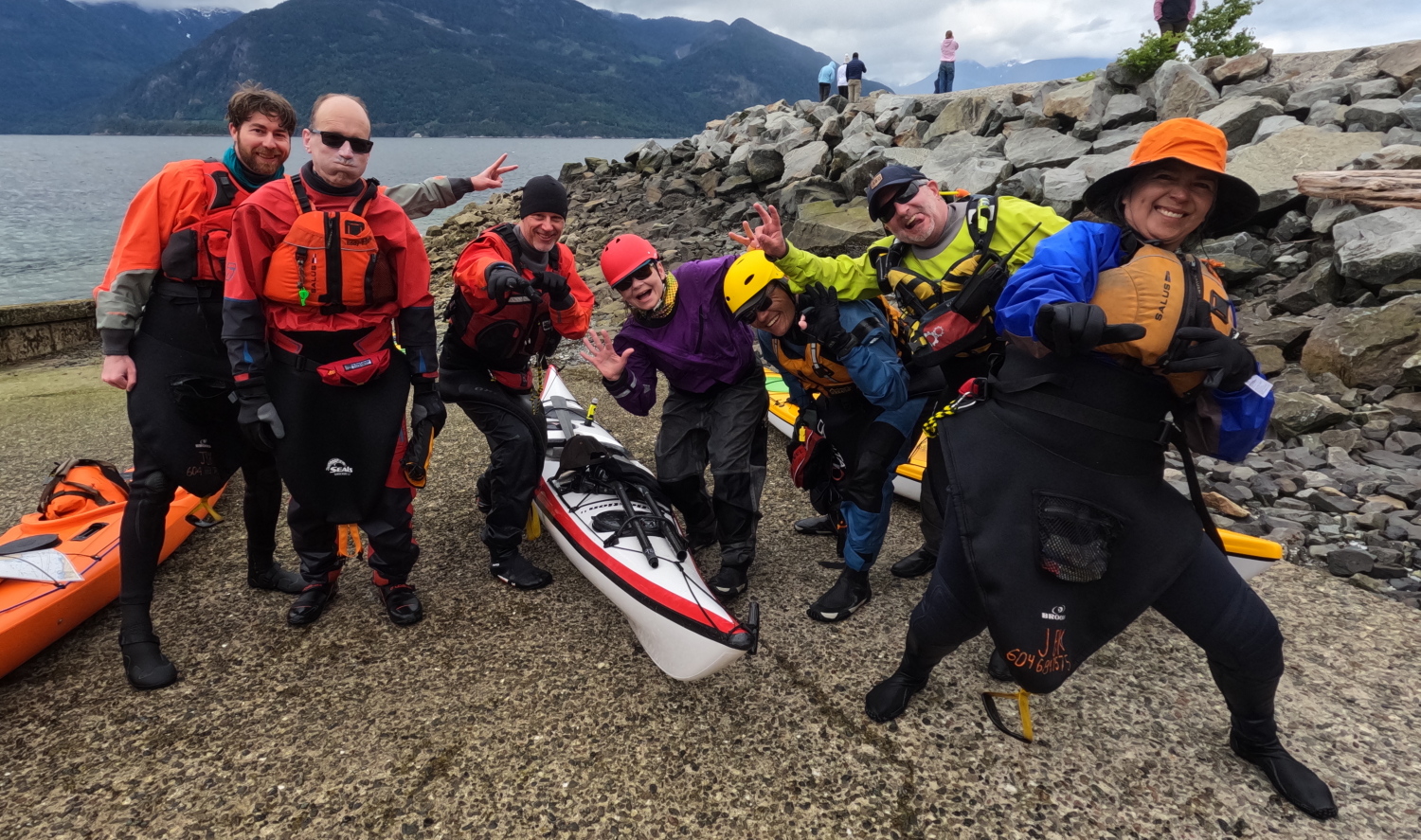
Happy landings!

Not long after that, we were safely ashore. After debriefing with each student individually, Mike and I set off to return the kayaks and gear to Jericho Beach Kayak. It was a very long day by the time we were finished and home, but as always, we were energized by the students’ enthusiastic response to the course and its challenges.  

Mike has made another of his excellent videos, with footage of many of the events described in this post.
Leveling Up: assisting on a Paddle Canada Sea Kayaking Level 2 course

Featured

I hugely enjoy my work as a sea kayak instructor, but since I’m only certified to teach up to Paddle Canada’s Sea Kayaking Level 1 on my own, I usually just get to paddle locally in the Iy̓ál̓mexw/Ayyulshun (Jericho Beach/English Bay) area with my students. So when the opportunity arose to assistant-instruct on a Paddle Canada Level 2 Sea Kayaking course, with three days and two nights away in Átl’ka7tsem/Txwnéwu7ts (Howe Sound), I was in faster than you can say “re-entry roll”!

Sweetening the pot was the fact that my friend and colleague, Mike McHolm, would be the lead instructor on the course. I’ve known Mike since he was a customer at the late, lamented Ecomarine. Mike absolutely caught fire as a kayaker, and recently earned his Paddle Canada Sea Kayaking Level 4 (for those not in the know, that’s about one step below being able to calm the seas and walk on the water.)

Mike and I have co-instructed on Paddle Canada Beginner Sea Kayaking and Intermediate (Level 1) courses before, and found we have nicely complementary skill sets: he’s the master of advanced strokes, braces, scrambles and rolls; I’ve got a solid background of practical experience with extended touring and navigation.

The prep for the trip portion of the course included two intense days of on-water and on-shore instruction at Jericho Beach over the September 16-17 weekend. As it happened, three of the six students in this Level 2 course were graduates of a Paddle Canada Level 1 course I’d taught the weekend before.    

September 29, 2023

A bit after 8AM, Mike and I rolled into Xwawchayay (Porteau Cove) in the Yakmobile (a Yukon truck with a custom-made roof rack that can accommodate up to ten kayaks). As we offloaded the boats, our students joined us. The usual knocked-over-anthill scurrying about ensued, as we all packed our kayaks for the first time on this trip. Next, we had a pre-launch meeting, where we went over “Me, We, and The Sea”, reviewed some compass navigation and dead reckoning techniques, confirmed our planned route, and designated lead and sweep paddlers.

sea kayak students at a prelaunch briefing
prelaunch briefing at Xwawchayay/Porteau Cove

We launched around 12:15PM onto calm and sunny seas, course set for the Defence Islands. About 45 minutes later we hit the gap between them, pretty much bang on our time-distance-speed prediction. 

sea kayakers crossing to the Defence Islands in Howe Sound, British Columbia
Crossing to the Defence Islands

From there, we handrailed along the shoreline to Ts’itpsm (Zorro Bay), practicing our bow and stern rudders as we went. The slight inflow wind that had picked up nudged us gently on our way.

Our class included many with prior sea kayaking experience, including Chessy, who’s previously paddled with Mike in some serious seas. She entertained us (and cooled herself off) by nonchalantly popping off both paddle and hand rolls enroute.

a sea kayaker handrolls her kayak
Chessy handrolls

We arrived at Zorro Bay to find, amazingly for a long weekend with such nice weather, that we had it all to ourselves. Some of us doubled up our tents on the pads sites to leave at least one platform open for possible later arrivals.

sea kayakers arriving at Zorro Bay/Ts’itpsm, Howe Sound, British Columbia
Arriving at Zorro Bay/Ts’itpsm. That’s me in the attractive orange Nor’western hat. Thanks to Julia for this image.

At about 15:30, we relaunched into the bay to work on bow and stern rudders and hanging draws. The shallow waters of the bay were turquoise, which combined with the sunshine to create an almost tropical vibe.

Actually performing a roll is not a requirement to pass Sea Kayaking Level 2: you’ve just got to be able to demonstrate you understand the theory. But Mike had led a rolling session during our pre-trip prep weekend, and some students had really gotten into it, among them Leah. Spotted by Chessy (she who had demonstrated hand rolls earlier), Leah pulled off a few paddle rolls herself before coming ashore.

Mike McHolm sea kayak instructing

stern rudder practice in Zorro Bay

Evening class was on knots and ropework as related to rigging tarps over tents and kitchens. Fortunately, this was all merely theoretical, as the clear skies continued.

With all this learning, we dined European-style late. The main course was a spicy dish of noodles in peanut sauce with stir-fried veggies, including wild-harvested mushrooms courtesy of Claus and Alysia (since none of us started tripping out or tripping over, we can assume they know their ‘shrooms.) For dessert, I heated a deep-dish apple pie in my Outback Oven ‘til it had a convincingly fresh-baked feel, then topped it with real, albeit aerosol-can, whipped cream. (In response to questions from the class, I did acknowledge that I’m not always sure whether I eat in order to kayak tour, or kayak tour in order to eat…)

I got to bed about 10PM. Initially it was warm enough that I merely draped my winter-weight down bag over myself duvet-style, but later in the night things cooled down enough that I burrowed into it full mummy-style, and was glad to have the option: crawling out of bed pre-chilled in the morning is not inspiring for a day of challenging paddling.

September 30, 2023

I made my way down to the beach to find warm and sunny conditions, with the water outside the bay windy with whitecaps – perfect Level 2 conditions (it’s a requirement for passing the course that students complete at least some paddling in waves with winds in the 19 knots range.) Tragically, the wind and waves died shortly after we launched at about 10:40. So all the students, who were attempting cowboy scramble re-entries (and reverting to paddlefloat re-entries if they couldn’t pull one off), got to swim in calm water.

It’s worth noting that Level 2 is the point at which instructors begin to stress test students a bit. It’s not stress for the sake of stress: it’s because, as Mike noted during class, overnight trips are getting into life-and-death decision territory, so it’s better to learn lessons from mistakes in practice than “for real”. It was in that spirit that I yanked an insufficiently-secured paddlefloat off the end of one student’s paddle during their re-entry. As I explained to them later on shore: if you think I was being harsh and unforgiving, imagine how harsh and unforgiving one metre seas would be. Fortunately the student understood my point completely, and no hard feelings resulted. 

After reviewing the bow and stern rudder and the hanging draw, we handrailed south along the shore towards Lhemlhemḵwús (Islet View) campsite. Enroute, Mike encouraged the students to head at maximum speed straight at a convenient cliff. This was not so much to test the strength of their kayaks; it was more to encourage them to deploy a low or high brace turn effectively!

sea kayak practice: a paddler uses a high-brace turn to avoid ramming a cliff with their kayak.
Putting his money where his mouth is: Mike McHolm uses a last-minute high-brace turn to avoid turning his very expensive sea kayak into very expensive kindling.

We landed at Islet View about 12:40. Shortly afterwards, a family arrived in a small RIB stacked high with camping gear and were visibly relieved to discover that the eight of us paddling riff-raff were just there for lunch. As Mike went over the shore lesson (the signs of and responses to hypo and hyperthermia), several of his friends from SKABC paddled in.

Ashore at Lhemlhemḵwúss/Islet View campsite, Howe Sound

We relaunched about 14:20, and did tows with both throwlines and towlines, working up to towing a victim who needed to be stabilized by being rafted with a second rescuer. This culminated in teams of three – two rescuers, one hypothermic capsize victim – towing a patient back to Zorro Bay, and setting up a rewarming “burrito”.

sea kayak rescue practice:  as one rescuer tows a "hypothermic capsize victim" a second rescuer is rafted up with the sometime swimmer to prevent a recapsize.
Tow me the way to go home: as one rescuer tows a “hypothermic capsize victim” a second rescuer is rafted up with the sometime swimmer to prevent a recapsize.
sea kayak rescue practice: rescuers help a simulated hypothermia victim out of her boat and onto the shore
Helping hands: the rescuers help the hypothermia victim out of her boat and onto the shore.
sea kayak rescue training: as a simulated hypothermia victim waits in the recovery position, two rescuers lay out a "burrito" for rewarming her.
Taco Time: as simulated hypothermia victim Chessy waits in the recovery position, Julia and Drew lay out a “burrito” for rewarming her.

Leah was once again keen to practice her rolls before supper, so I spotted her, occasionally offering my bow for a bow rescue. She returned the favour when I was ready to try a few. Fortunately for my instructor honour, no bow rescue was needed — all my rolls worked, though it has to be said that none of them were pretty or “demonstration quality.” Leah generously proffered the rationale that this was because we’d had a long, tiring day, and I gratefully seized on this pretext like, er, a kayaker who’s repeatedly failed their roll grabbing a friendly bow.

My drysuit insulation layers were mildly damp from a combination of sweat and slight seepage during my rolls. It was too late in the day to sun-dry them, so I used a trick from my days touring on the Northern wet coast: layering them onto the gear loft in my tent, then suspending a lit candle lantern a safe distance below. The gentle heat dries out the moisture and, as a bonus, provides a welcoming beacon for finding your tent after dark.

Drew and Julia were on supper duty, and did not disappoint: an excellent home-made chili with grated cheese, sour cream, bread and all the trimmings. I was once again the dessert chef. Tonight’s course was assorted Auntie’s Puddings. I hadn’t been able to fit the microwave oven recommended for reheating them into my skeg kayak, so I simmered them in hot water for 20 minutes instead. While that was happening I whipped up the instant custard without which no proper English dessert is complete. (I briefly thought I’d made far too much custard, but Leah and Julia actually hoarded the surplus in a water bottle overnight and added it to their breakfasts the next morning in lieu of milk!)

We were not the only mammals who dined well: as a shriek from the direction of the food cache box announced, Mike’s improvised fix to the box’s rusted-out bottom (piled-up gravel and rocks) had failed to keep out the mice. Fortunately, nothing critical was spoiled, and we moved our remaining provisions to the greater safety of the kayaks.

It was a working supper: as we ate, we covered Collision Regulations, Environmental Impact, Tool/Repair Kits and Indigenous Relations and Considerations (the latter especially appropriate as today was the National Day for Truth and Reconciliation, plus we were camped on First Nations Land generously made available as a water-access site.)

October 1, 2023

Determined not to be robbed of rougher conditions again, Mike had us all on the water shortly before 9AM. The sea state was a satisfactory brew of whitecaps and wind.

Making waves: rescue practice in rougher water
sea kayaking rescue practice: one sea kayaker offers the bow of her kayak to a capsized paddler, so the upside down paddler can roll up without having to wet exit their boat.
Bow rescue practice. For her first several capsizes, Chessy instinctively rolled up before Leah could “rescue” her. She had to make a conscious decision to refrain from rolling for this attempt.
sea kayak rescue practice: one kayaker uses the T-rescue technique to empty the boat of a capsized paddler prior to helping them reboard.
Returning the favour: Chessy T-rescues Leah in Level 2 conditions.

As expected, the class found all their maneuvers, from turns to re-entries, rather more challenging in sporty water. But when you think about it, bouncy seas are exactly the conditions in which you’re more likely to need braces, rolls or re-entries. So best to practice in realistic conditions. Enroute back to shore, the class got to use their stern rudders “for real” to keep their boats from being broached by the following seas.

We packed up camp while eating an early lunch, then launched for Porteau Cove, via a dogleg at Furry Creek. Enroute, Mike and I debriefed several of the students two-on-one.

Once we were just off Porteau Cove, a bit inshore of the buoys marking the sunken ship dive site, we did the final class exercise: an “all in” with everyone wet-exited and helping one another back into their boats.

Everyone in for the swim: an “all in” rescue at Porteau Cove

We landed, took advantage of the outdoor showers meant for the Porteau Cove divers to rinse the salt water off our immersion wear, skirts and PFDs, then packed up, including reloading several kayaks onto the yakmobile — that went a lot faster with a crowd of willing hands than it had on Thursday evening when Mike and I had been doing it ourselves at Jericho Beach Kayak. As we completed all this, we could see rain clouds moving in, proof that our timing had been perfect, weather-wise (and it was wonderful when unpacking at home not to be wrestling with wet and muddy gear).

Mike and I finished debriefing the remaining students, then said our congratulations and farewells. Holiday traffic meant it was fairly late in the day by the time we were back at Jericho Beach Kayak and offloading the boats, so we were both pretty bushed, and much overdue for showers (drysuits keep out the brine but seal in sweat and body odour with equal effectiveness). However, the satisfaction of having worked with a wonderful group of people and helped them towards new adventures kept us energized!

Putting the best face on things: all students and instructors looking alert!

Update: my fellow instructor Mike made a short video about the weekend that will give you a better sense of what dynamic water looks like.